Practice Operations
Infection Control in Australian GP Practices: A Practical Guide
Infection prevention and control sits at the centre of accreditation, clinical risk and patient trust in every Australian general practice. The framework is set by the RACGP Standards for general practices (5th edition), the GP and Medical Centre Reprocessing of reusable medical devices guidance, AS/NZS 4187 for reprocessable medical devices, and the NHMRC Australian Guidelines for the Prevention and Control of Infection in Healthcare. The practice manager owns the operational programme: making sure policies are written, training is current, equipment is validated, and evidence is on file when the assessor arrives.
TalentMed Pty Ltd (RTO 22151) delivers the HLT57715 Diploma of Practice Management, which covers the governance, risk and operational reporting competencies a PM needs to design and run an infection-control programme.
The regulatory landscape
Infection control in general practice is layered: national guidelines set the principles, RACGP Standards translate them into accreditation criteria, and state public-health legislation puts the legal floor under everything. Knowing the layer each requirement comes from helps a PM defend a decision when budget or process is challenged.
RACGP Standards 5th edition. Criterion C5.4 Infection prevention and control sets the accreditation requirement: written policy, hand-hygiene practice consistent with the WHO 5 Moments, environmental cleaning, sharps and waste management, sterilisation and reprocessing, and staff training and immunisation.
RACGP infection prevention and control guidelines. The detailed companion document to the Standards. Operational guidance on hand hygiene, PPE, environmental cleaning, sterilisation, sharps, and outbreak response. The single most useful document on a PM’s desk.
NHMRC Australian Guidelines for the Prevention and Control of Infection in Healthcare. National evidence-based reference. Cited by RACGP, ACSQHC and state regulators. Applies across acute and primary care.
AS/NZS 4187 Reprocessing of reusable medical devices. The technical standard for sterilisation. Practices reprocessing instruments on site must demonstrate compliance with cleaning, packaging, sterilisation, validation and traceability.
State and territory public health legislation. Notifiable disease reporting, vaccine cold-chain breach reporting, sharps injury reporting and waste disposal sit under state law. Requirements differ by jurisdiction; check the relevant state health department.
ACSQHC primary care resources. The Australian Commission on Safety and Quality in Health Care publishes hand-hygiene auditing tools, antimicrobial stewardship resources, and infection-prevention guidance applicable to primary care.
For how this fits into the wider accreditation programme, see RACGP Standards 5th edition and the accreditation cycle.
The practice manager’s responsibilities
The PM does not have to be the clinical expert, but does own the system that makes infection control happen. In smaller practices the PM often acts as the infection-control coordinator. In larger practices the role is delegated to a clinical lead, with the PM owning governance, training records and audit evidence.
Maintain a written infection-control policy covering hand hygiene, PPE, environmental cleaning, sterilisation, sharps, waste, vaccine cold chain, and outbreak response. Review at least every two years and date-stamp every revision.
Track training and competency for every team member: induction infection-control training, annual refresher, hand-hygiene competency, sterilisation competency for staff who reprocess, immunisation status, and exposure-prone procedure training where relevant.
Run audits on a schedule and document outcomes: hand-hygiene observation, environmental cleaning, sterilisation cycle records, sharps disposal, cold-chain temperature logs, and staff immunisation registry.
Manage incidents and notifiable events: sharps injuries, blood and body fluid exposures, cold-chain breaches, suspected outbreaks, and notifiable diseases. Each has a state-specific reporting pathway and an internal investigation requirement.
Coordinate with external auditors: RACGP-accredited assessors at accreditation, state health auditors for cold chain or sharps incidents, and Hand Hygiene Australia (where the practice participates) for benchmarked audit data.
The infection-control coordinator role is sometimes assumed to be a nursing-only role. RACGP Standards do not specify a profession; what matters is competence, time allocation, and accountability. A trained PM running a structured programme satisfies the standard.
Hand hygiene: the WHO 5 Moments
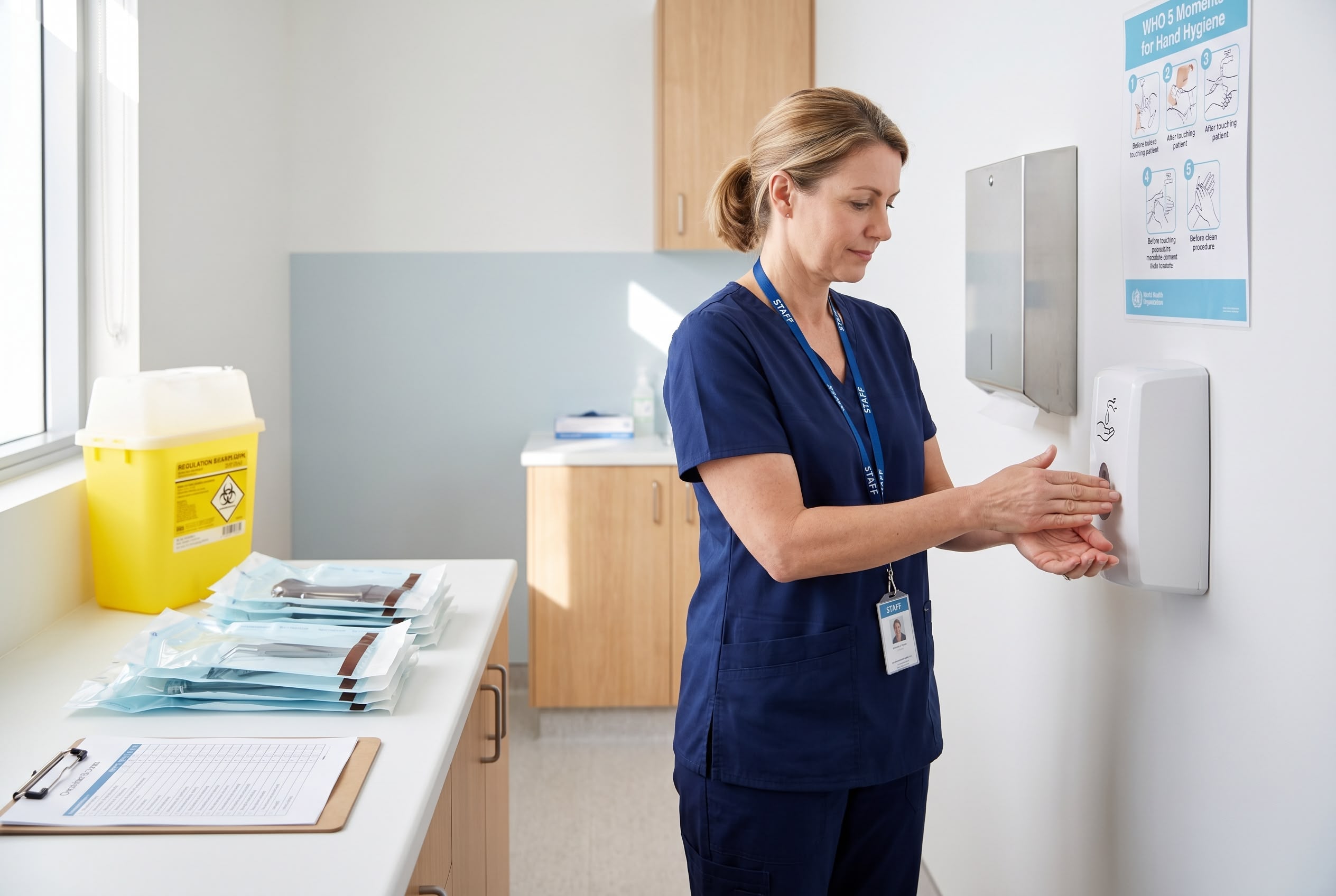
Hand hygiene is the single most effective infection-control measure and the most-audited element of any RACGP visit. The Australian standard is the World Health Organization 5 Moments for Hand Hygiene, adopted by Hand Hygiene Australia and embedded in the RACGP guidelines.
Moment 1: before patient contact
Clean hands before touching the patient. Protects the patient from microorganisms carried on the clinician’s hands.
Moment 2: before a clean or aseptic procedure
Clean hands immediately before any procedure with aseptic implications. Vaccinations, dressings, minor procedures, ear syringing.
Moment 3: after body fluid exposure risk
Clean hands immediately after any task with a body-fluid exposure risk, even if gloves were worn.
Moment 4: after patient contact
Clean hands after touching the patient, before touching anything in the wider environment.
Moment 5: after contact with patient surroundings
Clean hands after contact with the patient’s immediate surroundings, even if the patient was not touched.
The acceptable techniques
Alcohol-based hand rub for routine indications. Soap and water when hands are visibly soiled, after using the bathroom, and after caring for a patient with suspected gastroenteritis or C. difficile.
Operational requirements: alcohol-based hand rub at the point of care (room entry, beside the desk, on the trolley), wall-mounted dispensers regularly stocked, posters at every station, and bare-below-the-elbow practice for clinical staff during patient contact (no wrist watches, no rings other than plain bands, no long sleeves below the elbow).
Audit cadence: a structured hand-hygiene observation audit every quarter using the Hand Hygiene Australia methodology (or local equivalent), with results recorded and shared at the staff meeting. RACGP assessors expect to see audit data and the response actions taken.
Environmental cleaning, sharps and waste
Environmental cleaning, sharps management and clinical-waste disposal are the operational elements most likely to be observed during an accreditation visit. Each has documented requirements; gaps are visible the moment an assessor walks the consult rooms.
Cleaning schedule and product list. Documented cleaning frequency for each clinical surface (consult-room desks, examination couches, door handles, wash basins, trolleys, waiting room), the product used (hospital-grade detergent, neutral-detergent and disinfectant for body fluids, two-step or two-in-one), and the staff member responsible. Daily, between-patient and end-of-day frequencies all need to be defined.
Body fluid spill response. A documented protocol covering containment, PPE, two-step clean (detergent then disinfectant) or hospital-grade two-in-one, waste disposal, and staff exposure assessment. Spill kit on every floor, contents checked monthly.
Sharps containers and disposal. Australian Standard AS 4031 yellow sharps containers at every point sharps are used. Filled to the marked line only; sealed before transport. Disposal via a licensed clinical-waste contractor with documented chain-of-custody. Sharps injuries reported per state health legislation and internal incident logs.
Clinical waste segregation. Yellow contaminated-waste bags for clinical waste, sharps containers for sharps, cytotoxic waste in dedicated containers where applicable, general waste in conventional bags. Each waste stream documented in the practice’s waste management plan and contracted to an appropriate licensed disposer.
PPE availability and replenishment. Gloves (sterile and non-sterile), surgical and P2/N95 masks, eye protection, and impervious gowns stocked at point-of-use. Inventory checked weekly. Fit-testing for staff using P2/N95 respirators where the practice’s risk assessment requires it.
The waiting room is part of the picture. Magazines, toys and shared touchpoints are routinely removed from clinical environments; cushioned chairs need wipeable upholstery; and any shared surface (eftpos terminal, pen, kettle) needs a between-use cleaning protocol.
Sterilisation and reusable medical devices
Practices that reprocess reusable instruments on site must demonstrate AS/NZS 4187 compliance. Many practices have moved to single-use disposable instrumentation precisely because the documentation and validation burden of an in-house autoclave is significant. The PM’s call is whether on-site reprocessing is operationally and financially worthwhile against the alternative.
| Stage |
What is required |
Evidence |
| Cleaning |
Pre-clean to remove gross soil, then mechanical or manual clean per AS/NZS 4187 |
Documented cleaning protocol, staff competency record |
| Inspection and packaging |
Visual inspection for cleanliness and damage; package in approved sterilisation pouches with chemical indicators |
Pouch dated, batch-numbered, indicator visible through packaging |
| Sterilisation |
Autoclave (steam steriliser) operated to validated parameters per AS/NZS 4187 |
Cycle printout or electronic log per load, retained per state requirements |
| Validation |
Annual or commissioning validation of autoclave, plus daily Bowie-Dick or equivalent and routine biological/chemical indicators |
Validation certificate, daily test results, biological-indicator log |
| Storage and traceability |
Sterilised packs stored in clean, dry, dust-free conditions; traceability from autoclave cycle to patient where the procedure is invasive |
Storage area inspection, traceability log |
| Maintenance |
Scheduled service per manufacturer specification |
Service log, calibration certificate |
The single-use-versus-reprocessable decision is not just a cost calculation. Document risk, training cost, validation cost, audit time, instrument turnaround time, and clinical-quality implications. Many practices split the difference: single-use for higher-risk procedures, reprocessing for low-volume ear, eye and skin items.
Vaccine cold chain integrity
The vaccine cold chain is a separate and critical infection-control responsibility, governed by the National Vaccine Storage Guidelines (Strive for 5). Vaccines must be stored between +2 and +8 degrees Celsius from manufacture to administration. A breach renders vaccine product potentially ineffective and is reportable to the state immunisation programme.
Purpose-built vaccine refrigerator. Domestic-style fridges do not maintain stable temperature and are non-compliant. The practice must use a purpose-built vaccine fridge with continuous data-logging.
Continuous temperature monitoring. Min-max temperatures recorded twice daily and logged. Data-logger trace reviewed weekly. Out-of-range readings investigated immediately and documented.
Cold-chain breach response. Power outage, fridge fault or suspected breach: isolate stock, contact the state immunisation programme, follow their advice on stock viability, and document the incident.
Annual self-audit. Strive for 5 self-audit completed annually and signed off. Submitted to the state immunisation programme on request.
Staff training. Every staff member who unpacks, stores or administers vaccines must complete cold-chain training and refresh annually.
The vaccine fridge is one of the highest-risk pieces of equipment in the practice from a regulatory perspective: a single breach can cost thousands of dollars in stock and trigger a public-health investigation. Treat it as a critical asset.
Training, audit and accreditation evidence
The infection-control programme is only as strong as the evidence file behind it. RACGP assessors do not just want to see policies; they want to see policies in action and the audit trail that proves it.
Induction infection-control training for every new starter, with a competency sign-off held on file. Annual refresher for all clinical and reception staff.
Quarterly hand-hygiene audit documented with results, comparison to prior quarters, and any actions taken. Aim to participate in Hand Hygiene Australia or the equivalent state programme for benchmarked data.
Quarterly environmental cleaning audit covering all clinical and waiting areas, with photographic evidence and remediation notes.
Sterilisation cycle log retained per state record-keeping requirements (commonly 7 years), validation certificates, and biological-indicator results filed monthly.
Incident register for sharps injuries, body-fluid exposures, cold-chain breaches and suspected outbreaks, with root-cause analysis and prevention actions.
Staff immunisation register covering hepatitis B, MMR, varicella, pertussis (current booster), and seasonal influenza. Up-to-date records with declination forms where staff have declined a recommended vaccine.
The evidence file ties back to the wider performance picture; for how it sits inside an operations dashboard see GP practice KPIs and dashboards. For how the typical PM week absorbs this work, see a day in the life of a practice manager.
The single biggest accreditation finding in infection control is not absent policies, it is policies that are not being followed. Build the audit cadence first, then watch the evidence file fill itself.
The HLT57715 Diploma of Practice Management at TalentMed
The HLT57715 Diploma of Practice Management covers the governance, risk management and operational reporting competencies a PM needs to design and run an infection-control programme that holds up under accreditation.
12 months, possible in 6 for motivated students. 100% online, self-paced.
VSL approved. ZipMoney (up to 12 months interest-free), a 3-instalment plan, employer-funded, and upfront options.
Daily intakes, 365 days a year.
Nationally recognised AQF Level 5 diploma, applicable across medical, dental, allied health and specialist practices.
Related reading
The standards your infection-control programme evidences at accreditation.
Read the articleHow accreditation visits run, and where infection control lands inside the cycle.
Read the articleHow infection-control audit data flows into the operations dashboard.
Read the articleFrequently asked questions
Criterion C5.4 Infection prevention and control requires a written policy, hand-hygiene practice consistent with the WHO 5 Moments, environmental cleaning, sharps and clinical-waste management, sterilisation and reprocessing where reusable instruments are used, and staff training and immunisation. The companion RACGP infection prevention and control guidelines provide the operational detail.
RACGP Standards do not specify a profession. What matters is competence, time allocation and accountability. In smaller practices the practice manager often holds the role; in larger practices it is delegated to a clinical lead with the PM owning governance, training records and audit evidence. Either model is acceptable provided the work happens.
The World Health Organization 5 Moments for Hand Hygiene, adopted by Hand Hygiene Australia and embedded in the RACGP infection prevention and control guidelines. Alcohol-based hand rub for routine indications; soap and water when hands are visibly soiled or after caring for a patient with suspected gastroenteritis. Quarterly observation audits are the expected cadence.
Only practices that reprocess reusable medical devices on site need to demonstrate AS/NZS 4187 compliance. Many small practices have moved to single-use disposable instrumentation to avoid the validation and documentation burden. The decision is operational and financial, not regulatory; both pathways are acceptable.
Cycle printout or electronic log per autoclave load, daily Bowie-Dick or equivalent test, biological and chemical indicator results, annual validation certificate, manufacturer service log, and traceability from autoclave cycle to patient where the procedure is invasive. State record-keeping requirements typically require retention for 7 years.
Per the National Vaccine Storage Guidelines (Strive for 5). Purpose-built vaccine fridge, continuous data-logging, twice-daily min-max temperature recording, weekly logger trace review, immediate response to out-of-range readings, annual self-audit submitted to the state immunisation programme on request, and staff training refreshed annually. Domestic-style fridges are non-compliant.
Quarterly hand-hygiene observation audit, quarterly environmental cleaning audit, monthly biological and chemical indicator review for sterilisation, twice-daily cold-chain temperature recording with weekly trace review, annual cold-chain self-audit, and annual review of the infection-control policy. Document outcomes and response actions; the response actions are what RACGP assessors look at most closely.
The HLT57715 Diploma of Practice Management covers the governance, risk management and operational reporting competencies a PM needs to design, run and report from an infection-control programme. The clinical detail of hand hygiene, sterilisation and outbreak response sits with clinical training; the PM’s contribution is the system that makes the clinical practice happen and produces the evidence file at accreditation.
TalentMed Pty Ltd, RTO 22151. HLT57715 Diploma of Practice Management is a nationally recognised AQF Level 5 qualification, delivered fully online. Verify regulatory information against current RACGP, NHMRC, ACSQHC, AS/NZS standards and state health department publications.