Clinical Coding Codebooks: Digital vs Physical
Post Author:
TalentMed

Tools of the trade
Clinical Coding Codebooks: Digital vs Physical
Australian clinical coders use either the printed ICD-10-AM, ACHI, and ACS volumes published by IHACPA, or an electronic coding tool such as Solventum Codefinder or TurboCoder that reproduces the same content in a searchable interface. Most hospitals run digital tools day to day. Most students still learn on the physical books first so they understand how the classification is structured. This guide compares both options so you can see which works best for training and which works best on the job.
The short answer: physical books for learning, digital tools for production coding, and most working coders end up using a mix. The long answer.
The three classifications every codebook contains
Whether you’re turning pages or searching on screen, every Australian clinical codebook reproduces the same three classifications. Understanding what each one covers is the first step to choosing the right format.
All three are in their 13th edition (effective from 1 July 2025), published by the Independent Health and Aged Care Pricing Authority (IHACPA). For the detail on how the diagnosis classification is structured, see ICD-10-AM explained. For the rule book, see Australian Coding Standards.
The physical codebook set: five volumes, five colours

The printed IHACPA set is a boxed run of five hardcover volumes, colour-coded by spine so coders can grab the right book without reading the title. The colour convention is consistent across every edition and is how working coders refer to the books in conversation (“pass me the red one” means the ICD-10-AM Tabular List).
Yellow: ICD-10-AM Alphabetic Index
The lookup volume. You start here when you know the diagnosis in plain English. Find the lead term, follow the modifiers, note the suggested code.
Red: ICD-10-AM Tabular List
The verification volume. Once you have a candidate code from the Index, you turn to the Tabular List to confirm it, read inclusion and exclusion notes, and check for instructional flags.
Green: ACHI Alphabetic Index
The procedure lookup volume. Same pattern as the ICD Index, but for interventions rather than diagnoses.
Blue: ACHI Tabular List
The procedure verification volume. Confirm the seven-digit ACHI code, read block notes, check the procedure description matches what was performed.
Purple: Australian Coding Standards (ACS)
The rule book that sits alongside the lookups. When the classifications don’t give a clear answer, the ACS does.
Digital coding tools used in Australian hospitals
Most working coders spend most of their day inside an electronic coding tool rather than the printed books. Three names come up over and over in Australian hospital position descriptions.

Digital vs physical: how they compare
Neither format is objectively better. The right choice depends on what you’re doing, where you’re doing it, and how you learn. This comparison covers the trade-offs working coders actually hit day to day.
| Factor | Physical books | Digital tools |
|---|---|---|
| Speed of lookup | Slower. Physical flipping, manual cross-references between Index and Tabular. | Faster. Text search, click-through between Index and Tabular, history of recent lookups. |
| Depth of understanding | Stronger. Physical layout teaches the structure of the classification. | Weaker if used before you understand the books. Stronger once you do. |
| Internet requirement | None. | Solventum needs internet. TurboCoder runs offline after install. |
| Device compatibility | Universal (paper). | Solventum: Windows, macOS, Chromebook. TurboCoder: Windows desktop plus iOS and Android apps. |
| Updates between editions | Manual. New edition, new books. | Automatic for cloud tools. Manual download for desktop-only tools. |
| Portability | Heavy. Five hardcover volumes plus the ACS. | Any device. |
| Workplace match | Used in training and on the desk as a reference. | Used in production coding in most Australian hospitals. |
| Cost (indicative) | One-time purchase per edition from IHACPA. Set pricing varies by edition and sales channel. | Typically institutional subscription paid by the employer. Student pricing available via training providers. |
Cost and feature comparison: books, TurboCoder, and Solventum Codefinder

The three options sit at different price points and serve different needs. Physical books are the cheapest one-time outlay and the strongest learning tool. TurboCoder is the long-running offline desktop alternative. Solventum Codefinder is the cloud-based industry standard, offered to TalentMed students at $495 as an optional add-on that integrates directly into the HLT50321 course.
| Feature | Physical books (IHACPA) | TurboCoder (EIS) | Solventum Codefinder (via TalentMed) |
|---|---|---|---|
| Cost | From approximately $330 plus delivery for the 13th edition student set (check the IHACPA distributor for current pricing) | $572 for a 2-year student licence | $495 for the duration of your HLT50321 enrolment, exclusive to TalentMed students |
| Operating systems | Universal. No device required. | Windows desktop only (plus iOS and Android apps) | Windows, macOS, Chromebook. Runs in the browser on Mac or PC. |
| Internet required | No | No (offline after installation) | Yes (cloud-based) |
| Edition updates | Manual. Buy a new set every edition. | Manual download required. | Automatic. Always on the current edition. |
| Multi-device access | Single physical location | One licensed device | Any device with a browser |
| Setup | None. Open the book. | Download, install, configure, manage licence activation. | None. Instant browser access via your TalentMed login. |
| Search | Manual lookup using the Index | Digital search built in | Advanced search, cross-references, code verification, AR-DRG grouping |
| Integration with HLT50321 | No. Bring your own. | No. Bring your own. | Yes. Fully integrated into the course. |
| Portability | Heavy. Five hardcover volumes plus the ACS. | Limited. Tied to one device. | Excellent. Study from anywhere. |
| Best for | Learning the classification structure; durable offline reference | Windows users who need offline access (remote, contract, low-connectivity sites) | TalentMed students who want the industry-standard tool, Mac compatibility, and seamless course integration |
What students typically use
Most students learn on the physical books, then add a digital tool as they become confident. The reason is pedagogical: you cannot search your way to understanding a classification you don’t yet know. Starting in the printed Alphabetic Index, following the indentation, and turning to the Tabular List teaches you how ICD-10-AM and ACHI are actually structured. That knowledge doesn’t transfer backwards from a search bar.
TalentMed’s HLT50321 Diploma of Clinical Coding uses a hybrid approach. Students work through the classifications in the physical-book format for the early modules, then move to Solventum Codefinder for later coursework. The course is fully integrated with Solventum, so it slots straight in. Solventum access is offered to TalentMed students as an optional $495 add-on covering the full duration of your enrolment, not part of the tuition fee. Students who’d rather bring their own resources are welcome to use TurboCoder or the printed IHACPA books instead.
What working coders typically use
Once you’re employed, what you use is usually decided by your employer. Public hospitals tend to standardise on one electronic encoder across the coding team, most commonly Solventum. Private hospitals and remote contract coders often favour TurboCoder because it works offline and has a lower per-seat cost when a hospital isn’t running the full Solventum 360 Encompass platform.
Almost every working coder keeps a physical ACS volume within reach regardless of which encoder they’re using. When the software gives an ambiguous result, the coder opens the purple book. The ACS is the authority both the books and the software reproduce, so checking it directly settles most disputes.
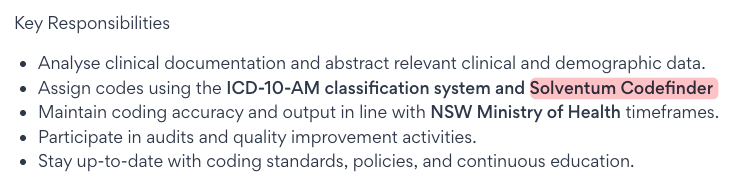
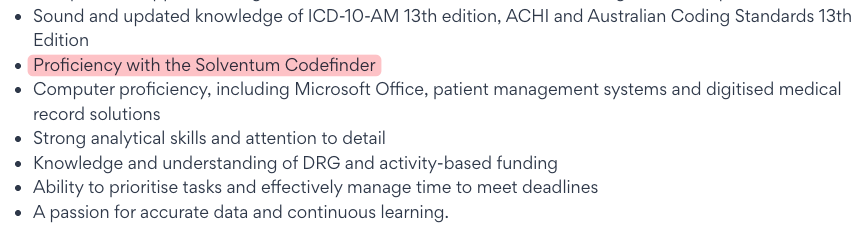
Direct evidence from Australian Seek job listings: hospitals routinely list Solventum Codefinder (formerly 3M Codefinder) and electronic encoder experience as required or preferred skills for clinical coder roles.


Pros and cons at a glance
Choosing between them for your training
If you’re training with TalentMed, you don’t have to choose. HLT50321 is fully integrated with Solventum Codefinder, available as an optional $495 add-on covering the full duration of your enrolment. You’ll start with the classification structure (usually in printed-book format, either a borrowed set or a rented edition from IHACPA’s distributor), and transition to Solventum as you build confidence. By graduation you’ve used the industry-standard tool and learnt how to read the books underneath it, which is what hospitals want from an entry-level coder. If you’d rather bring your own resources, TurboCoder ($572) or the printed IHACPA books work alongside the course materials.
If you’re self-studying outside a diploma, a realistic starting kit is: current-edition physical books (ICD-10-AM Alphabetic Index, Tabular List, ACHI Alphabetic Index, Tabular List, plus the ACS), and either a TurboCoder student licence ($572 for 2 years) or, if you’ve enrolled in HLT50321 with TalentMed, the optional Solventum Codefinder add-on ($495). Working coders typically get Solventum access from their employer. The books alone will get you through the theory. The digital tool will get you production-ready.
Ready to start training?
If you’re ready to learn on the same toolset Australian hospitals actually use, the next step is a nationally recognised Diploma. The HLT50321 Diploma of Clinical Coding is TalentMed’s flagship qualification. It’s 100% online, self-paced, takes about 12 months, and is fully integrated with Solventum Codefinder, offered as an optional $495 add-on for the full duration of your enrolment.
Related reading
Explore further
Frequently asked questions
Want to find out more?
Speak to a TalentMed course adviser about HLT50321.
12 months, 100% online, flexible payment plans, daily intakes year-round.