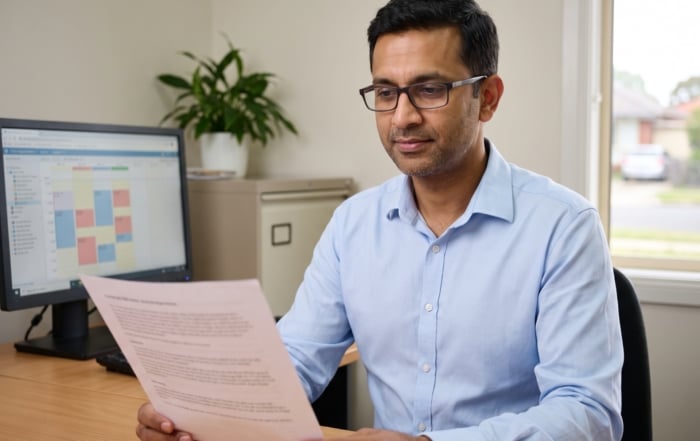
A Day in the Life of an Australian Practice Manager
Post Author:
TalentMed

A Day in the Role
A Day in the Life of an Australian Practice Manager
An Australian practice manager runs the operational, financial, compliance and people side of a healthcare clinic, juggling a roster check at 7:30am, MBS billing reconciliation by mid-morning, staff one-on-ones in the afternoon and an end-of-day cash-up after the last patient leaves. The role is part air-traffic-controller, part finance lead, part HR business partner, part RACGP accreditation steward. Almost no two days look the same.
This guide walks you through one realistic day at a busy Australian general practice. Times, tasks and stakeholders are drawn from how working practice managers actually structure their day across GP, specialist and allied-health settings. If you’re considering the HLT57715 Diploma of Practice Management, this is the kind of day you’re training for. TalentMed Pty Ltd (RTO 22151) delivers HLT57715 fully online, and it is one of only a handful of Australian practice management diplomas approved for VET Student Loans.
The shape of a practice manager’s day
A typical day for an Australian practice manager runs from before the doors open to well after the last patient leaves. The role flexes between rapid-fire morning operational work, a midday accreditation, finance and software focus, afternoon people leadership and end-of-day reconciliation. Some days break the pattern entirely when an audit visit, software outage or staff resignation lands, but the rhythm below is the baseline.
Across general practice, specialist rooms, allied health and dental settings the cadence is recognisably similar. Smaller clinics compress the day; larger corporate groups add committee meetings and reporting cycles. The role itself sits at the intersection of operations, finance, HR, IT, compliance and patient experience, which is exactly what the Practice Management in Australian Healthcare pillar covers in depth.
7:30am: roster check and clinical handover
7:30 AM
The practice manager is the first non-clinical person through the door. The lights go on, the front-of-house checks are completed, and the first task is the roster. Are all rostered staff confirmed? Has anyone called in sick? Is the locum GP for Dr Patel’s leave week confirmed for 8:30? Is the third treatment room booked for the visiting podiatrist on Wednesday?
By 7:45 the senior receptionist arrives. There is a brief huddle: who is in today, which doctors have flagged double-bookings, which patients are flagged for sensitive follow-ups. The clinical lead nurse joins for a five-minute handover from yesterday’s late shift, including any incidents, urgent recalls and the Schedule 8 register sign-off from the previous evening.
This early window is also when the practice manager scans the overnight email inbox. RACGP standards updates, a Department of Health bulletin on a vaccine recall, an email from the practice’s accountant about end-of-month reporting, two job applications for the casual receptionist role advertised on Seek, and a complaint email from a patient about wait times last week. The complaint goes into the day’s priority list.
9:00am: doors open, operations on a knife-edge
9:00 AM
The first hour after the clinic opens is the practice manager’s most reactive window. Reception is fielding the morning call surge, the EFTPOS terminal needs a paper roll, the new receptionist has a question about a Medicare safety net query, and the practice software has flagged a printer offline error in treatment room two.
The practice manager’s job here is not to do every task. It is to triage what needs attention now versus what can wait. The receptionist’s Medicare question is answered in 30 seconds. The printer issue is delegated to the IT support contractor with a quick ticket logged. The EFTPOS roll is replaced because reception is on the phone. By 9:30 the floor is steady and the practice manager retreats to the back office.
This kind of constant micro-prioritisation is one of the core skills of the role, and one of the harder things to learn from a textbook. It develops on the job and gets reinforced through formal study. For the broader skillset that employers screen for, see 10 skills every Australian practice manager needs.
[/fusion_text
10:00am: MBS billing reconciliation
10:00 AM
Mid-morning is when most Australian practice managers tackle finance and billing. The practice software (Best Practice, Medical Director, Genie or Zedmed depending on the clinic) is open in one window, the bank reconciliation file in another, and the previous day’s Medicare claim batch report in a third. The job is to reconcile yesterday’s billings against what actually came through from Medicare and the patient EFTPOS gateway.
Three claims have rejected. One is missing a referring provider number for a specialist consultation. One has used the wrong item number for a chronic disease management plan review. One is a duplicate created when reception accidentally lodged the same claim twice. The practice manager fixes the first two in the software and resubmits, then voids the duplicate and notes it in the daily exceptions log.
This is where MBS, Medicare, ECLIPSE, bulk billing rules and the Practice Incentives Program (PIP) come together every day. A practice manager who is fluent in all of them protects the clinic’s revenue. A practice manager who isn’t will quietly leak income through small repeated errors. The HLT57715 Diploma covers the framework that sits behind this daily reconciliation.
12:00pm: a working lunch and the patient complaint
12:00 PM
Midday is rarely a clean break. The practice manager grabs a sandwich and uses the half hour between the morning patient run and the afternoon list to handle the email complaint that came in overnight. The patient was unhappy about a 45-minute wait last Thursday and is asking for a partial refund on the consultation fee.
The job here is not to defend the clinic, and not to give in automatically. It is to gather the facts. The practice manager pulls the appointment log for that afternoon, sees that two patients had been worked in as urgent on top of the existing schedule, drafts an apology email that acknowledges the wait and explains the operational pressure without disclosing other patient details, and offers a small goodwill gesture. The complaint, the response and the resolution all go into the patient feedback register, which the clinic reviews quarterly as part of its quality improvement program.
Patient experience and complaint handling sit on every practice manager’s desk. Done well, this work prevents AHPRA notifications, AHPRA-related stress for clinicians and reputational damage to the clinic. Done badly, it escalates fast.
1:00pm: a one-on-one with the senior nurse
1:00 PM
Early afternoon is the practice manager’s best window for people leadership. Today’s calendar has a 30-minute one-on-one with the senior practice nurse. They run through her workload, recent vaccination clinics, the cold-chain monitoring records, an update on a junior nurse who is studying part-time and needs flexible shift planning, and a request to bring in a second sterilisation cycle each day to handle the increased minor-procedure load.
The conversation is half operational, half developmental. The practice manager listens, agrees the second sterilisation cycle, blocks 30 minutes a fortnight for the junior nurse’s study time, and notes a follow-up to revisit the staffing model in three months. None of this is dramatic. Most of it is the steady, unglamorous work of keeping the team supported and the clinic functioning.
Recurring one-on-ones with each team member, structured properly, are one of the lowest-cost and highest-value habits a practice manager can build. They surface issues early, demonstrate the manager is listening, and create the conditions for honest performance feedback when it is needed later.
3:30pm: RACGP accreditation evidence
3:30 PM
Mid-afternoon is reserved for the RACGP 5th edition Standards work that quietly fills a portion of every week. The clinic’s next accreditation visit is six months away and the practice manager keeps a rolling evidence register against each criterion. Today’s task is the privacy and confidentiality module: confirming the staff training record is up to date, that the practice’s Privacy Policy has been reviewed in the last twelve months, and that any data-breach incidents in the period have been logged in line with the Office of the Australian Information Commissioner (OAIC) Notifiable Data Breaches scheme.
The practice manager works through the criteria methodically, scans signed policy acknowledgements into the evidence folder, drafts a short refresher email for the next staff meeting, and books a 30-minute slot in next week’s calendar to update the Privacy Policy itself.
This kind of structured accreditation prep is what separates a smooth visit from a stressful one. For a deeper module-by-module walkthrough of what RACGP 5th edition Standards actually require, see RACGP Standards explained for practice managers.
5:30pm: end-of-day reconciliation
5:30 PM
The last patient leaves around 5:30 and the practice manager moves into close-of-day mode. Reception cashes up the till, the EFTPOS terminal is settled, the petty cash record is checked, and the day’s banking is prepared for tomorrow’s drop. The clinical team finalises notes, the lead nurse signs off the Schedule 8 register, and the practice manager walks through the rooms confirming everything is ready for the morning.
Back at the desk, the day’s exceptions log gets a final review. The two billing rejections were resolved. The complaint was responded to. The senior nurse’s one-on-one is documented. The privacy evidence is filed. Tomorrow’s roster has a hole in the late shift because a casual called in this afternoon, so the practice manager sends two text messages to the casual pool and locks in cover within ten minutes.
By 6:15 the lights are off and the alarm is set. Total day length: roughly ten hours, with maybe forty minutes of personal time inside it. This is closer to the realistic upper end of a practice manager’s day than the average. Quieter days exist, especially in smaller clinics. And at month end, quarter end, accreditation visit week, or when a senior staff member resigns, the day stretches further.
How the day varies by setting
Not every practice manager’s day looks the same. The shape of the day is recognisably similar across general practice, specialist rooms, allied health and dental, but the emphasis shifts.
| Setting | What dominates the day | What is lighter |
|---|---|---|
| General practice (GP clinic) | MBS billing reconciliation, RACGP accreditation, PIP reporting, mixed billing oversight, larger team management. | Theatre or instrument tracking, complex procedural billing. |
| Specialist rooms | Referral tracking, ECLIPSE and private health fund billing, theatre or procedure scheduling, surgeon liaison. | Bulk billing volume, walk-in triage. |
| Allied health (physio, podiatry, psychology) | Mixed funding streams (private, Medicare CDM, NDIS, DVA, workers compensation), small-team rostering, patient retention. | RACGP-specific accreditation cycles. |
| Dental and aesthetic | Treatment plan financing, retail and patient experience, dental health fund interfaces, sterilisation and instrument tracking. | MBS-driven reporting cadences. |
| Day surgery and procedure centres | Theatre scheduling, instrument tracking, infection-control auditing, procedural billing complexity, accreditation under hospital-grade standards. | Walk-in patient flow. |
The HLT57715 Diploma of Practice Management covers the core operational, financial and compliance frameworks that apply across all of these settings. Your specific role then layers the setting-specific knowledge on top, usually by working in the setting itself.
The HLT57715 Diploma of Practice Management at TalentMed
The HLT57715 Diploma of Practice Management is TalentMed’s flagship practice-management qualification, designed for Australian healthcare workers stepping into the kind of operations role described above. It is delivered 100 per cent online, includes RACGP-aligned content, MBS and Medicare modules, accreditation frameworks and people-leadership units, and is approved for VET Student Loans.
Related reading
Keep exploring
Frequently asked questions
TalentMed Pty Ltd, RTO 22151. HLT57715 Diploma of Practice Management is delivered fully online. VSL approval, current fees and intake details are confirmed on the course page and at training.gov.au. Always confirm specific funding eligibility at studyassist.gov.au.

Want to find out more?
Enter your details below to receive a free information pack instantly.