Musculoskeletal System Medical Terminology: A Deep Reference
Post Author:
TalentMed
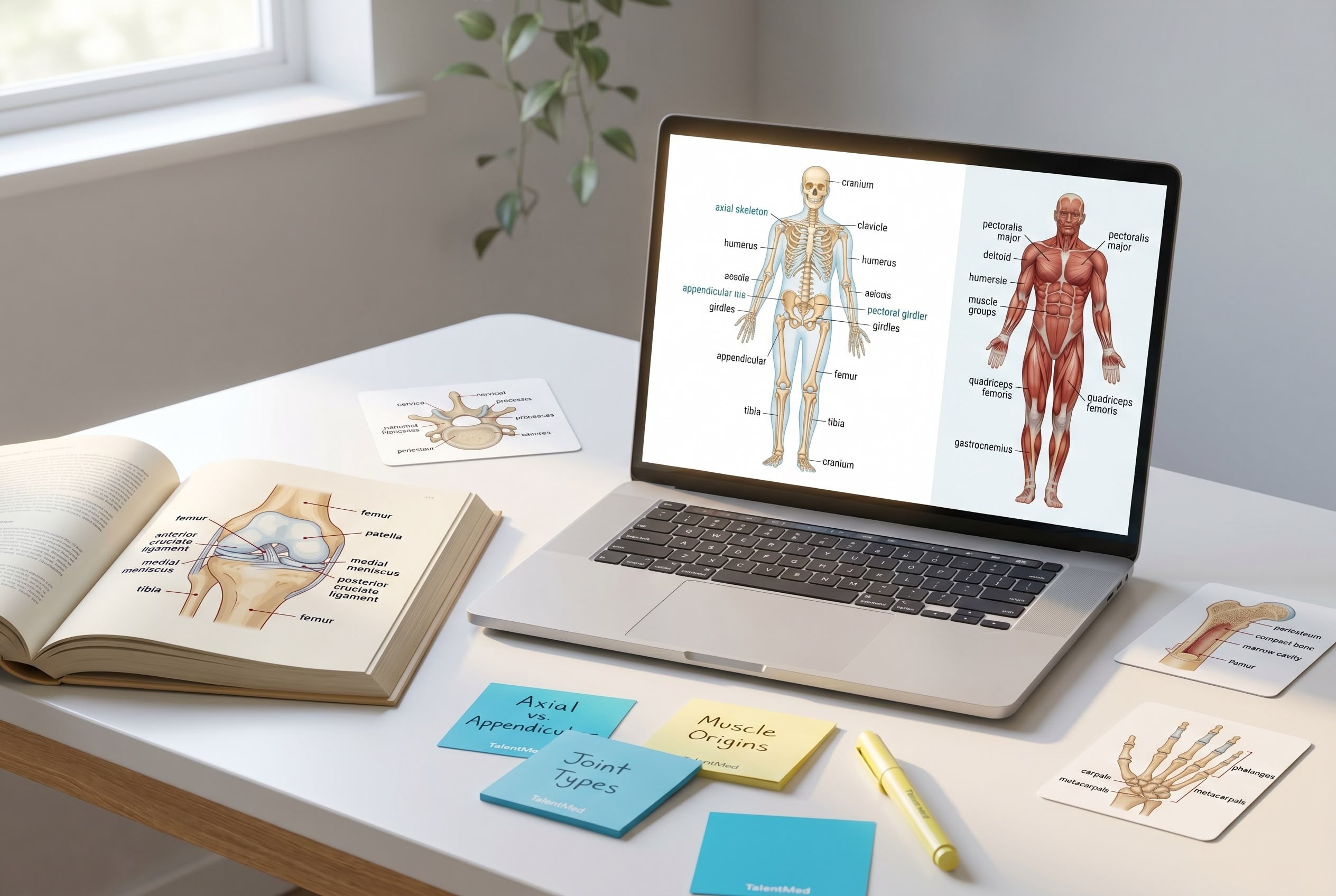
The Deep Reference
Musculoskeletal System Medical Terminology: A Deep Reference
The musculoskeletal system carries the heaviest terminology load in primary care, emergency, orthopaedics and rehabilitation. Bones, joints, muscles, ligaments, tendons and cartilage each have their own Greek and Latin roots, and the same handful of suffixes (-itis, -plasty, -ectomy, -porosis) recur across hundreds of conditions and procedures. Once oste-, arthr-, my-, ten-, lig- and chondr- are familiar, fracture clinic letters, MRI reports and physiotherapy notes become readable.
This reference covers skeletal and muscular anatomy, the physiology of bone and movement, a working table of musculoskeletal prefixes, roots and suffixes, and the most common conditions, investigations and drug classes you will meet across Australian healthcare.
Musculoskeletal system at a glance
The musculoskeletal system is everything that gives the body shape, support and movement. It pulls together three tissue families that always work as a unit: the skeleton (bones and cartilage), the muscles, and the connective tissues (ligaments, tendons, bursae) that join them.
For a broader view across systems, see medical terms by body system. The pillar at medical terminology covers the framework. Sister references include cardiovascular, respiratory and nervous system.
Anatomy: bones, joints and muscles
Musculoskeletal anatomy clusters around bone names by region, joint types by structure and movement, and named muscle groups. Knowing the correct anatomical name for each part lets you read X-ray reports, operation notes and physiotherapy assessments without guessing.
Bones by region
| Term | Meaning | Where you meet it |
|---|---|---|
| cranium and facial bones | skull bones (frontal, parietal, temporal, occipital, mandible, maxilla, zygomatic) | head injury, facial trauma, dental records |
| vertebral column (cervical C1-C7, thoracic T1-T12, lumbar L1-L5, sacrum, coccyx) | 33 vertebrae stacked from skull to pelvis | back pain, disc herniation, spinal injury |
| ribs and sternum | 12 pairs of ribs articulating with the sternum and thoracic spine | rib fractures, chest trauma |
| clavicle, scapula, humerus | shoulder girdle and upper arm bone | clavicle fractures, rotator cuff disease |
| radius, ulna, carpals, metacarpals, phalanges | forearm, wrist and hand bones | Colles fracture, carpal tunnel, finger injuries |
| pelvis (ilium, ischium, pubis), femur | pelvic girdle and the longest bone in the body | fractured neck of femur, pelvic trauma |
| patella, tibia, fibula | kneecap and lower-leg bones | knee injuries, tibial fractures |
| tarsals, metatarsals, phalanges | ankle, foot and toe bones | ankle sprains, metatarsal fractures, gout |
Joint types and named joints
| Term | Meaning | Notes |
|---|---|---|
| synovial joint | freely movable joint with a synovial cavity, capsule and cartilage surfaces | most named joints (knee, hip, shoulder, elbow) |
| hinge joint | movement in one plane (flexion and extension) | elbow, knee, finger interphalangeal joints |
| ball-and-socket joint | movement in many planes | hip, shoulder (glenohumeral) |
| pivot, saddle, gliding joints | specialised synovial joint shapes | atlantoaxial (neck rotation), thumb base, intercarpal joints |
| cartilaginous joint | joined by cartilage; limited movement | intervertebral discs, pubic symphysis |
| fibrous joint | joined by fibrous tissue; little or no movement | cranial sutures, distal tibiofibular joint |
Major muscle groups
| Group | Examples | Where you meet it |
|---|---|---|
| shoulder and rotator cuff | deltoid, supraspinatus, infraspinatus, teres minor, subscapularis | rotator cuff tears, shoulder impingement |
| upper limb | biceps brachii, triceps brachii, brachialis, forearm flexors and extensors | biceps tendinopathy, tennis and golfer’s elbow |
| core and back | rectus abdominis, obliques, transversus abdominis, erector spinae, latissimus dorsi | back pain, core rehabilitation |
| hip and gluteal | gluteus maximus, medius, minimus, iliopsoas, piriformis | hip bursitis, gluteal tendinopathy, sciatica |
| thigh | quadriceps (rectus femoris, vasti), hamstrings (semitendinosus, semimembranosus, biceps femoris), adductors | hamstring strains, ACL rehab |
| lower leg and foot | gastrocnemius, soleus, tibialis anterior, peroneals | calf strain, Achilles tendinopathy, shin splints |
Physiology: bone, muscle and movement
Musculoskeletal physiology vocabulary describes how bone is built and remodelled, how muscles contract, and how joints move. These terms recur across orthopaedics, rheumatology, sports medicine and rehabilitation.
Bone, muscle and movement terms
| Term | Meaning |
|---|---|
| compact (cortical) bone, spongy (trabecular) bone | dense outer shell of bone; lighter inner lattice that houses marrow |
| periosteum | tough membrane covering the outer surface of bone |
| osteoblast, osteoclast, osteocyte | bone-building cells; bone-resorbing cells; mature bone cells maintaining tissue |
| ossification, remodelling | formation of bone tissue; ongoing balance of resorption and new bone deposition |
| articular cartilage, meniscus | smooth cartilage on joint surfaces; fibrocartilage shock absorber (e.g. in the knee) |
| synovial fluid | lubricating fluid in the joint cavity |
| contraction (isotonic, isometric) | muscle shortening with movement; muscle tension without movement |
| flexion, extension | decreasing the angle of a joint; increasing the angle of a joint |
| abduction, adduction | moving a limb away from the midline; moving it towards the midline |
| pronation, supination | turning the palm down; turning the palm up |
| range of motion (ROM) | extent of movement possible at a joint |
| proprioception | sense of joint position and movement |
Common musculoskeletal prefixes, roots and suffixes
This is the working table. Pair these with general prefixes and suffixes (covered in common medical prefixes and suffixes) and most orthopaedic and rheumatology reports become readable.
Musculoskeletal roots
| Root | Meaning | Example term | Example meaning |
|---|---|---|---|
| oste-, osteo- | bone | osteoporosis | porous, weakened bone |
| oss-, ossi- | bone (Latin form) | ossification | process of becoming bone |
| arthr-, arthro- | joint | arthritis | inflammation of a joint |
| chondr-, chondro- | cartilage | chondromalacia | softening of cartilage |
| my-, myo- | muscle | myalgia | muscle pain |
| ten-, tendo-, tenon- | tendon | tendonitis (tendinitis) | inflammation of a tendon |
| lig-, ligament- | ligament | ligamentous | relating to or made of ligament |
| burs- | bursa (fluid-filled sac) | bursitis | inflammation of a bursa |
| spondyl-, spondylo- | vertebra | spondylosis | degenerative vertebral disease |
| cost-, costo- | rib | costochondritis | inflammation of rib cartilage |
| crani-, cranio- | skull | craniotomy | surgical opening of the skull |
| kinesi-, kine- | movement | dyskinesia | abnormal involuntary movement |
Musculoskeletal prefixes and suffixes
| Affix | Meaning | Example term | Example meaning |
|---|---|---|---|
| -itis | inflammation | arthritis, tendinitis, bursitis | inflammation of a joint, tendon or bursa |
| -algia, -dynia | pain | myalgia, arthralgia | muscle pain; joint pain |
| -pathy | disease | arthropathy, tendinopathy | disease of a joint; disease of a tendon |
| -malacia | softening | osteomalacia | softening of bone (often vitamin D deficiency) |
| -porosis | porous condition | osteoporosis | weakened, porous bone |
| -trophy | development, growth | atrophy, hypertrophy | wasting; excessive growth |
| -plasia | formation, development | dysplasia | abnormal development (e.g. hip dysplasia) |
| -ectomy | surgical removal | meniscectomy, discectomy | removal of meniscus; removal of part of an intervertebral disc |
| -otomy, -tomy | incision, cutting into | osteotomy, laminotomy | cutting bone to realign; cutting through a vertebral lamina |
| -plasty | surgical repair, reshaping | arthroplasty | joint replacement or reshaping |
| -desis | surgical fusion | arthrodesis, spondylodesis | joint fusion; vertebral fusion |
| -scopy | visual examination | arthroscopy | looking inside a joint with a scope |
| sub-, supra-, infra- | under; above; below | subluxation, supraspinatus, infraspinatus | partial dislocation; muscle above the spine of scapula; muscle below it |
Common conditions (with abbreviation references)
Musculoskeletal conditions split cleanly into trauma (fractures, dislocations, sprains and strains), degenerative and inflammatory disease (osteoarthritis, rheumatoid arthritis, gout, osteoporosis), spinal conditions and overuse injuries. For broader abbreviation help, see medical abbreviations list and the warnings in dangerous abbreviations.
Fractures, dislocations and soft-tissue injuries
| Term | Meaning |
|---|---|
| fracture (#) | a break in the continuity of a bone |
| simple (closed) vs compound (open) fracture | skin intact vs bone breaching the skin |
| greenstick, comminuted, spiral, transverse, oblique fractures | fracture patterns: incomplete (paediatric), multiple fragments, twisting, straight across, angled |
| impacted, displaced, pathological fractures | ends driven together; bone fragments out of alignment; through diseased bone (e.g. malignancy, osteoporosis) |
| fractured neck of femur (#NOF) | hip fracture; common in older adults after falls |
| Colles fracture | distal radius fracture, classically after a fall on an outstretched hand |
| dislocation, subluxation | complete loss of normal articulation; partial separation |
| sprain | injury to a ligament (overstretch or tear) |
| strain | injury to a muscle or tendon |
| tendinopathy, tendinitis | tendon disease (often degenerative); inflammation of a tendon |
| bursitis | inflammation of a bursa (e.g. trochanteric, subacromial, olecranon) |
Degenerative, inflammatory and metabolic disease
| Term / abbreviation | Meaning |
|---|---|
| osteoarthritis (OA) | degenerative joint disease; cartilage loss with bony changes (osteophytes) |
| rheumatoid arthritis (RA) | chronic autoimmune inflammatory arthritis; symmetrical small joints first |
| gout | monosodium urate crystal arthropathy; classically first MTP joint of the great toe |
| ankylosing spondylitis (AS) | seronegative inflammatory spondyloarthropathy; sacroiliac and spine |
| psoriatic arthritis, reactive arthritis | inflammatory arthritis associated with psoriasis or post-infectious |
| septic arthritis | infection within a joint; orthopaedic emergency |
| osteomyelitis | infection of bone |
| osteoporosis | reduced bone mineral density; raised fracture risk |
| osteomalacia, rickets | defective bone mineralisation in adults; the equivalent in children |
| Paget’s disease of bone | disordered bone remodelling; localised enlargement and weakness |
Spinal and other regional conditions
| Term / abbreviation | Meaning |
|---|---|
| scoliosis, kyphosis, lordosis | lateral spinal curvature; excessive thoracic outward curve; excessive lumbar inward curve |
| herniated (prolapsed) intervertebral disc | nucleus pulposus extrusion through annulus, often pressing on a nerve root |
| spinal stenosis | narrowing of the spinal canal or neural foramina |
| spondylolisthesis | forward slip of one vertebra on the one below |
| radiculopathy, sciatica | nerve root disease; specifically, lumbosacral nerve root irritation causing leg pain |
| carpal tunnel syndrome (CTS) | median nerve compression at the wrist |
| plantar fasciitis | inflammation of the plantar fascia, causing heel pain |
| frozen shoulder (adhesive capsulitis), rotator cuff tear | shoulder capsule contracture; tear of one or more rotator cuff tendons |
| fibromyalgia | chronic widespread musculoskeletal pain syndrome |
| compartment syndrome | raised pressure within a fascial compartment, threatening tissue viability |
Common diagnostic procedures and treatments
Musculoskeletal investigations and treatments fall into three buckets: imaging and electrodiagnostics, procedures, and drug therapy. The suffix is often the hint: -graphy or -gram for imaging; -ectomy, -otomy, -plasty or -desis for surgery; class names for drugs.
Diagnostic procedures
| Procedure | What it shows or does |
|---|---|
| plain X-ray (radiograph) | first-line imaging for fractures, dislocations and most bone disease |
| computed tomography (CT) | cross-sectional imaging for complex fractures and surgical planning |
| magnetic resonance imaging (MRI) | detailed soft-tissue imaging for ligaments, tendons, cartilage, discs, marrow |
| ultrasound | dynamic imaging for tendons, muscles, joint effusions, soft-tissue lumps |
| bone scan (nuclear scintigraphy) | whole-body screen for occult fractures, metastases, infection |
| DEXA (dual-energy X-ray absorptiometry) | bone mineral density measurement for osteoporosis |
| joint aspiration (arthrocentesis) | removing synovial fluid for analysis (crystal arthritis, septic arthritis) |
| nerve conduction studies (NCS), EMG | peripheral nerve and muscle function tests (e.g. carpal tunnel) |
Procedures and surgical interventions
| Procedure | What it does |
|---|---|
| closed reduction, splinting, casting | realigning a fracture without surgery and immobilising the limb |
| open reduction and internal fixation (ORIF) | surgically realigning a fracture and holding it with plates, screws or rods |
| traction | controlled pulling force to align bones, especially in pelvic and femoral fractures |
| arthroscopy | keyhole inspection (and often repair) of a joint |
| arthroplasty (total hip or knee replacement) | joint replacement, often for severe osteoarthritis |
| arthrodesis | surgical fusion of a joint |
| discectomy, laminectomy, spinal fusion | removing a herniated disc fragment; removing part of a vertebral lamina; fusing vertebrae |
| physiotherapy, occupational therapy, hydrotherapy | rehabilitation by allied health professionals |
| corticosteroid joint injection | image-guided or landmark-based steroid injection for inflammation |
Major drug classes
| Class | What they do | Common examples (generic names) |
|---|---|---|
| simple analgesics | relieve mild to moderate pain | paracetamol |
| non-steroidal anti-inflammatory drugs (NSAIDs) | reduce pain and inflammation | ibuprofen, naproxen, diclofenac, celecoxib |
| opioids | moderate to severe pain (short-term, post-operative or palliative) | oxycodone, tramadol, tapentadol, morphine |
| corticosteroids | strong anti-inflammatory effect (oral, IV, intra-articular) | prednisolone, methylprednisolone |
| disease-modifying antirheumatic drugs (DMARDs) | slow rheumatoid and other autoimmune inflammatory arthritis | methotrexate, sulfasalazine, hydroxychloroquine, leflunomide |
| biologic DMARDs | targeted immunotherapy for inflammatory arthritis | adalimumab, etanercept, infliximab, tocilizumab |
| bisphosphonates | reduce bone resorption in osteoporosis | alendronate, risedronate, zoledronic acid |
| other anti-osteoporosis agents | alternative anti-resorptive or anabolic therapy | denosumab, teriparatide, raloxifene |
| gout therapy | treat acute attacks; lower urate long term | colchicine, NSAIDs (acute); allopurinol, febuxostat (preventive) |
| muscle relaxants, neuropathic pain agents | reduce muscle spasm; treat nerve pain associated with spinal disease | diazepam, orphenadrine; gabapentin, pregabalin |
Useful suffix patterns include -dronate in many bisphosphonates (alendronate, risedronate, zoledronate) and -mab in monoclonal antibody biologics (adalimumab, denosumab, infliximab).
Where you’ll see this terminology in practice
Musculoskeletal vocabulary surfaces across emergency, orthopaedic and rheumatology wards, primary care, rehabilitation and aged care. The same terms appear in very different roles.
Other surfaces where this vocabulary shows up:
For a study plan that builds musculoskeletal vocabulary in context, see how to learn medical terminology and the quick-reference medical terminology cheat sheet. The prefixes and suffixes reference covers the affixes used here. For body-position terms used in orthopaedic imaging and operation notes, see anatomical position and directional terms.
Frequently asked questions
Want to find out more?
Enter your details below to receive a free information pack instantly.