Respiratory System Medical Terminology: A Deep Reference
Post Author:
TalentMed
The Deep Reference
Respiratory System Medical Terminology: A Deep Reference
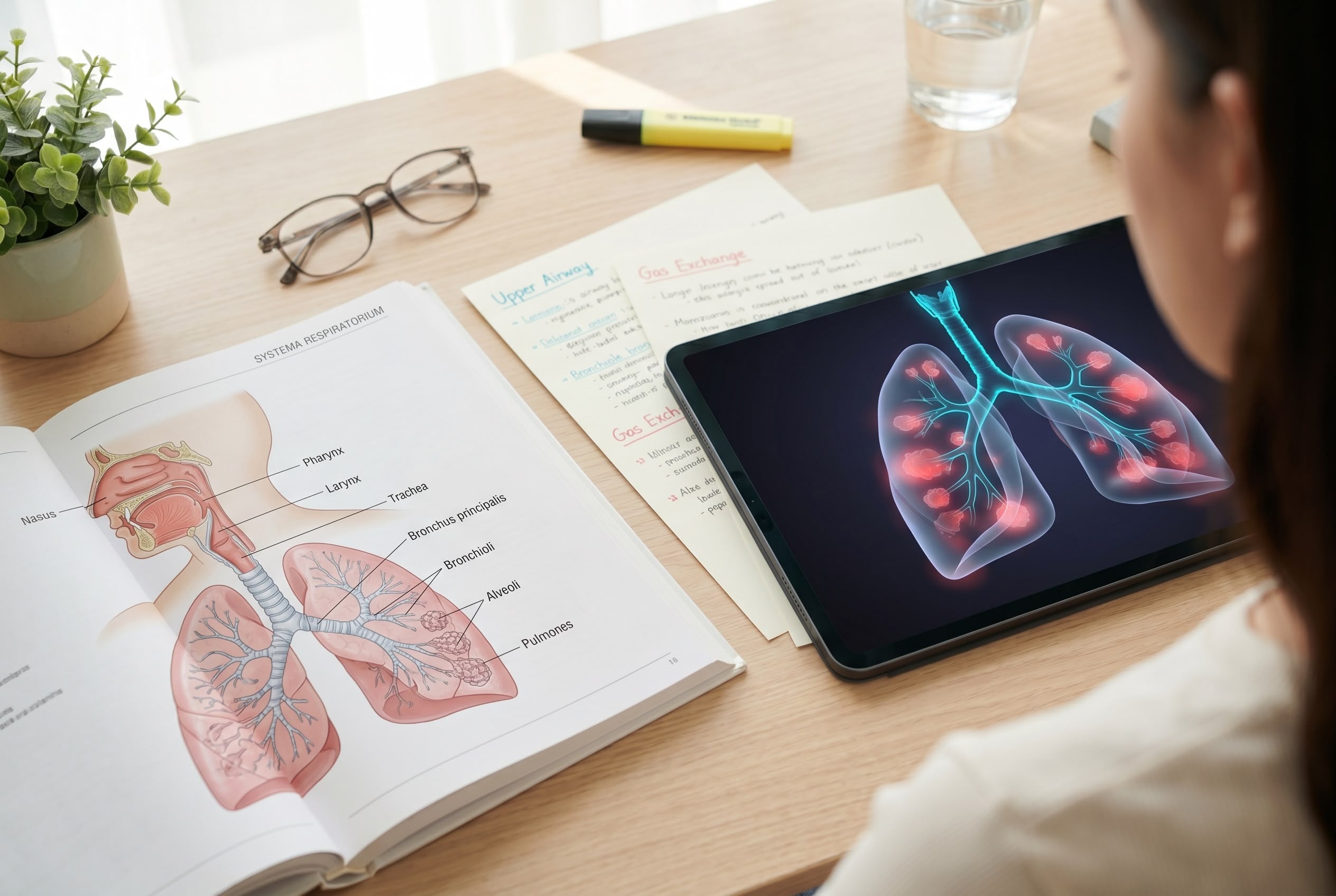
The respiratory system carries one of the densest vocabularies in clinical care. Airway anatomy, gas-exchange physiology, a long list of obstructive and restrictive diseases, ventilator settings, sleep-medicine terms and inhaled drug classes all share a tight family of Greek and Latin roots. Once you can decode pulmo-, pneumo-, bronch-, trache-, laryng-, pharyng-, rhin-, alveol- and the suffixes -pnea and -ptysis, every chest X-ray report, sleep study and discharge summary becomes more readable.
This reference goes deeper than a general body-system list. It pairs anatomy with physiology, builds a working table of respiratory prefixes, roots and suffixes, then walks through the most common conditions, procedures and drug classes you will meet in admission notes, ICU charts, sleep clinic letters, MBS billing and pathology results across Australian healthcare. Use it as a study companion and as a quick lookup.
Respiratory system at a glance
The respiratory system is a tree of branching airways ending in millions of microscopic gas-exchange sacs. Think of it as four interlocking parts.
For a broader treatment of how respiratory roots fit alongside the other body systems, see medical terms by body system. The pillar at medical terminology covers the framework that ties this reference together.
Anatomy: airways and lungs
Respiratory anatomy clusters around the upper airway, the lower airway, the lungs themselves, and the pleura and chest wall. Knowing the correct name for each part lets you read chest imaging reports, bronchoscopy notes and operation reports without guessing.
Upper airway
| Term | Meaning | Where you meet it |
|---|---|---|
| nose / nasal cavity | entry to the airway; warms, humidifies and filters air | ENT consults, allergy clinic letters, nasal swab reports |
| paranasal sinuses (frontal, maxillary, ethmoid, sphenoid) | air-filled cavities in the skull around the nose | sinusitis documentation, CT sinus reports |
| pharynx (nasopharynx, oropharynx, laryngopharynx) | throat; shared passage for air and food | ENT, sleep medicine (obstructive sleep apnoea) |
| larynx (voice box) | contains the vocal cords; guards the airway during swallowing | laryngitis, laryngoscopy reports, intubation notes |
| vocal cords (vocal folds) | two folds of mucous membrane that vibrate to produce voice | ENT, voice clinic, anaesthetic intubation grading |
| epiglottis | cartilage flap that covers the larynx during swallowing | epiglottitis (paediatric airway emergency), intubation notes |
Lower airway and lungs
| Term | Meaning | Where you meet it |
|---|---|---|
| trachea (windpipe) | main central airway from larynx to the bronchi | tracheostomy, intubation, tracheal deviation on chest X-ray |
| carina | the ridge where the trachea splits into the two main bronchi | bronchoscopy reports, chest CT |
| main bronchi (right and left) | first branches off the trachea, one to each lung | bronchoscopy, foreign body aspiration documentation |
| lobar and segmental bronchi | branches that supply each lobe and segment of the lung | chest imaging, lobectomy and segmentectomy operation notes |
| bronchioles | small airways without cartilage; terminal and respiratory bronchioles | asthma, bronchiolitis, COPD documentation |
| alveoli (singular: alveolus) | microscopic air sacs where gas exchange occurs | pneumonia, ARDS, emphysema documentation |
| lungs (right: 3 lobes; left: 2 lobes plus lingula) | paired organs of respiration; right lung has 3 lobes, left has 2 | chest X-ray reports (RUL, RML, RLL, LUL, LLL) |
| hilum (plural: hila) | the root of the lung where bronchi, vessels and nerves enter | chest X-ray and CT reports (hilar lymphadenopathy) |
| apex / base of the lung | top and bottom of each lung | imaging reports (apical opacity, basal consolidation) |
Pleura, chest wall and the pump
| Term | Meaning | Where you meet it |
|---|---|---|
| pleura (visceral and parietal) | two-layered serous membrane covering the lungs and lining the chest wall | pleurisy, pleural effusion, pleurodesis |
| pleural cavity | potential space between the two pleural layers; normally a thin film of fluid | pleural effusion, pneumothorax, haemothorax |
| diaphragm | the main muscle of inspiration; separates thorax from abdomen | diaphragmatic hernia, paralysis, surgical reports |
| intercostal muscles | muscles between the ribs; assist breathing | chest pain documentation, intercostal nerve block notes |
| mediastinum | central compartment of the thorax containing heart, great vessels, trachea, oesophagus | mediastinal mass on chest imaging, mediastinoscopy |
| thorax (chest) | the body cavity containing the lungs and heart | thoracic surgery, thoracic spine, thoracentesis |
Physiology: ventilation and gas exchange terms
Respiratory physiology vocabulary describes how air moves (ventilation), how oxygen and carbon dioxide cross between alveoli and capillaries (diffusion and gas exchange), and how clinicians measure performance. These are the terms you meet in respiratory consults, ICU charts, sleep studies and pulmonary function reports.
Breathing mechanics
| Term | Meaning |
|---|---|
| inspiration (inhalation) | breathing in; the diaphragm contracts and the chest expands |
| expiration (exhalation) | breathing out; usually passive at rest |
| ventilation | movement of air into and out of the lungs |
| perfusion | blood flow through the pulmonary capillaries |
| ventilation / perfusion (V/Q) matching | the alignment of air and blood at each gas-exchange unit; mismatch causes hypoxaemia |
| tidal volume (Vt) | the volume of air moved with one normal breath (about 500 mL in an adult) |
| respiratory rate (RR) | breaths per minute (normal adult: 12 to 20) |
| minute ventilation | tidal volume multiplied by respiratory rate |
| dead space | volume of air that does not reach gas-exchange units (anatomical or physiological) |
| compliance | how easily the lungs and chest wall expand |
| resistance | opposition to airflow through the airways |
Gas exchange and oxygenation
| Term | Meaning |
|---|---|
| oxygenation | loading of oxygen onto haemoglobin in the pulmonary capillaries |
| SpO2 (oxygen saturation) | percentage of haemoglobin carrying oxygen, measured by pulse oximetry (normal: 95% or higher) |
| PaO2 | partial pressure of oxygen in arterial blood (from arterial blood gas) |
| PaCO2 | partial pressure of carbon dioxide in arterial blood |
| FiO2 | fraction of inspired oxygen (room air is 0.21 or 21%) |
| hypoxia | low oxygen in tissues |
| hypoxaemia | low oxygen in arterial blood |
| hypercapnia (hypercarbia) | raised carbon dioxide in arterial blood |
| hypocapnia | low carbon dioxide in arterial blood (often from hyperventilation) |
| respiratory acidosis | acid-base disturbance from carbon dioxide retention |
| respiratory alkalosis | acid-base disturbance from carbon dioxide loss (hyperventilation) |
Lung volumes and pulmonary function
| Term / abbreviation | Meaning |
|---|---|
| FEV1 | forced expiratory volume in 1 second; key measure in obstructive disease |
| FVC | forced vital capacity; total volume forcefully exhaled after a full breath |
| FEV1 / FVC ratio | obstructive pattern when reduced; restrictive pattern when preserved with low FVC |
| peak expiratory flow (PEF) | maximum speed of forced exhalation; tracked at home in asthma |
| total lung capacity (TLC) | maximum volume of air the lungs can hold |
| residual volume (RV) | air left in the lungs after maximal exhalation |
| diffusing capacity (DLCO) | how well gas crosses the alveolar-capillary membrane |
Common respiratory prefixes, roots and suffixes
This is the working table. Each entry decodes a slice of respiratory vocabulary. Pair these with general prefixes and suffixes (covered in common medical prefixes and suffixes) and most respiratory reports become readable.
Respiratory roots
| Root | Meaning | Example term | Example meaning |
|---|---|---|---|
| pulmo-, pulmon- | lung (Latin) | pulmonary embolism | clot lodged in a lung artery |
| pneum-, pneumo-, pneumon- | lung, air or gas (Greek) | pneumonia | infection of the lung tissue |
| bronch-, broncho- | bronchus, airway | bronchitis | inflammation of the bronchi |
| bronchiol- | bronchiole (small airway) | bronchiolitis | inflammation of the small airways |
| trache-, tracheo- | trachea | tracheostomy | surgical opening into the trachea |
| laryng-, laryngo- | larynx, voice box | laryngoscopy | visual examination of the larynx |
| pharyng-, pharyngo- | pharynx, throat | pharyngitis | inflammation of the throat |
| rhin-, rhino- | nose | rhinitis | inflammation of the nasal lining (allergic or infective) |
| nas-, naso- | nose (Latin) | nasogastric tube | tube from the nose to the stomach |
| sinus- | sinus, cavity | sinusitis | inflammation of the paranasal sinuses |
| alveol-, alveolo- | alveolus, small sac | alveolitis | inflammation of the alveoli |
| pleur-, pleuro- | pleura, the membrane around the lungs | pleuritis (pleurisy) | inflammation of the pleura |
| thorac-, thoraco- | chest, thorax | thoracentesis | needle drainage of fluid from the pleural cavity |
| cost-, costo- | rib | costochondritis | inflammation where the rib meets the cartilage |
| phren-, phreno- | diaphragm (also: mind) | phrenic nerve | nerve to the diaphragm |
| spir-, spiro- | breath, breathing | spirometry | measurement of breathing |
| oxy- | oxygen, sharp | oxygen therapy | delivery of supplemental oxygen |
| capn-, capno- | carbon dioxide, smoke | capnography | recording of exhaled carbon dioxide |
| haem-, haemo-, haemato- | blood | haemoptysis | coughing up blood |
| muc-, muco- | mucus | mucolytic | medication that thins mucus |
Respiratory prefixes and suffixes
| Affix | Meaning | Example term | Example meaning |
|---|---|---|---|
| -pnea, -pnoea | breathing | dyspnoea | difficult or laboured breathing |
| a- / an- (with -pnoea) | without, absence | apnoea | cessation of breathing |
| brady- (with -pnoea) | slow | bradypnoea | abnormally slow breathing |
| tachy- (with -pnoea) | fast | tachypnoea | abnormally fast breathing |
| orth- (with -pnoea) | straight, upright | orthopnoea | shortness of breath when lying flat, relieved by sitting up |
| hyper- (with -pnoea or -ventilation) | excessive | hyperventilation | breathing in excess of metabolic need |
| hypo- (with -pnoea or -ventilation) | deficient | hypoventilation | insufficient breathing for metabolic need |
| -ptysis | spitting, coughing up | haemoptysis | coughing up blood |
| -itis | inflammation | bronchitis | inflammation of the bronchi |
| -ectasis | dilation, stretching | bronchiectasis | permanent dilation of the bronchi |
| -ectomy | surgical removal | lobectomy | removal of a lobe of the lung |
| -stomy | creation of an opening | tracheostomy | surgical opening into the trachea |
| -tomy | incision, cutting into | thoracotomy | surgical incision into the chest wall |
| -centesis | surgical puncture for drainage | thoracentesis | needle drainage of pleural fluid |
| -scopy | visual examination | bronchoscopy | visual examination of the airways with a scope |
| -graphy | recording, imaging | bronchography | imaging of the bronchi (largely historical) |
| -metry | measurement | spirometry | measurement of breathing |
| -oxia | oxygen condition | hypoxia | low oxygen in tissues |
| -aemia (UK / AU) / -emia (US) | blood condition | hypoxaemia | low oxygen in arterial blood |
| -capnia | carbon dioxide condition | hypercapnia | raised carbon dioxide in arterial blood |
| -thorax | condition of the chest | pneumothorax | air in the pleural cavity |
Common conditions (with abbreviation references)
Respiratory medicine has a heavy abbreviation load. The same condition is often written as a full term in admission notes and as an abbreviation in handover sheets, ward round summaries and discharge documents. Knowing both forms cuts decoding time. For the broader abbreviation reference, see medical abbreviations list and the warning list in dangerous abbreviations.
Obstructive airway diseases
| Term / abbreviation | Meaning |
|---|---|
| asthma | reversible airway obstruction with airway inflammation and hyper-responsiveness |
| chronic obstructive pulmonary disease (COPD) | umbrella term for chronic bronchitis and emphysema; progressive airflow limitation |
| chronic bronchitis | chronic productive cough most days for 3 months in 2 consecutive years |
| emphysema | destruction of alveolar walls leading to enlarged airspaces and trapped air |
| bronchiectasis | permanent dilation of bronchi with chronic infection and copious sputum |
| cystic fibrosis (CF) | genetic disease causing thick mucus, recurrent chest infections and progressive lung damage |
| acute exacerbation of COPD (AECOPD) | sudden worsening of COPD symptoms, often triggered by infection |
Infections and inflammation
| Term / abbreviation | Meaning |
|---|---|
| upper respiratory tract infection (URTI) | infection of nose, sinuses, pharynx or larynx (the common cold, sinusitis, pharyngitis) |
| lower respiratory tract infection (LRTI) | infection of bronchi, bronchioles or lung parenchyma |
| pneumonia | infection of the lung tissue with consolidation on imaging |
| community-acquired pneumonia (CAP) | pneumonia acquired outside hospital |
| hospital-acquired pneumonia (HAP) | pneumonia developing 48 hours or more after admission |
| aspiration pneumonia | pneumonia following inhalation of stomach contents or oral secretions |
| tuberculosis (TB) | infection with Mycobacterium tuberculosis; most often pulmonary |
| bronchitis (acute) | self-limiting inflammation of the bronchi, usually viral |
| bronchiolitis | viral inflammation of the small airways, mainly in infants |
| COVID-19 | respiratory and multi-system illness caused by SARS-CoV-2 |
| influenza | viral infection caused by influenza A or B viruses |
| pleurisy (pleuritis) | inflammation of the pleura, typically with sharp chest pain on breathing |
Pleural and vascular conditions
| Term / abbreviation | Meaning |
|---|---|
| pleural effusion | abnormal accumulation of fluid in the pleural cavity |
| pneumothorax | air in the pleural cavity, causing partial or total lung collapse |
| tension pneumothorax | life-threatening pneumothorax with progressive air trapping and circulatory compromise |
| haemothorax | blood in the pleural cavity, usually after trauma |
| empyema | pus in the pleural cavity |
| chylothorax | lymphatic fluid in the pleural cavity |
| pulmonary embolism (PE) | clot lodged in a pulmonary artery, typically from a deep vein thrombosis |
| pulmonary hypertension (PHT) | raised pressure in the pulmonary arteries |
| pulmonary oedema | fluid in the alveoli, usually from heart failure |
Restrictive, occupational and other conditions
| Term / abbreviation | Meaning |
|---|---|
| interstitial lung disease (ILD) | umbrella term for diseases that scar the lung interstitium |
| idiopathic pulmonary fibrosis (IPF) | progressive scarring of the lung of unknown cause |
| sarcoidosis | multi-system granulomatous disease that often affects the lungs |
| pneumoconiosis | lung disease from inhaled dusts (asbestosis, silicosis, coal workers’ pneumoconiosis) |
| asbestosis | lung fibrosis from asbestos exposure |
| silicosis | lung fibrosis from silica exposure (a current Australian occupational concern) |
| acute respiratory distress syndrome (ARDS) | severe acute lung injury with diffuse alveolar damage and refractory hypoxaemia |
| obstructive sleep apnoea (OSA) | repeated upper-airway collapse during sleep, causing oxygen dips and arousals |
| central sleep apnoea | sleep apnoea from absent or reduced respiratory drive (no airway collapse) |
| lung cancer | malignant tumour of the lung; non-small-cell or small-cell subtypes |
| atelectasis | collapse of part or all of a lung |
| respiratory failure (type 1 / type 2) | type 1: low PaO2 with normal or low PaCO2; type 2: low PaO2 with raised PaCO2 |
Common procedures and interventions
Respiratory procedures fall into four buckets: imaging and pulmonary function, airway and pleural procedures, intensive-care airway and ventilation interventions, and surgery. Knowing the suffix tells you which bucket: -metry, -graphy, -gram, -scopy for diagnostic; -centesis, -stomy for drainage and access; -ectomy for surgery.
Diagnostic and pulmonary function
| Procedure | What it shows |
|---|---|
| chest X-ray (CXR) | plain-film imaging of the lungs, heart and chest wall |
| chest CT (computed tomography) | detailed cross-sectional imaging; high-resolution CT (HRCT) for parenchymal disease |
| CT pulmonary angiography (CTPA) | CT with intravenous contrast to look for pulmonary embolism |
| ventilation / perfusion (V/Q) scan | nuclear medicine scan to assess for pulmonary embolism, especially in pregnancy or contrast allergy |
| spirometry | measurement of FEV1, FVC and the FEV1 / FVC ratio |
| peak expiratory flow (PEF) | handheld measure of maximum forced exhalation; tracked at home in asthma |
| full lung function tests | spirometry plus lung volumes and diffusing capacity (DLCO) |
| arterial blood gas (ABG) | blood test from an artery measuring PaO2, PaCO2, pH and bicarbonate |
| polysomnography (sleep study) | overnight study recording breathing, oxygen, ECG, brain activity and limb movement |
| capnography | continuous recording of exhaled carbon dioxide; standard during anaesthesia and ICU ventilation |
Airway, pleural and bronchoscopic procedures
| Procedure | What it does |
|---|---|
| bronchoscopy | visual examination of the airways through a flexible or rigid scope |
| endobronchial ultrasound (EBUS) | bronchoscopy combined with ultrasound for sampling lymph nodes and masses |
| bronchoalveolar lavage (BAL) | washing of a lung segment via bronchoscope, with fluid sent for analysis |
| endotracheal intubation | insertion of a tube through the larynx into the trachea to secure the airway |
| tracheostomy | surgical or percutaneous opening into the trachea, usually for prolonged ventilation |
| thoracentesis (pleurocentesis) | needle drainage of pleural fluid for diagnosis or relief |
| intercostal catheter (ICC) / chest drain | tube placed into the pleural cavity to drain air, fluid, blood or pus |
| pleurodesis | obliteration of the pleural space (chemical or surgical) to prevent recurrent effusion or pneumothorax |
| cricothyroidotomy | emergency airway through the cricothyroid membrane in failed intubation |
Oxygen therapy and ventilation
| Procedure | What it does |
|---|---|
| supplemental oxygen (nasal prongs, Hudson mask, non-rebreather mask) | delivery of oxygen at controlled FiO2 |
| high-flow nasal oxygen (HFNO) | heated, humidified high-flow oxygen via nasal interface |
| non-invasive ventilation (NIV: CPAP, BiPAP) | positive-pressure ventilation via mask, used in OSA and acute respiratory failure |
| continuous positive airway pressure (CPAP) | constant pressure support; standard treatment for moderate or severe OSA |
| bilevel positive airway pressure (BiPAP) | different inspiratory and expiratory pressures; used for hypercapnic failure |
| mechanical ventilation | invasive ventilation through an endotracheal or tracheostomy tube |
| extracorporeal membrane oxygenation (ECMO) | external circuit oxygenating blood when the lungs cannot |
| incentive spirometry | device-based deep-breathing exercises, used post-operatively to prevent atelectasis |
Surgical procedures
| Procedure | What it does |
|---|---|
| thoracotomy | surgical incision into the chest wall to access the thoracic organs |
| video-assisted thoracoscopic surgery (VATS) | minimally invasive thoracic surgery via small incisions and a camera |
| lobectomy | surgical removal of a lobe of the lung |
| segmentectomy / wedge resection | removal of a smaller portion of the lung |
| pneumonectomy | surgical removal of an entire lung |
| lung transplant (single or double) | replacement of one or both lungs with donor lungs |
| lung volume reduction surgery | removal of damaged emphysematous lung tissue to improve mechanics in selected patients |
Pharmacology basics for respiratory care
Respiratory medications cluster into a small number of classes that you meet again and again in admission notes, discharge summaries, sleep clinic letters and MBS billing. Knowing the class tells you what the drug is doing, even when the brand name is unfamiliar.
Major drug classes
| Class | What they do | Common examples (generic names) |
|---|---|---|
| short-acting beta-2 agonists (SABA) | relax airway smooth muscle; reliever for asthma and COPD | salbutamol (Ventolin), terbutaline |
| long-acting beta-2 agonists (LABA) | sustained airway relaxation; preventer use, always paired with an inhaled corticosteroid in asthma | salmeterol, formoterol, vilanterol |
| short-acting muscarinic antagonists (SAMA) | block muscarinic receptors; bronchodilation, especially in COPD | ipratropium |
| long-acting muscarinic antagonists (LAMA) | sustained muscarinic blockade; mainstay COPD preventer | tiotropium, glycopyrronium, umeclidinium |
| inhaled corticosteroids (ICS) | reduce airway inflammation; preventer in asthma and severe COPD | budesonide, fluticasone, beclomethasone |
| combination inhalers (ICS + LABA, ICS + LABA + LAMA) | fixed-dose preventers | budesonide / formoterol, fluticasone / salmeterol, triple combinations |
| oral corticosteroids | systemic anti-inflammatory; used in acute exacerbations | prednisolone, hydrocortisone |
| leukotriene receptor antagonists | oral preventer in asthma, particularly in exercise- or allergy-related disease | montelukast |
| mucolytics and expectorants | thin or loosen mucus to make it easier to clear | acetylcysteine, dornase alfa (in cystic fibrosis) |
| antibiotics for chest infection | treat bacterial pneumonia, exacerbations and bronchiectasis | amoxicillin, doxycycline, ceftriaxone (per local guidelines) |
| antivirals | influenza and COVID-19 treatments | oseltamivir, nirmatrelvir / ritonavir, remdesivir (selected patients) |
| nicotine replacement and smoking-cessation therapy | support for smoking cessation, central to all respiratory care | nicotine patches, varenicline, bupropion |
| oxygen (medical) | treats hypoxaemia; titrated to a target SpO2 range | delivered via nasal prongs, mask or ventilator |
Class-by-class shorthand: -terol long-acting beta agonists (salmeterol, formoterol, vilanterol), -tropium / -clidinium muscarinic antagonists (tiotropium, glycopyrronium, umeclidinium), -sone / -ide corticosteroids (fluticasone, budesonide). Generic-name endings are not perfectly consistent across all classes, but for respiratory medicines they are a strong first hint.
Where you’ll see this terminology in practice
Respiratory vocabulary is one of the highest-frequency families in Australian healthcare admin and clinical work. The same terms surface across very different roles.
Other surfaces where this vocabulary shows up:
For a study plan that builds respiratory vocabulary in context, see how to learn medical terminology and the quick-reference medical terminology cheat sheet. The plurals reference at medical plurals and pronunciation guide covers tricky forms (alveoli, bronchi, hila, pleurae, bullae). For body-position terms (anterior, posterior, lateral, medial, apical, basal) used in chest imaging reports, see anatomical position and directional terms. For an adjacent body system, see cardiovascular system medical terminology.
Frequently asked questions
Want to find out more?
Enter your details below to receive a free information pack instantly.