AI Tools for Medical Transcriptionists: A Practical Workflow Guide
Post Author:
TalentMed
AI & the working transcriptionist
AI Tools for Medical Transcriptionists: A Practical Workflow Guide
AI tools for medical transcription are now a normal part of the working day for most Australian transcriptionists, with speech-recognition software producing a first draft and the human transcriptionist editing for accuracy, formatting and clinical meaning. The job has shifted from typing every word to verifying every word, and the workflow rewards transcriptionists who pair careful listening with disciplined editing.
This guide walks through the categories of AI tools currently in use, how they typically slot into a daily workflow, where they help, where they slow you down, and how to handle the privacy and data-residency questions that come with cloud-based AI in an Australian healthcare context. TalentMed Pty Ltd (RTO 22151) delivers the 11288NAT Diploma of Healthcare Documentation fully online and prepares graduates for the editor-style workflow that now dominates the industry. For the strategic outlook on where the role is heading, see AI in medical transcription in Australia.
How AI is reshaping the medical transcription workflow
The most visible change in Australian medical transcription over the last five years is the shift from typing-first to editing-first. Speech-recognition engines have become accurate enough to produce a usable first draft for most clinical dictations, which means the transcriptionist now spends most of their time correcting, formatting and verifying that draft rather than typing every word from scratch.
This is not the end of the role. Clinical dictation contains accents, drug names, anatomical terminology, dates, doses and structural conventions that AI still mishandles in ways that matter. A misheard drug dose or a confused laterality is not a typo, it is a clinical safety issue. The Australasian Association of Medical Transcriptionists (AAMT) and the American AHDI both publish current guidance describing the modern role as a healthcare documentation editor rather than a typist. The work is more cognitive and less mechanical than it was a decade ago. For more on the day-to-day shape of this work, see What does a medical transcriptionist do.
Front-end versus back-end AI tools
AI transcription tools fall into two broad categories: front-end speech recognition where the clinician dictates and sees text appear in real time, and back-end speech recognition where the dictation is recorded and processed into a draft for a transcriptionist to edit. Most Australian transcriptionists work with the back-end model, which is where the editor workflow lives.
Front-end tools sit on the clinician’s desk. The clinician dictates, the software converts speech to text on screen, and the clinician reviews and signs off in the same session. These tools reduce the volume of work flowing to a transcription team but create new tasks around clinician training, template management and exception handling. Back-end tools sit between the dictation system and the transcriptionist. The clinician records, the audio file enters a queue, the AI engine produces a draft, and the transcriptionist opens both the audio and the draft to edit and finalise. Back-end output is where most agency and hospital outsourcing work now lives.
| Tool category | Best fit | Strengths | Limitations |
|---|---|---|---|
| Front-end speech recognition | Clinicians dictating in real time at the point of care. | Immediate draft on screen, fast clinician sign-off, reduces back-end queue. | Still mishears accents, drug names and complex anatomy. Needs clinician training and ongoing template work. |
| Back-end speech recognition | Hospitals and agencies running transcription teams as editors. | Produces a usable first draft, frees the transcriptionist for editing rather than typing. | Quality varies by accent and specialty. Always needs human review before report leaves the system. |
| AI-assisted formatting and punctuation | Transcriptionists working from a raw speech-to-text dump. | Restores headings, paragraph breaks, capitalisation and basic punctuation. | Often misjudges clinical structure, especially for operative and discharge formats. |
| Terminology and drug-name checkers | Final-pass quality assurance before submission. | Flags unfamiliar drug names, dose anomalies and possible mishears. | Cannot replace human clinical judgement on ambiguous dictation. |
| AI-assisted summarisation | Producing short clinical summaries from long dictations. | Useful for discharge summary drafting and structured handover notes. | Still requires careful human review for clinical accuracy and completeness. |
The editor workflow most transcriptionists are moving toward
The dominant Australian back-end workflow is now: receive audio with AI draft, listen and edit in parallel, run a final QA pass, submit. The shape is consistent across hospitals, agencies and private specialist practices that have adopted speech-recognition platforms.
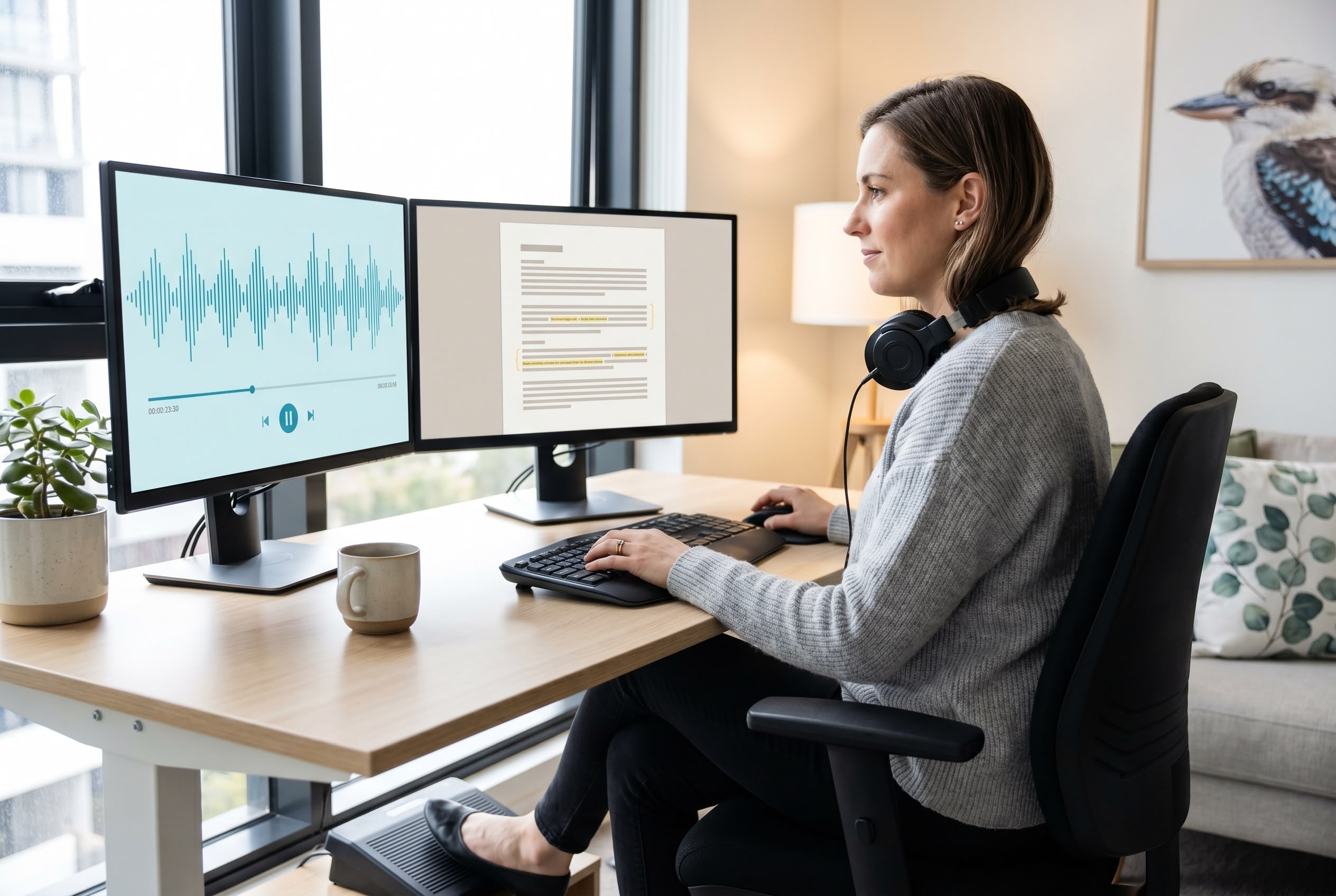
A typical pass looks like this. The transcriptionist opens the dictation in their editor and starts the audio with foot-pedal control. The AI draft is already loaded in the document pane. They listen to the dictation while the cursor follows the draft, pausing to correct mishears, fix punctuation, restructure paragraphs and verify drug names, doses and anatomical detail. A second pass without audio reads the document for flow, formatting and consistency with the employer’s house style. A final QA pass checks demographics, specialty-specific structure and any flagged exceptions before submission. For productivity context on how this changes typical line counts per hour, see Medical transcription productivity benchmarks.
When AI helps and when it slows you down
AI-generated drafts are a clear productivity win on routine dictations and a clear productivity loss on noisy, accented or unusually structured ones. Knowing which is which inside the first thirty seconds of audio is one of the skills experienced editors develop quickly.
AI helps most when the dictation is clean audio, clear pronunciation, predictable structure and routine vocabulary. Standard discharge summaries, follow-up consultation letters, straightforward radiology reports and routine surgical operative notes all benefit. The transcriptionist’s edit pass is faster than typing the same content from scratch, often substantially so. AI slows you down when the audio is noisy, the clinician has a strong accent the engine has not been trained on, the specialty uses unusual vocabulary, the structure is non-standard, or the dictation is full of corrections and asides. In those cases the editor sometimes finds it faster to discard the AI draft entirely and transcribe from audio. Recognising the signal in the first half-minute of listening, then choosing edit-mode or type-mode appropriately, is a real productivity skill.
Accuracy validation: keeping the human in the loop
Every AI-generated draft in a clinical setting requires human verification before the report leaves the system. This is not a stylistic preference, it is a patient-safety requirement and a fundamental position of both AAMT and AHDI in their published guidance on AI-assisted documentation.
The verification work is the editor’s contribution to clinical safety. AI engines mishear in predictable ways: drug names that sound alike, doses where milligrams and micrograms are confused, laterality where left and right are inverted, negations where “no acute findings” becomes “acute findings”. A human editor with clinical-language training catches these because they understand what a plausible clinical statement looks like. The AI does not. The strongest validation discipline is a structured final pass focused on the high-risk fields: patient identifiers, drug names and doses, dates and times, laterality, and any negation. For the style-guide foundation that supports this verification work, see The AAMT style guide.
PHI and data-residency concerns when using cloud AI
Cloud-based AI tools that process clinical dictation are subject to the Privacy Act 1988 and the Australian Privacy Principles, and most Australian healthcare employers will not allow real patient health information to be sent to a third-party AI tool that has not been formally vetted. This is the single most important boundary for an Australian transcriptionist learning to use AI in their workflow.
The hospital, agency or specialist practice you work with will have an approved tool list. Real dictations stay inside those tools. Personal experimentation with consumer AI services using real patient audio or text is a privacy breach, regardless of how the experiment is framed. Personal practice with AI tools is fine on your own synthesised dictations, course-provided files or fully fictional scenarios. Real PHI never leaves the approved environment. Data-residency questions also matter. Some Australian healthcare contracts require all processing and storage to happen onshore. Always check your employer’s policy before connecting any new tool to live work.
Productivity benchmarks with AI assistance
An experienced editor working back-end speech recognition on routine dictations typically processes more lines per hour than an experienced typist working from raw audio, but the gap narrows considerably on complex or specialty work. Public benchmarks vary by source and employer, so treat any specific number as indicative rather than guaranteed.
For a graduate moving from typing-mode to editor-mode, expect a transition period of several weeks. The eye-and-ear discipline is different. Reading along while listening, catching mishears in real time, and resisting the urge to over-edit clean draft sections all take practice. Most graduates find their throughput is initially lower in editor-mode than it would have been typing from scratch, then climbs above the typing baseline somewhere between week four and week eight as the editor habits solidify. For broader productivity context including the specialty-by-specialty differences, see Medical transcription productivity benchmarks.
The 11288NAT Diploma of Healthcare Documentation at TalentMed
The 11288NAT Diploma of Healthcare Documentation is TalentMed’s flagship medical-transcription qualification. The course teaches Australian medical language, structured-report formatting and AAMT-aligned style-guide discipline so graduates step into the editor role rather than the typist role from day one. It is delivered 100 per cent online by TalentMed Pty Ltd (RTO 22151).
Related reading
Keep exploring
Frequently asked questions
TalentMed Pty Ltd, RTO 22151. 11288NAT Diploma of Healthcare Documentation is delivered fully online. Current fees and intake details are confirmed on the course page and at training.gov.au.
Want to find out more?
Enter your details below to receive a free information pack instantly.