A Day in the Life of an Australian Medical Transcriptionist
Post Author:
TalentMed
A Day in the Role
A Day in the Life of an Australian Medical Transcriptionist
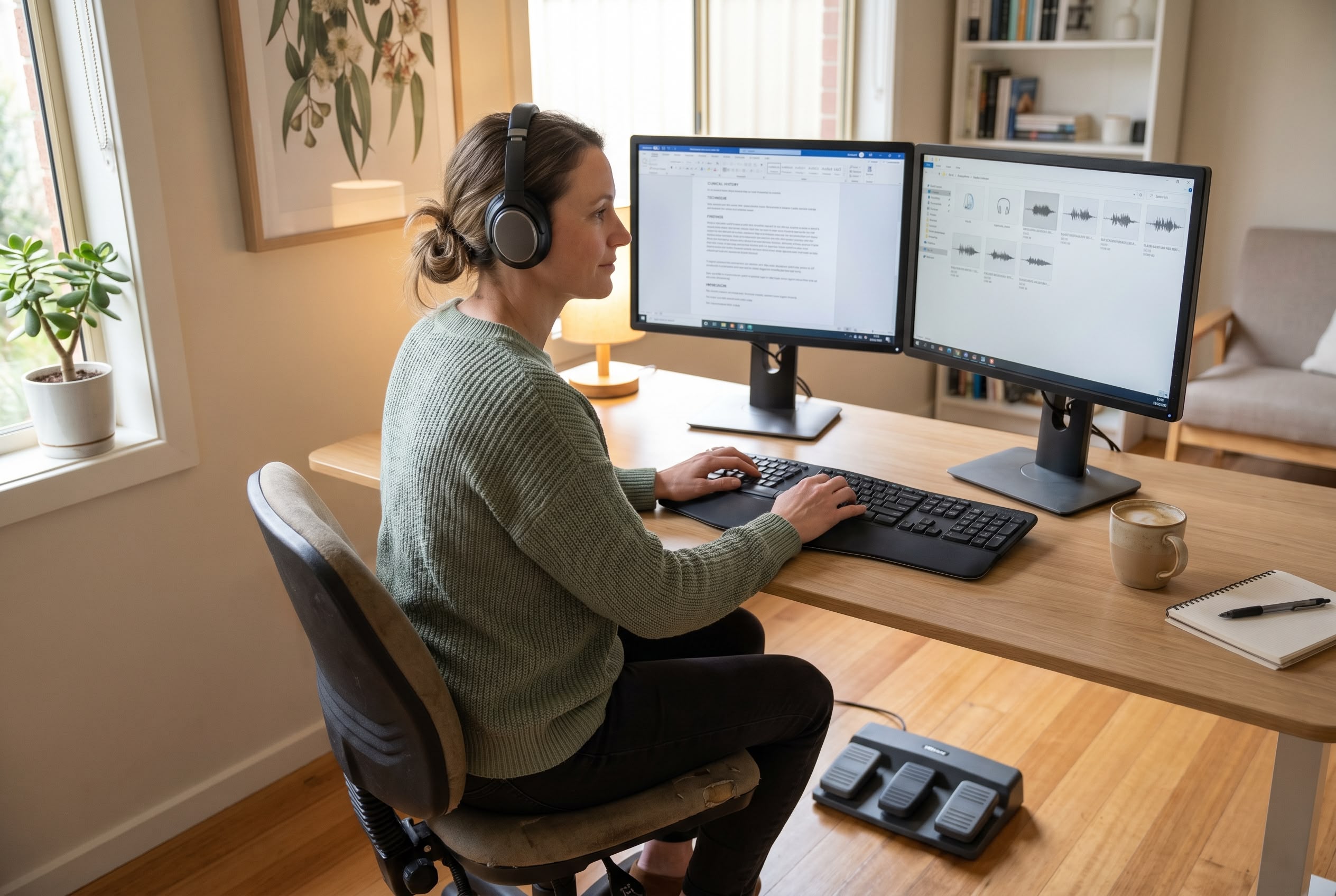
An Australian medical transcriptionist working from home opens the dictation queue around 7:00am, picks up overnight radiology first, moves to operative reports mid-morning, drafts discharge summaries through the afternoon, runs a QA pass on a contractor’s work, and signs off around 6:00pm. The day is quiet, focused, sometimes monotonous, and far more flexible than most healthcare roles. Headphones on, foot pedal under the desk, a fresh coffee, and a steady stream of audio files moving from inbox to delivered.
This guide walks through one realistic working day for an experienced Australian medical transcriptionist (MT). Times and report types are drawn from how working MTs actually structure a WFH day across radiology, surgical, hospital and specialist work. If you’re considering the 11288NAT Diploma of Healthcare Documentation, this is the kind of day you’re training for. TalentMed Pty Ltd (RTO 22151) delivers 11288NAT fully online.
The shape of a transcriptionist’s day
A typical day for an Australian medical transcriptionist runs from a quiet early-morning queue check to an end-of-day sign-off, with most of the working time spent in deep focus on audio files. The role is asynchronous. No patients in the room, no waiting room to manage, no roster to wrangle. Just a queue of dictations and a turnaround clock. Some MTs treat the day as a strict 7am to 4pm; others split it around school pick-ups or work weekend hours when overnight radiology volumes peak.
Across hospital outsourcing, private radiology, surgical clinics and specialist rooms the cadence is recognisably similar. Solo home-based MTs structure the day around their own batches; agency MTs work through a shared queue with team-level deadlines; in-house MTs at a private hospital fit around the dictating clinicians’ rhythms. The role sits at the intersection of clinical language, audio comprehension and accurate documentation, which is what the Medical Transcription pillar covers in depth.
7:00am: logging in, the dictation queue
7:00 AM
The first task of the day is opening the queue. A cup of coffee, headphones plugged in, foot pedal under the desk, and the transcription platform loading on the left monitor. Overnight, the radiology queue has filled up: a few CT and ultrasound reports, several plain-film X-ray dictations, and an MRI, mostly flagged routine 24-hour turnaround. Two are urgent: an overnight CT head from a regional hospital with a query stroke, and an inpatient X-ray for a query pneumothorax.
The MT picks up the urgent CT head first. Click play, foot pedal forward, the radiologist’s voice in the headphones at a comfortable speed (experienced MTs typically run at 1.1× to 1.4× depending on the dictator). Type, foot pedal back to rewind, type, foot pedal stop. Five minutes of audio resolves to about three pages of structured report: clinical history, technique, findings, impression. The MT knows exactly which heading is coming next because the radiologist is following a template.
By 7:30 both urgent reports are delivered and the queue is steady. This is the part of the day most MTs say they enjoy most. Quiet house, fresh coffee, the satisfaction of clearing a backlog, no one interrupting. For a closer look at how the queue itself works at experienced level, see Medical transcription productivity benchmarks.
9:30am: operative reports from a private hospital
9:30 AM
Mid-morning the report mix changes. The radiology queue thins out as day-shift radiologists start dictating their first cases live, and the MT shifts to a different account: operative reports from a private surgical hospital. These are longer, denser, and far more variable than radiology. One surgeon dictates fast in clean structured paragraphs. Another talks slowly but rambles between findings and procedural steps. A third uses dense surgical terminology that requires constant attention.
The MT works through a laparoscopic cholecystectomy report (around twelve minutes of audio, roughly six pages), then a hernia repair, then a knee arthroscopy. Surgical reports require careful handling of anatomical terms, instrument names, suture types and laterality (left versus right knee must never be wrong). The MT cross-checks one ambiguous instrument name against the AAMT-aligned style guide and a personal terminology shortlist built up over the years.
This is where deep medical-language fluency pays off. Newer MTs often need 20 to 30 percent longer to clear an operative report than an experienced one. Experienced MTs have a mental library of thousands of consistent terms and only stop to verify the tricky ones. For more on how the AAMT and AHDI style guides shape this work in Australia, see The AAMT style guide for Australian medical transcription.
12:30pm: lunch and body-management between sessions
12:30 PM
Lunch is one of the flexible parts of the day. The MT closes the platform, stretches, walks the dog, makes a proper sandwich. There is no roster covering for them, no patient waiting in the room, no manager glancing at the clock. Most accounts run on team-level deadlines, not minute-by-minute monitoring, so a 45-minute lunch break is normal and expected.
Body-management matters in this role more than people often expect. Sitting still with headphones on for hours, fingers on the keyboard, foot on the pedal, takes a real toll if it is not actively managed. Most experienced MTs build in micro-breaks every 45 to 60 minutes, a proper lunch break, and end the day with a deliberate “off the desk” boundary. Wrist support, an ergonomic chair, a properly-set monitor height and a quality headset are baseline equipment, not luxuries.
This is also when many MTs check email, run a load of laundry, sort out school pick-up logistics, or take a phone call. The mid-day flexibility is one of the strongest reasons people choose medical transcription as a long-term career, particularly carers, people managing chronic conditions, and anyone who values a calm working environment.
2:00pm: discharge summaries (the toughest TAT)
2:00 PM
Early afternoon is usually when discharge summaries land in the queue. These are the reports clinicians dictate at the end of a patient’s hospital stay, and they are routinely flagged with the tightest turnaround in the day, often four to six hours. The hospital needs the discharge summary to reach the patient’s GP before the patient turns up for their follow-up, which can be the next morning.
Discharge summaries are also the most complex report type. They cover the full admission narrative: presenting complaint, examination, investigations, management, complications, discharge medications with dose and frequency, follow-up appointments, and recommended GP actions. The MT is reconciling several sources of information from a single dictation: the registrar’s voice, sometimes a consultant’s addendum, occasionally a corrected medication list at the end of the file.
The MT works through three discharge summaries in two hours. One is straightforward, one has a complex medication reconciliation requiring attention to dose changes during the admission, and one has an addendum from a different clinician that needs to be incorporated cleanly. By 4:00 all three are delivered. For an overview of the major report types and how they vary in difficulty, see Medical transcription report types in Australia.
4:30pm: QA pass on a contractor’s work
4:30 PM
Senior MTs often take on a quality-assurance role alongside their own transcription work. Today the MT is rostered for a 90-minute QA window: reviewing five reports completed earlier by a contractor MT who is still building experience. The job is to listen back to the original audio, read the draft, flag errors, suggest corrections, and feed back constructively.
Most of the contractor’s work is solid. Two minor terminology choices the senior MT would have made differently, one missing word that did not affect meaning, and one genuine error: a medication dose typed as “5 mg” when the audio clearly says “50 mg”. That last one matters. The MT corrects it, flags it in the QA log with a note about double-checking dose-related numbers, and moves on.
This is where the role broadens out. Experienced MTs become editors, mentors, style guide custodians and team leads. The pay reflects it: senior and QA-focused roles typically sit higher than entry-level production roles. For more on this progression, see Medical transcription jobs in Australia.
6:00pm: day-end and tomorrow’s prep
6:00 PM
By 6:00 the queue is in a steady state for the evening shift. The MT clears their last report (a short specialist consultation note), runs the daily delivery report, and confirms all completed work has uploaded to each client’s platform. One private account requires a manual end-of-day confirmation email. That goes out, the MT logs the day’s productivity in their personal tracker, and starts shutting down.
Before signing off, the MT scans tomorrow’s likely workload. The radiology overnight queue will be there at 7:00am, the surgical hospital has a busy theatre list which means more operative reports, and a specialist clinic has flagged a higher-than-usual referral letter volume. Nothing dramatic, but enough to plan the morning around.
Total day length: roughly nine to ten hours, with about an hour of break time inside it. This is broadly typical for an experienced WFH MT working full-time, although many MTs work shorter days (school-hours-only is a common shape) or split into morning-and-evening sessions.
How the day distributes by activity
Most experienced full-time MT days have a recognisable distribution across activities. The exact split varies by account mix and personal pace.
| Activity | Approximate share of the day | Why it varies |
|---|---|---|
| Active transcription (audio playback and typing) | 5 to 6 hours | Faster on familiar dictators and shorter report types; slower on new accounts or dense operative reports. |
| QA, proofreading and self-review | 30 to 45 minutes | More on senior or QA-focused roles, less on production-only roles. |
| Reference checking (style guide, terminology lookups) | 20 to 30 minutes | Drops sharply with experience as the personal terminology library builds. |
| Account admin (delivery confirmations, time logging) | 20 to 30 minutes | Heavier for solo contractors juggling several clients; lighter for in-house roles. |
| Breaks and body-management | 45 to 60 minutes | Critical for sustainable performance; reduces wrist and back issues over years in the role. |
| Email, training, professional development | 15 to 30 minutes | Higher around onboarding to new accounts or new dictators. |
The 11288NAT Diploma of Healthcare Documentation builds the medical-language fluency, audio-comprehension training and Australian style-guide knowledge that make the active-transcription portion of the day productive. Without that foundation, reference-checking time balloons and pay-per-line earnings suffer.
The 11288NAT Diploma of Healthcare Documentation at TalentMed
The 11288NAT Diploma of Healthcare Documentation is TalentMed’s flagship medical-transcription qualification, designed for Australians stepping into a WFH transcription role like the one described above. It is delivered 100 per cent online, includes Australian medical terminology, audio comprehension, AAMT-style-guide-aligned content and the report-type training that maps directly onto a working day.
Related reading
Keep exploring
Frequently asked questions
TalentMed Pty Ltd, RTO 22151. 11288NAT Diploma of Healthcare Documentation is delivered fully online. Current fees and intake details are confirmed on the course page and at training.gov.au.
Want to find out more?
Enter your details below to receive a free information pack instantly.