What Does a Medical Transcriptionist Do? A Day in the Role
Post Author:
TalentMed
The Role
What Does a Medical Transcriptionist Do? A Day in the Role
A medical transcriptionist converts dictated medical recordings into accurate, formatted clinical documents that become part of the patient’s permanent health record. The role involves listening to dictation from doctors, surgeons, specialists and allied-health professionals, transcribing it into the correct medical report format (operative reports, discharge summaries, consult letters, radiology, pathology, progress notes), checking medical terminology and abbreviations, and meeting strict accuracy and turnaround standards. Most Australian medical transcriptionists work for hospital records pools, outsourced transcription companies, or directly for private specialist clinics, with the work overwhelmingly done from home.
This article walks through the actual work, hour by hour and report by report. It covers the typical daily workflow, the report types you’ll handle, the skills the role demands, the software and equipment that make it possible, the accuracy and turnaround standards employers measure, and where the medical transcriptionist sits inside the broader healthcare team. The picture below is current as of 2026 and reflects how the role looks in Australian transcription companies, hospital records departments and private specialist clinics today.
The core daily workflow
A typical Australian medical transcriptionist’s day runs as a continuous loop: log in to the transcription platform, pull the next dictation from the queue, listen and transcribe in short repeated passes, format the report to the client’s template, run a self-quality check, submit, and pick up the next file. The work is rhythmic and overwhelmingly solo. Most home-based transcriptionists set their own start time within a contracted weekly volume, and the rest of the day is structured around productivity targets rather than meeting attendance.
The day arc below describes a generalist transcriptionist working from home for an outsourced transcription company, the most common employment shape in Australia. In-house clinic, hospital records and freelance contractor days look slightly different (more variety, occasional phone calls, less queue-based pacing) but the core work cycle is the same.
Workspace setup and platform login
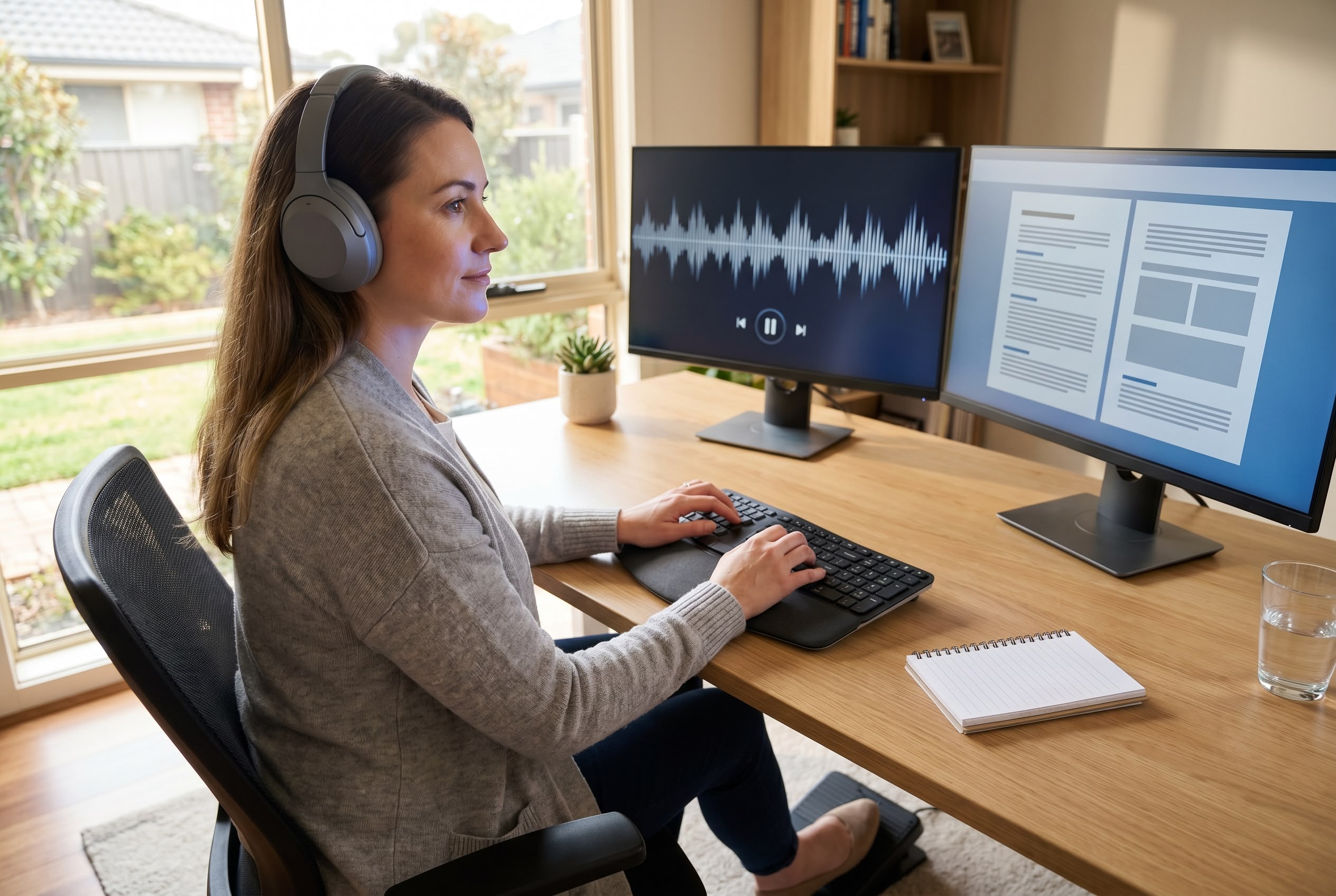
Boot the workstation, plug in the foot pedal and headphones, log in to the transcription platform (Bighand, Olympus ODMS, the in-house portal), check the day’s queue length and any priority flags from the supervisor. Five to ten minutes.
First production block (90 minutes)
Pull the first dictation, usually a short one to warm up. Listen in 8 to 12 second segments, transcribe each segment, advance with the foot pedal. A short operative report or consult letter typically takes 15 to 25 minutes start to finish. Five to seven reports completed in this block.
Posture and screen break
Stand, walk, water, eyes off the screen. The role is physically demanding in subtle ways. Experienced transcriptionists treat 10-minute breaks every 90 minutes as non-negotiable.
Second production block (90 minutes)
The longer reports usually go in the mid-morning block. A complex operative report (multi-specialist surgery) or a discharge summary for a long-stay patient can take 35 to 50 minutes each. Three to five reports in this block.
Specialty terminology lookup window
Set aside 15 minutes for the harder vocabulary calls. Reach for Dorland’s, Stedman’s, or the MIMS database for any drug, anatomical term or abbreviation that wasn’t 100 per cent confident. This pass is what separates a 95 per cent accuracy transcriptionist from a 99 per cent one.
Third production block (90 minutes)
The afternoon-priority reports. Anything flagged by the supervisor as fast turnaround (24 hours or less) gets cleared in this window. Three to five more reports.
Lunch and full mental reset
One full hour off the keyboard. Most experienced transcriptionists get out of the workspace entirely. Coming back fresh for the afternoon shift is the difference between a productive 8-hour day and an exhausting 6-hour one.
Self-QA pass on the morning’s work
Before submitting any morning reports, do a final read-through. Check spelling on all medication names, verify any abbreviation expansions, confirm formatting matches the client’s template, run spell-check one more time. Submit the morning’s batch.
Afternoon production block (90 minutes)
Routine afternoon work. Energy is usually a touch lower than the morning, so easier reports go here, the structured single-speaker dictations and predictable consult letter formats.
Final production block and shutdown
Last 60 to 90 minutes of focused production. Final QA pass before submitting the afternoon’s reports. Log productivity metrics for the day (lines per hour, reports completed, error flags). Shut down by 5 PM or earlier if the daily volume target was met sooner.
Across an 8-hour day, a productive Australian medical transcriptionist typically completes 18 to 25 reports of mixed length and complexity, totalling 250 to 320 lines per hour at a 96 to 98 per cent accuracy benchmark. New entrants in the first 6 months sit lower (around 150 to 200 lines per hour); senior transcriptionists with strong specialty depth clear 350 to 400 lines per hour on familiar work.
The types of medical reports transcribed
Australian medical transcriptionists handle a mix of report types within a typical day, from short consult letters to long operative reports. The split varies with the employer (a general transcription company sees the broadest spread, a cardiology specialist clinic sees mostly consult letters and procedure reports, a hospital records department sees a heavier discharge summary load) but the core report families below appear in nearly every transcription role.
Each report type follows its own structural template, and muscle memory for those templates is one of the biggest productivity differentiators. Below is a reference summary of the main report families, with the typical length, accuracy expectation, turnaround window and originating specialty.
| Report type | Typical length | Accuracy benchmark | Turnaround | Originating specialty |
|---|---|---|---|---|
| Operative report | 1 to 4 pages | 98% or higher | 24 to 48 hours | Surgery (general, ortho, cardiothoracic, gynae) |
| Discharge summary | 2 to 6 pages | 97% or higher | 24 hours | Hospital admitting team |
| Consult letter | 1 to 3 pages | 97% or higher | 48 to 72 hours | Specialist practice (cardiology, neurology, etc.) |
| Radiology report | Half page to 2 pages | 99% or higher | 4 to 24 hours | Radiology, often AI-assisted |
| Pathology report | 1 to 3 pages | 99% or higher | 24 hours | Pathology / laboratory |
| Progress notes | Half page to 1 page | 97% or higher | 24 hours | Hospital ward, allied health |
| GP referral letter | Half page to 1 page | 97% or higher | 48 to 72 hours | General practice |
| Procedure report | 1 to 2 pages | 98% or higher | 24 to 48 hours | Cardiology, gastroenterology, interventional radiology |
The 11288NAT Diploma trains across all of these report families, with practical assessments built around the actual templates Australian transcription companies use. New transcriptionists typically gain confidence on consult letters and progress notes first, then build into operative reports and discharge summaries as their terminology fluency deepens.
The skills medical transcriptionists use day to day
The skills required day to day in medical transcription are tightly bounded and entirely measurable. Australian transcription employers screen on touch-typing speed, medical terminology fluency, dictation comprehension across accents, English grammar accuracy and self-quality-assurance habits. The qualification gets you to the application stage; these eight skills get you the role and lift your pay over time.
Tools and software medical transcriptionists use
The Australian medical transcription toolkit is mature and standardised. Most outsourced transcription companies and hospital records departments specify the platform they use, and you log in to their system rather than installing your own. The hardware is more personal: comfortable headphones, a USB foot pedal, an ergonomic workstation, and a reliable broadband connection. Total upfront hardware cost typically sits between $400 and $1,200, with the platform software provided by the employer.
The software and reference tools transcriptionists use day to day fall into four families: the dictation playback platform, the foot pedal driver, the medical reference and terminology tools, and the productivity tracking system the employer uses to measure your output. Each family has a small handful of dominant products in the Australian market.
On the hardware side, the standard kit is a Windows 10 or 11 computer (most platforms are Windows-first), closed-back over-ear headphones with a flat speech response (Sennheiser HD 25 or Audio-Technica ATH-M30x are widespread), a USB foot pedal, an ergonomic chair and desk, and an NBN50 or better broadband connection. Apple Mac compatibility is improving as more platforms move to the cloud, but most employers still prefer a Windows machine.
Quality and accuracy standards employers measure
Australian medical transcription employers measure two metrics above all others: accuracy and turnaround. Accuracy is benchmarked at 95 to 99 per cent depending on report type (radiology and pathology sit at the strict end), and turnaround is measured in hours from dictation upload to submitted report (4 hours for radiology, 24 to 72 for most other types). Pay reviews, queue assignments and seniority all flow from your rolling performance against these two numbers.
Errors are categorised by clinical impact rather than character count. Most Australian transcription companies use a three-tier framework that separates the trivial from the consequential, and pay reviewers focus heavily on the top tier.
Two productivity-related expectations also matter. Lines-per-hour productivity tracks output volume against a 65-character American Health Information Management Association (AHIMA) line definition, the de facto industry standard. Minutes-of-audio-per-hour productivity tracks output against the audio length, and a 4-to-1 ratio (one hour of typing per 15 minutes of audio) is the typical mid-tier benchmark. Senior transcriptionists clear closer to a 3-to-1 ratio on familiar specialty work.
Where medical transcriptionists fit in the healthcare team
Medical transcriptionists sit alongside the clinical workforce, not inside it. They don’t see patients, don’t make clinical decisions, and don’t carry treating-clinician responsibility. What they do is convert the clinician’s spoken record into the written record that the rest of the healthcare team relies on. Their immediate working relationships are with the dictating doctor (whose recordings they transcribe), the medical records officer (who manages the document storage and access), and the clinical coder (who reads the finished documentation to assign ICD-10-AM codes).
The four key working relationships in a typical Australian healthcare setting are summarised below. The transcriptionist is the documentation specialist; the others have separate clinical, administrative or compliance roles, and the work flows in a sequence rather than running in parallel.
How AI is changing the medical transcriptionist role
AI has changed the day-to-day shape of the role but has not replaced it in Australia. Voice-recognition tools (Dragon Medical One, Speechmatics, Nuance DAX, the AI scribe products) handle routine single-speaker dictation well, especially in radiology where AI-assisted transcription has been the norm for over a decade. Complex consults, accented dictation, multi-speaker recordings and clinically critical reports still require human transcriptionists or editors, and the role is evolving toward an AI-assisted editor model where the human reviews, corrects and signs off the AI’s first pass.
For someone choosing the career today, the practical implication is simple: learn both the traditional transcription skills (typing, terminology, formatting) and the AI-edit workflow (reviewing AI drafts, recognising error patterns, flagging clinical ambiguities). The 11288NAT Diploma trains for both ends of the role, so graduates are positioned for the QA and editor work that now defines the senior end of the profession.
For the full analysis of where AI is and isn’t displacing the role, including the editor pathway and Australian privacy considerations, read AI in Medical Transcription: What’s Changing in Australia.
Train for the role with the 11288NAT Diploma of Healthcare Documentation
The 11288NAT Diploma of Healthcare Documentation is TalentMed’s nationally recognised qualification for the medical transcription and healthcare documentation profession. It teaches the actual workflow described above: dictation playback, terminology across 30+ specialties, the report families and their templates, productivity habits, accuracy and self-QA discipline, the Australian privacy framework, and the modern AI-edit workflow. It’s the qualification Australian transcription companies, hospital records departments and private specialist clinics consistently look for when shortlisting applicants.
Related reading
Frequently asked questions
TalentMed Pty Ltd, RTO 22151. Pricing and intake details on the 11288NAT course page. Always confirm current fees and entry requirements with TalentMed before enrolling.
Want to find out more?
Enter your details below to receive a free information pack instantly.