Nervous System Medical Terminology: A Deep Reference
Post Author:
TalentMed
The Deep Reference
Nervous System Medical Terminology: A Deep Reference
The nervous system is the most cross-disciplinary terminology family in clinical practice. Brain and spinal cord anatomy, peripheral nerve anatomy, neuron physiology, neurological conditions and neurosurgical procedures all share a tight set of Greek and Latin roots. Once you decode neur-, encephal-, mening-, myel- and cerebr-, neurology consults, stroke admission notes and rehabilitation discharge summaries become much easier to read.
This reference pairs central and peripheral anatomy with the physiology of how neurons signal, builds a working table of nervous-system prefixes, roots and suffixes, and walks through the most common conditions, diagnostic procedures and drug classes you will meet across Australian healthcare. Use it as a study companion and as a quick lookup.
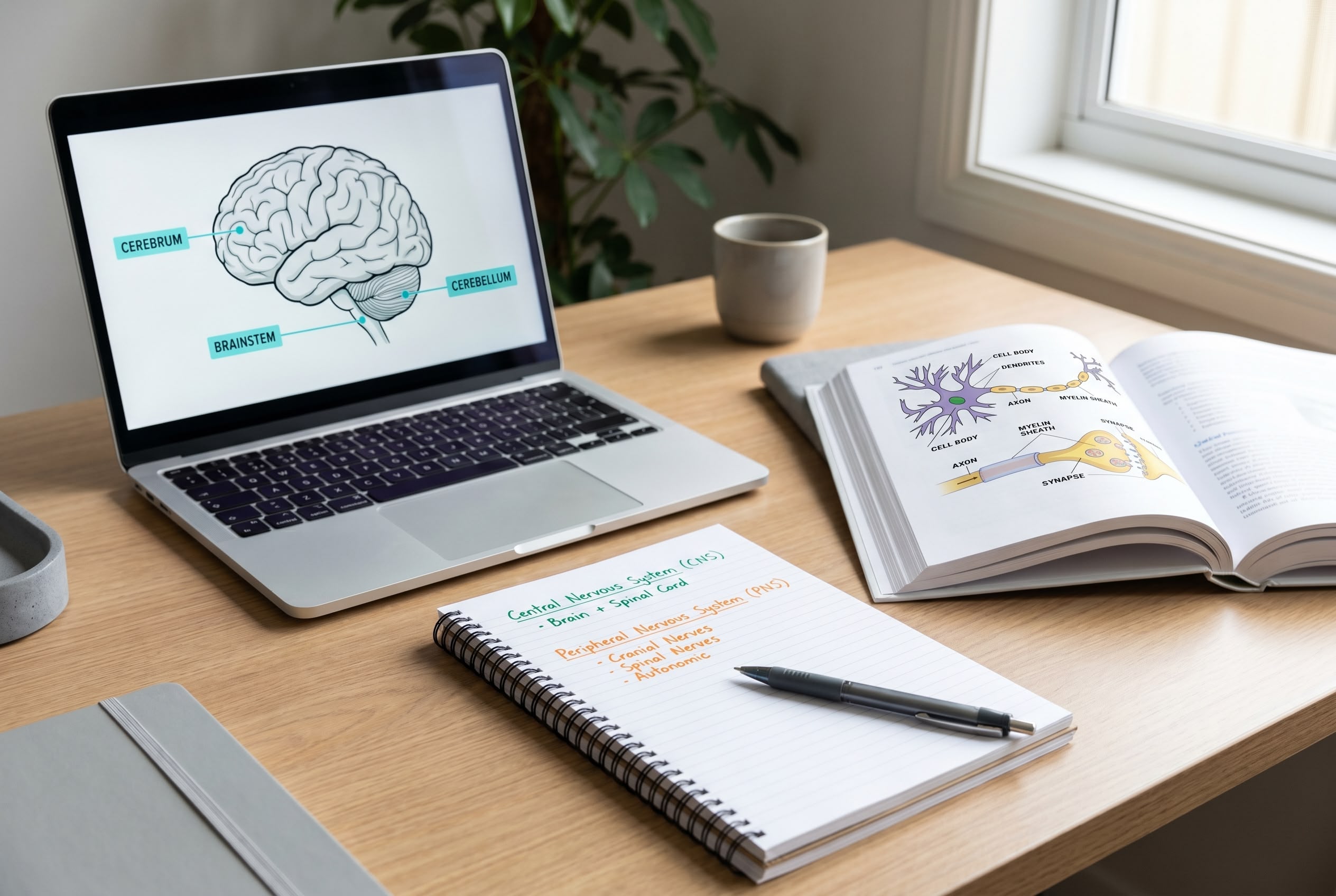
Nervous system at a glance (CNS and PNS)
The nervous system is the body’s communication network. It splits cleanly into the central nervous system (CNS) and the peripheral nervous system (PNS). Almost every neurological term sits in one half or the other.
For a broader view across systems, see medical terms by body system. The pillar at medical terminology covers the framework. The cardiovascular and respiratory references follow the same structure.
Anatomy: brain, spinal cord, peripheral nerves
Neurological anatomy clusters around brain regions, spinal cord segments, the meninges and the named cranial and spinal nerves. Knowing the correct name for each part lets you read CT and MRI reports, operation notes and rehabilitation summaries without guessing.
Brain regions
| Term | Meaning | Where you meet it |
|---|---|---|
| cerebrum | largest part of the brain; left and right hemispheres, four lobes each | stroke documentation, dementia notes |
| frontal, parietal, temporal, occipital lobes | the four cerebral lobes (motor and executive, sensory, hearing and memory, vision) | localising stroke, tumour and seizure focus |
| cerebellum | coordinator of balance and fine movement | cerebellar stroke, ataxia, MS |
| brainstem (midbrain, pons, medulla) | connects brain to cord; controls breathing, heart rate, consciousness | brainstem stroke, brain death assessment |
| thalamus, hypothalamus | sensory relay; master regulator of hormones, temperature, hunger | thalamic stroke, endocrine and neurology overlap |
| basal ganglia | deep grey-matter structures controlling movement initiation | Parkinson’s disease, Huntington’s disease |
| hippocampus | temporal-lobe structure central to memory formation | Alzheimer’s disease, temporal lobe epilepsy |
| corpus callosum | white-matter band connecting left and right hemispheres | MS lesions, refractory epilepsy |
Spinal cord and meninges
| Term | Meaning | Where you meet it |
|---|---|---|
| spinal cord | bundle of nerves running from brainstem through vertebral canal | spinal cord injury, MS, transverse myelitis |
| cervical, thoracic, lumbar, sacral segments | the four functional regions of the spinal cord | SCI level (C5, T6, L1), radiculopathy |
| cauda equina | bundle of lumbosacral nerve roots below the cord’s end | cauda equina syndrome (a surgical emergency) |
| dura mater, arachnoid mater, pia mater | the three meningeal layers (outer, middle web-like, inner adherent) | subdural haematoma, subarachnoid haemorrhage, meningitis |
| cerebrospinal fluid (CSF) | clear fluid in the subarachnoid space and ventricles | lumbar puncture, hydrocephalus |
| ventricles (lateral, third, fourth) | fluid-filled cavities inside the brain | hydrocephalus, ventriculoperitoneal shunt |
Peripheral nerves
| Term | Meaning | Notes |
|---|---|---|
| cranial nerves (I to XII) | 12 paired nerves originating from the brain or brainstem | e.g. CN VII facial, CN X vagus |
| spinal nerves (31 pairs) | nerves leaving the spinal cord between vertebrae | 8 cervical, 12 thoracic, 5 lumbar, 5 sacral, 1 coccygeal |
| dermatome | area of skin supplied by a single spinal nerve root | shingles, radiculopathy, sensory level mapping |
| plexus (brachial, lumbar, sacral) | network where spinal nerves regroup before continuing | brachial plexus injuries, plexopathy |
| autonomic ganglia | nerve cell bodies outside the CNS | autonomic neuropathy, dysautonomia |
Physiology: how neurons communicate
Nervous-system physiology vocabulary describes how neurons fire, signal across synapses and produce reflexes. These terms recur across neurology consults, anaesthetic records and pharmacology references.
Neurons, signalling and reflexes
| Term | Meaning |
|---|---|
| neuron | signalling cell of the nervous system; cell body, dendrites and axon |
| dendrite, axon | branched receivers and the long projection that carries signals away |
| myelin sheath | fatty insulating layer around many axons; speeds conduction |
| synapse | junction between two neurons (or neuron and muscle) where signals cross |
| neurotransmitter | chemical messenger released at the synapse (acetylcholine, dopamine, serotonin, GABA, glutamate) |
| action potential | brief electrical impulse that travels along the axon |
| reflex arc | sensory neuron, integrating centre, motor neuron pathway producing an automatic response |
| grey matter, white matter | regions rich in neuron cell bodies; regions rich in myelinated axons (the cabling) |
| blood-brain barrier | tight capillary lining that limits what crosses into brain tissue |
Common nervous-system prefixes, roots and suffixes
This is the working table. Pair these with general prefixes and suffixes (covered in common medical prefixes and suffixes) and most neurology reports become readable.
Nervous-system roots
| Root | Meaning | Example term | Example meaning |
|---|---|---|---|
| neur-, neuro- | nerve, nervous system | neurology | study of the nervous system |
| encephal-, encephalo- | brain | encephalitis | inflammation of the brain |
| cerebr-, cerebro- | cerebrum, brain | cerebrovascular | relating to the blood vessels of the brain |
| cephal-, cephalo- | head | hydrocephalus | excess CSF in the brain |
| mening-, meningo- | meninges (brain and cord linings) | meningitis | inflammation of the meninges |
| myel-, myelo- | spinal cord OR bone marrow (context) | myelitis | inflammation of the spinal cord |
| gli-, glio- | glial cells (CNS supporting cells) | glioma | tumour arising from glial cells |
| radicul-, radiculo- | nerve root | radiculopathy | disease of a spinal nerve root |
| psych-, psycho- | mind | psychiatry | specialty for mental health disorders |
| phas-, phaso- | speech | aphasia | loss or impairment of language ability |
| esthes-, algi-/alges-, kines- | sensation; pain; movement | anaesthesia, analgesia, dyskinesia | loss of sensation; relief from pain; abnormal involuntary movement |
| somn-, somno- | sleep | insomnia | inability to sleep |
Neurological prefixes and suffixes
| Affix | Meaning | Example term | Example meaning |
|---|---|---|---|
| hemi- | half (one side) | hemiplegia | paralysis of one side of the body |
| para- | beside; both lower limbs | paraplegia | paralysis of both lower limbs |
| quadri-, tetra- | four | quadriplegia (tetraplegia) | paralysis of all four limbs |
| dys- | difficult, abnormal | dysphasia | difficulty with language |
| a-, an- | without, absence of | aphasia | absence or severe loss of language |
| poly-, mono- | many; one | polyneuropathy, mononeuropathy | disease affecting many or a single peripheral nerve |
| -plegia, -paresis | paralysis; weakness | hemiplegia, hemiparesis | full paralysis vs weakness of one side |
| -algia | pain | neuralgia | nerve pain |
| -itis, -pathy | inflammation; disease | encephalitis, neuropathy | inflammation of the brain; disease of a nerve |
| -oma | tumour, mass | meningioma | tumour of the meninges |
| -ectomy, -otomy | surgical removal; incision | laminectomy, craniotomy | removal of part of a lamina; opening of the skull |
| -graphy, -gram | recording or imaging; the recorded image | electroencephalography, EEG | recording the brain’s electrical activity, and the tracing it produces |
| -genic | causing, originating | epileptogenic | causing or producing seizures |
Common conditions (with abbreviation references)
Neurology has a heavy abbreviation load. The same condition is often written as a full term in admission notes and as an abbreviation in handover sheets, ward rounds and discharge documents. For the broader reference, see medical abbreviations list and the warning list in dangerous abbreviations.
Stroke and cerebrovascular disease
| Term / abbreviation | Meaning |
|---|---|
| cerebrovascular accident (CVA, stroke) | sudden neurological deficit from disrupted brain blood supply |
| ischaemic stroke, haemorrhagic stroke | stroke from blocked artery, or from bleeding into or around the brain |
| transient ischaemic attack (TIA) | brief stroke-like episode that resolves without infarct |
| subarachnoid haemorrhage (SAH) | bleeding into the subarachnoid space, often from a ruptured aneurysm |
| intracerebral haemorrhage (ICH) | bleeding within the brain tissue itself |
| subdural haematoma, extradural haematoma | blood collections between dura and arachnoid, or between skull and dura (often from head trauma) |
Degenerative and demyelinating disease
| Term / abbreviation | Meaning |
|---|---|
| Alzheimer’s disease, vascular dementia | most common dementia subtypes (cortical degeneration; cumulative cerebrovascular disease) |
| Parkinson’s disease (PD) | tremor, rigidity, bradykinesia from basal ganglia dopamine loss |
| multiple sclerosis (MS) | autoimmune demyelinating disease of the CNS; relapsing-remitting or progressive |
| motor neurone disease (MND, ALS) | progressive degeneration of upper and lower motor neurons |
| Guillain-Barre syndrome (GBS) | acute autoimmune demyelinating polyneuropathy of the PNS |
Seizure, headache and other conditions
| Term / abbreviation | Meaning |
|---|---|
| epilepsy | tendency to recurrent unprovoked seizures |
| seizure (focal, generalised, tonic-clonic, absence) | abnormal synchronised electrical activity in the brain |
| status epilepticus | prolonged or repeated seizures without recovery; medical emergency |
| migraine (with or without aura) | recurrent headache disorder, often unilateral, with associated symptoms |
| meningitis, encephalitis | inflammation of the meninges, or the brain itself; often infective |
| traumatic brain injury (TBI) | brain injury from external force; mild (concussion) to severe |
| spinal cord injury (SCI) | traumatic damage to the spinal cord; complete or incomplete |
| peripheral neuropathy | damage to peripheral nerves; many causes (diabetes, alcohol, chemotherapy) |
| trigeminal neuralgia, Bell’s palsy | cranial nerve syndromes (CN V pain, CN VII facial palsy) |
| myasthenia gravis | autoimmune disorder of the neuromuscular junction; fluctuating weakness |
| delirium | acute confusional state; often reversible cause |
| hydrocephalus | excess CSF in the brain ventricles |
Common diagnostic procedures and treatments
Neurological investigations and treatments fall into three buckets: imaging and electrodiagnostics, procedures, and drug therapy. The suffix is often the hint: -graphy or -gram for imaging; -ectomy, -otomy or -plasty for surgery; class names for drugs.
Diagnostic procedures
| Procedure | What it shows or does |
|---|---|
| computed tomography (CT) brain | fast cross-sectional X-ray imaging; first-line for suspected acute stroke or trauma |
| magnetic resonance imaging (MRI) brain or spine | detailed soft-tissue imaging; better for tumour, MS, subtle stroke, cord lesions |
| CT angiography (CTA), MR angiography (MRA) | vascular imaging of intracranial and neck vessels |
| electroencephalogram (EEG) | recording of brain electrical activity; primary tool for epilepsy |
| electromyography (EMG) and nerve conduction studies (NCS) | tests of muscle and peripheral nerve function |
| lumbar puncture (LP) | needle aspiration of CSF for analysis; key in suspected meningitis or SAH |
| neurology consultation | specialist review for diagnosis and management planning |
| cognitive assessment (MMSE, MoCA) | structured bedside testing of memory and executive function |
Procedures and surgical interventions
| Procedure | What it does |
|---|---|
| thrombolysis (tPA, alteplase) | IV clot-dissolving therapy for acute ischaemic stroke within the time window |
| endovascular thrombectomy | catheter-based clot retrieval for large-vessel occlusion stroke |
| craniotomy, burr hole drainage | surgical opening of the skull (full or small access for haematoma drainage) |
| aneurysm clipping or coiling | open or endovascular treatment of a cerebral aneurysm |
| ventriculoperitoneal (VP) shunt | tube to drain excess CSF from the ventricles to the abdomen (hydrocephalus) |
| laminectomy, discectomy | removal of part of a vertebral lamina or a herniated disc fragment to decompress nerves |
| deep brain stimulation (DBS) | implanted electrodes for Parkinson’s disease, tremor, dystonia |
| tumour resection | surgical removal of a brain or spinal cord tumour |
Major drug classes
| Class | What they do | Common examples (generic names) |
|---|---|---|
| antiepileptics (anticonvulsants) | prevent or reduce seizures | levetiracetam, sodium valproate, lamotrigine, carbamazepine |
| antiparkinsonian agents | replace or mimic dopamine in Parkinson’s disease | levodopa with carbidopa, pramipexole, ropinirole |
| antidepressants (SSRIs, SNRIs, TCAs) | treat depression and several neuropathic pain syndromes | sertraline, duloxetine, amitriptyline |
| benzodiazepines | reduce anxiety, treat status epilepticus, sedation | diazepam, lorazepam, midazolam |
| neuropathic pain agents | treat nerve pain (different from typical analgesics) | gabapentin, pregabalin, amitriptyline |
| migraine-specific agents | abort or prevent migraine | sumatriptan, rizatriptan (acute); propranolol, topiramate (preventive) |
| cognitive enhancers (Alzheimer’s) | partial symptomatic benefit in dementia | donepezil, rivastigmine, memantine |
| disease-modifying therapy (MS) | slow MS progression and reduce relapses | interferon beta, ocrelizumab, fingolimod |
| thrombolytics | break down clots in acute ischaemic stroke | alteplase (tPA), tenecteplase |
Useful suffix patterns include -pam in many benzodiazepines (diazepam, lorazepam) and -triptan in migraine abortive agents (sumatriptan, rizatriptan).
Where you’ll see this terminology in practice
Nervous-system vocabulary surfaces across stroke admissions, neurology and neurosurgery wards, rehabilitation, mental health and aged care. The same terms appear in very different roles.
Other surfaces where this vocabulary shows up:
For a study plan that builds neurological vocabulary in context, see how to learn medical terminology and the quick-reference medical terminology cheat sheet. The medical plurals guide covers tricky neurological forms (gyrus / gyri, sulcus / sulci, ganglion / ganglia). For body-position terms used in brain and spinal imaging, see anatomical position and directional terms.
Frequently asked questions
Want to find out more?
Enter your details below to receive a free information pack instantly.