How to Become a Clinical Coder in Australia
Step-by-step guide to becoming a qualified clinical coder in Australia in 2026. Training pathways, entry requirements, salary outlook, and first jobs.
Post Author:
TalentMed

How to Become a Clinical Coder in Australia
The Career
Becoming a qualified clinical coder in Australia usually takes about 12 months through a nationally recognised diploma such as TalentMed’s HLT50321 Diploma of Clinical Coding. You don’t need a clinical background or a previous qualification in healthcare. With self-paced online study, practical coding assessments, and the right first job, most people move from their first day of study to their first paid coding role within 12 to 18 months.
This guide walks through every step: what a clinical coder actually does, what you need to get started, which training pathway to choose, how long the study takes, how to land your first job, and what to expect in pay and progression. It’s written for career changers, healthcare workers exploring a new direction, and anyone curious about an unusual and flexible healthcare career.
What does a clinical coder do?
A clinical coder reads a patient’s hospital record after discharge and translates what happened during the stay into standardised codes. Those codes feed national health data, research, and the funding that hospitals receive. A skilled coder is part investigator, part translator, part guardian of data accuracy.
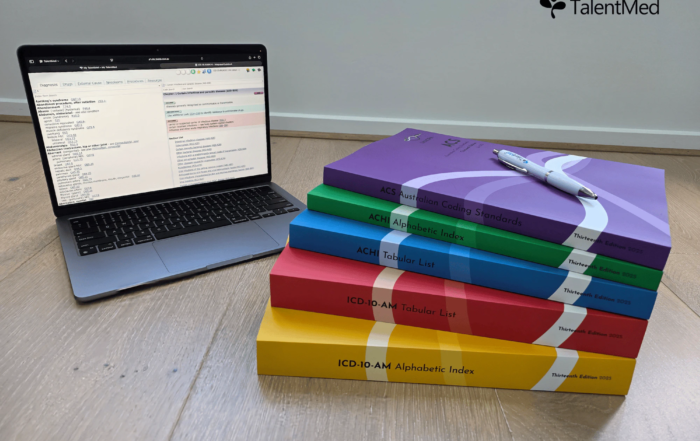
Every admission generates a trail of documentation: doctor’s notes, operation reports, pathology results, medication charts, discharge summaries. The coder reviews that trail against three reference systems.
The coder then assigns a final code set that captures the admission accurately. Those codes roll up into an AR-DRG (Australian Refined Diagnosis Related Group), which determines how much the hospital is paid for that stay under activity-based funding.
“A lot of people don’t know this career exists. When they hear about it, the common response is: that sounds like the job for me, actually.“
Detail-oriented, problem-solving, healthcare-adjacent, often remote, and in high demand.
Do I need a medical background?
No. You don’t need to be a nurse, a doctor, or a previous healthcare worker. Most clinical coding students come from administration, transcription, data entry, or completely unrelated careers. What matters is an interest in medicine, an eye for detail, and the willingness to learn a new technical language.
A previous healthcare qualification can shorten some of the learning curve on anatomy and medical terminology. But the classification systems themselves are new to almost everyone, and people starting from scratch are at no disadvantage.
How do I train to become one?
There is one primary pathway: nationally recognised vocational training. The qualification that meets industry requirements is the HLT50321 Diploma of Clinical Coding, delivered by TalentMed.
Without a nationally recognised qualification you’ll struggle to get past most employer shortlists. Hospitals almost universally require HLT50321 or equivalent as the minimum entry qualification.
The path looks like this:
- 1Enrol in HLT50321. Daily intakes run 365 days a year, start whenever suits you.
- 2Complete the diploma over 12 months at around 15 hours of study per week, 100% online, self-paced.
- 3Apply for entry-level coder roles in public hospital coding departments, private hospital operators, or graduate programs.
- 4Build speed on the job. Reach independent-coder level within 12 months of your first hire.
How long does it take?
From first day of study to first paid coding role, expect:
How much does it cost?
TalentMed offers Australia’s best-value HLT50321 Diploma of Clinical Coding, backed by flexible payment plans so you can study affordably while you work. For current fees and eligibility, see the course page or speak to a course adviser on 1300 737 781.
Options to cover your fees:
How do I get my first coding job?
Most first jobs are entry-level coder positions in public hospital coding departments or at private hospital operators. Remote coding and contract roles are usually only available to coders with at least 12 months of hands-on experience.
Where to look
What can I earn?
Entry-level coders typically start around $87,000 to $96,000 in public hospitals, rising to $101,000 to $111,000 for experienced coders. Senior coders, auditors and educators reach $117,000 to $142,000, and managers or statewide leads earn $148,000 to $158,000 at the top of the scale, per current public-sector awards (Queensland Health EB12, effective 1 September 2025). Private sector rates and contract work vary.
Figures are from the Queensland Public Health Sector Certified Agreement (EB12), effective 1 September 2025. Other states’ public-sector awards and private-sector rates vary. See our Clinical Coder Salary in Australia guide for a detailed breakdown.
What does progression look like?
Most coders reach independent-coder status in the first 12 months, then branch in whichever direction suits. Common paths:
Many coders move into adjacent fields: clinical documentation improvement, health data analysis, case-mix analysis, and quality auditing. Our Diploma of Quality Auditing (Healthcare) is a common next step for coders moving toward audit and governance roles.
Is it the right career for me?
The honest test is whether the actual day-to-day work suits you. Before committing, try these three things:
If you enjoy puzzles, like working independently with structure, are curious about medicine without wanting a clinical role, and want flexibility, the chances are strong this career suits you. If you’re not sure, our Is Clinical Coding Right for You? article walks through the five signs that predict a good fit.
About the HLT50321 Diploma of Clinical Coding
Designed to teach you clinical coding from the ground up, TalentMed’s HLT50321 Diploma of Clinical Coding is your first step towards becoming a qualified clinical coder. This qualification reflects the role of an entry-level coder: using the skills, medical knowledge, and classification fluency above to analyse and code medical records accurately.
Key benefits of the course:
Frequently asked questions
Want to find out more?
Speak to a TalentMed course adviser about HLT50321.
12 months, 100% online, flexible payment plans, daily intakes year-round.