Clinical Coding in Private vs Public Hospitals: Which Suits You?
Post Author:
TalentMed
Working in Clinical Coding
Clinical Coding in Private vs Public Hospitals: Which Suits You?
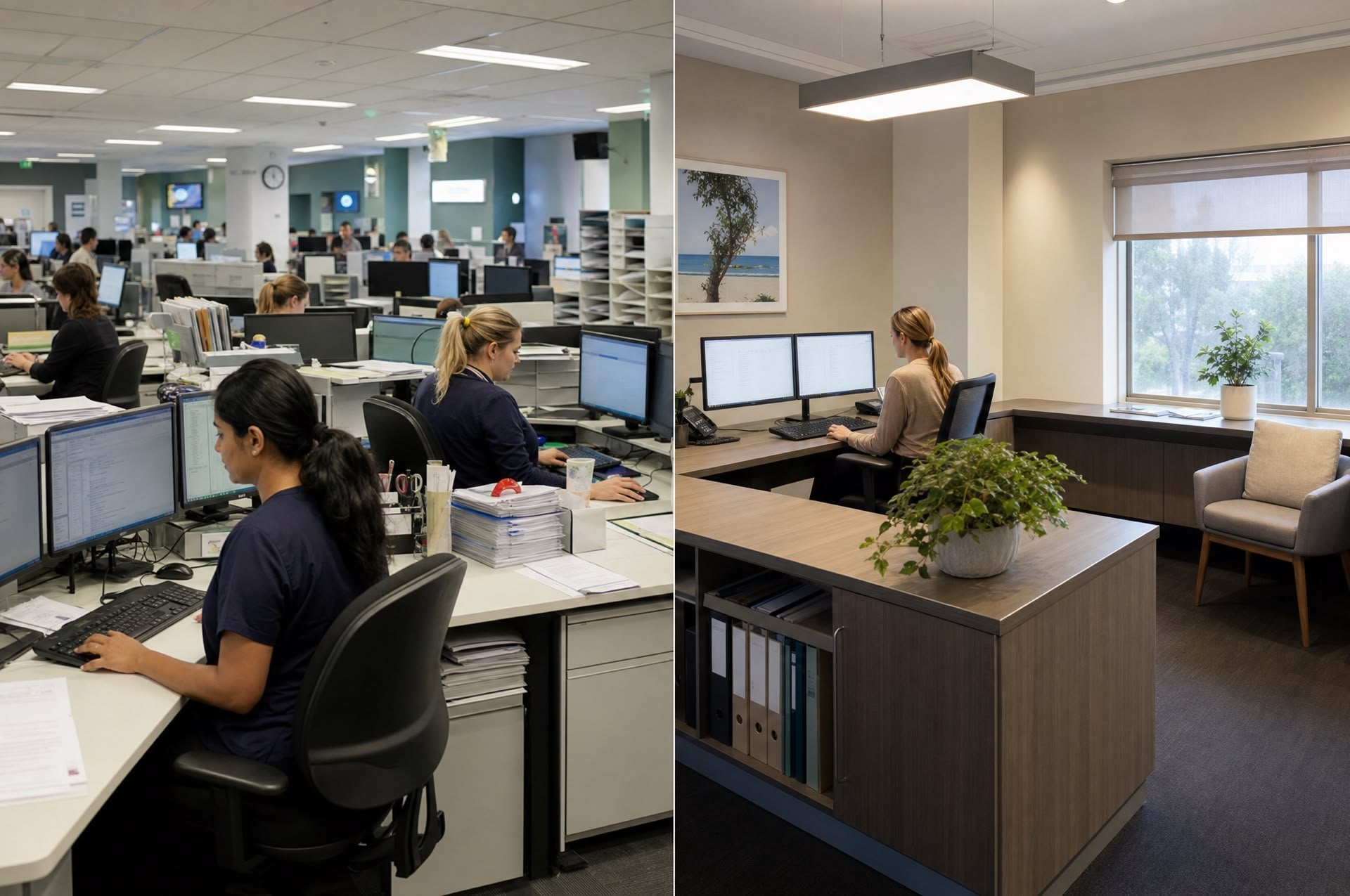
Australia’s dual healthcare system gives clinical coders two different working environments. Public hospitals code the complex, the urgent, and the unfunded; private hospitals code planned surgical and procedural casemix tied closely to insurance billing. Neither is better. They suit different people, and choosing well at the start of your career saves years of drift.
Two worlds in clinical coding: public and private
The work splits along a structural line: public hospitals (state-funded, networked through Local Health Districts and equivalents) and private hospitals (owned by groups like Ramsay, Healthscope, Healthe Care, St John of God, and a tail of independent operators). Coders in both sectors use the same classifications, the same ACS, and the same NCA rulings. What changes is the casemix, the funding logic, the team shape, and the working day.
An HLT50321 Diploma of Clinical Coding from TalentMed RTO 22151 prepares you for either. The course does not push you towards public or private; the choice sits with the graduate. Knowing what each environment is actually like, before you accept a first role, lets you choose with intent rather than by accident of which job came up first.
This article is plain comparison: how each sector funds its work, what kind of cases land on a coder’s desk, what employment looks like, what tools each side uses, and what career trajectories open from each. The closing section is a self-selection framework. For broader context, see clinical coding jobs in Australia, remote clinical coding, and the salary article.
Funding and casemix differences
The single biggest difference between public and private hospital coding is what the codes are paying for. The classifications are the same; the money behind them is not.
Public hospitals are funded through Activity Based Funding (ABF). Each coded episode groups to an AR-DRG (currently AR-DRG v12.0, paired with the 13th Edition classifications), and the state pays the hospital a price tied to the AR-DRG’s National Weighted Activity Unit (NWAU) value, set against the National Efficient Price (NEP) that IHACPA publishes annually. The coder’s accurate selection of principal diagnosis, additional diagnoses, and procedures determines the AR-DRG, which determines what the hospital receives. See clinical coding and hospital funding and AR-DRG explained for the deeper read.
Private hospitals are funded differently. The patient (or their private health insurer) pays the hospital, with most inpatient episodes settled through insurer contracts. Many of those contracts are DRG-based, so coding still drives funding, but the counterparty is the insurer rather than the state. Gap management, prosthesis billing, and excluded-services rules sit on top. The coder’s work feeds a billing process that is closer to a commercial transaction than to a public-sector ABF claim.
What this means day to day:
One myth worth flagging early: private hospital coding is not “easier” because the casemix skews elective. The volume pressure is real, the billing-accuracy stakes are real, and senior private coders are every bit as technical as senior public coders. They just work on different cases under different timelines.
Case-mix complexity
The casemix differences between public and private hospitals are structural, not coincidental. Public hospitals carry the emergency departments, the trauma centres, the ICU and high-dependency volume, and the unfunded admissions that private hospitals do not take. Private hospitals concentrate on planned surgical and procedural work where the funding model rewards predictability.
A rough sketch of what each sector codes:
| Casemix area | Public hospital | Private hospital |
|---|---|---|
| Emergency presentations | Major volume, includes urgent and unplanned admissions | Minimal; most private hospitals do not run a full ED |
| Trauma and multi-injury | Common, particularly at tertiary and quaternary public hospitals | Rare; trauma typically transfers to public |
| ICU and high-dependency | Significant proportion of complex episodes | Present at larger private hospitals but lower volume |
| Elective surgery | Substantial, with longer waitlists | The core of private hospital activity |
| Day-procedure work | Present, often co-located with elective | Major share of throughput |
| Mental health admissions | Major public sector responsibility | Concentrated in dedicated private psychiatric hospitals |
| Obstetrics | Across both sectors; public carries most high-risk and public-patient deliveries | Concentrated in private maternity hospitals; private-patient deliveries |
| Paediatrics | Most paediatric volume sits in public | Selective elective paediatric work |
| Oncology | Major share, particularly inpatient chemotherapy and radiation | Significant in private cancer centres |
The practical effect on a coder’s working day is real. A public hospital coder might move in one shift from a multi-trauma ICU admission to an obstetric delivery to a cardiology workup, applying acute care, maternity, and chronic disease rules in the same morning. A private hospital coder might code thirty elective orthopaedic episodes in a row, going deep on prosthesis billing rules, surgical approach detail, and length-of-stay accuracy.
Public hospitals do not code “better” casemix; they code different casemix because they carry different responsibilities under the Australian system. A coder who enjoys variety and acute-care depth will thrive in public; a coder who enjoys volume, surgical specificity, and a tighter feedback loop on billing will thrive in private. For more on specific complex casemix, see coding injuries and trauma and coding mental health admissions.
Employment conditions comparison
Employment conditions differ between the sectors. The figures below are indicative ranges drawn from public job postings, professional surveys, and industry conversations across 2024 to 2026. They vary by state, employer, individual experience, and time of year. Use them for orientation, not as a guarantee.
| Employment factor | Public hospital | Private hospital |
|---|---|---|
| Entry-level salary (indicative) | $65,000 to $80,000 | $65,000 to $85,000 |
| Senior coder salary (indicative) | $90,000 to $110,000 | $95,000 to $120,000+ |
| Rostering | Predominantly Monday to Friday business hours; some flex around month-end | Monday to Friday; private group networks may offer compressed weeks or hybrid arrangements |
| Team size | Often 10 to 30 coders in larger public hospitals; smaller in regional services | Typically 3 to 15 coders, depending on hospital size and group structure |
| Award and union coverage | State health awards (e.g. NSW Health Service Health Professionals Award), strong union representation through HSU and equivalents | Mixed; some private group enterprise agreements, lower historical union density |
| Career pathways | Structured progression bands within state health services; HIM and audit pathways well-established | Group-level progression (e.g. cross-site senior roles); casemix consulting and audit roles common |
| Job security | Generally strong; public health services are persistent employers | Group-dependent; strong with established hospital groups, more variable with smaller operators |
| Remote work | Hybrid arrangements common in metropolitan public services; fully remote less common in state-funded roles | Hybrid and fully remote more common, particularly with larger private groups and contract coders |
The two sectors pay similarly at entry and at senior level, with private edging higher at the top for coders concentrating on high-volume surgical casemix or moving into group-level roles. The gap is not large; what differs more is the rest of the package. Public hospital coders trade ceiling for stability, defined progression bands, and strong leave entitlements. Private hospital coders trade some of that structure for faster pay reviews, more flexible work arrangements, and a closer connection between individual coding output and the hospital’s revenue picture. Contract auditor and consultant rates regularly exceed both sectors’ salaried tiers; see the career progression article for the full pathway picture.
Tools and technology
The coding software and audit tools used in each sector overlap but tilt differently. Both use ICD-10-AM, ACHI, and the Australian Coding Standards (currently 13th Edition 2025), but the supporting ecosystem differs.
The most visible difference is PICQ. Performance Indicators for Coding Quality (PICQ) screens coded data for likely errors against a published library of indicators. It is widely embedded in public sector audit programs, particularly through state coding audit work (the NSW Coding Audit Program is the most established example). Private hospitals use PICQ less consistently; some groups have adopted it, others rely on internal indicator sets and external consultant audits. What this looks like across the two sectors:
For new coders this matters less than it sounds at year one. Both sectors will train you on whichever coding software they use, and both expect ACS and NCA fluency rather than tool depth. By year three or four, tool familiarity matters more, particularly if you want to move into audit or consulting where PICQ literacy opens specific doors. For broader context on quality tooling, see clinical audit methodology in Australian healthcare and internal versus external healthcare auditor.
Coding volume and KPIs
Productivity measurement differs between the sectors, and it shapes the working day in ways that take a year or two to fully appreciate.
Public hospital KPIs typically focus on episode count per coder per day at a specified accuracy threshold, with audit results feeding back through monthly or quarterly reviews. The expected count depends heavily on casemix. A coder working in ICU coding might handle 12 to 18 episodes per day; a coder on general medical and surgical work might handle 25 to 35. Audit accuracy expectations sit above 95 per cent for DRG-affecting codes.
Private hospital KPIs typically focus on episode count alongside turnaround time, because billing cycles depend on coded data being available within tight windows after discharge. Private hospital coders often work to a turnaround target measured in days (sometimes 48 or 72 hours from discharge). A delay in coding is a delay in billing. Neither environment is more demanding in the abstract; they demand different things:
A useful frame for prospective coders: if the idea of coding 30 elective hip replacements in a day sounds soul-destroying, public hospital work probably suits you better. If the idea of switching between trauma, obstetrics, ICU, and mental health in the same week sounds exhausting, private hospital work probably suits you better. Most coders feel one of those two reactions more strongly than the other.
Career development opportunities
Senior pathways from each sector overlap but have distinct character. Both reward technical depth; the routes through, and the kind of senior coder you become, are not identical.
| Pathway | Public sector strength | Private sector strength |
|---|---|---|
| Senior coder | Strong; broad casemix breadth, ACS fluency built through complex cases | Strong; surgical and procedural depth, tight feedback loop on accuracy and billing |
| Coding manager | Established progression band, often within a Local Health District or state health service | Group-level scope (managing coders across multiple sites in a private group) |
| Health information management | The historic HIM pathway; tertiary-level HIM roles concentrate in larger public services | Present in private groups but less commonly under the HIM title; often blended with billing leadership |
| Casemix consulting | Less common as an internal role; more often consultant-facing engagement | Strong; private groups regularly hire or contract casemix consultants for funding optimisation and billing accuracy |
| Coding audit | Strong; NSW Coding Audit Program and equivalents in other states are major audit employers | Strong; private groups use both internal auditors and external consultancies, generating contract opportunities |
| CCSA leadership | Both sectors are well represented in CCSA committees, working groups, and the annual conference | Both sectors are well represented in CCSA committees, working groups, and the annual conference |
| Coding education and training | Strong, often connected to state health workforce development | Strong, often connected to in-group induction and ongoing accuracy training |
The Clinical Coders’ Society of Australia (CCSA) sits across both sectors, and its CPD framework, certification tiers, and annual conference are recognised regardless of where a coder works. CCSA credentialling is voluntary (clinical coding is not a regulated profession in Australia), but it is widely valued. See the CCSA professional association article and ccsofa.org.au for current requirements.
Casemix consulting is one of the different opportunities in private. Private hospital groups regularly engage consultants to advise on coding accuracy, DRG capture, contract-tier optimisation, and prosthesis billing. The work pays at consultant day rates and is project-shaped rather than employment-shaped. Public sector consultant work exists, but it is more often delivered through state-program engagements or by individuals on secondment.
Health information management (HIM) pathways concentrate in the public sector. Most senior HIM roles in Australian healthcare sit in larger public hospitals and Local Health Districts, and the pathway typically involves a Bachelor of Health Information Management on top of coding experience. Private hospitals have HIM-equivalent roles, but they are often blended with billing or operations leadership rather than carrying a pure HIM title. For the full ladder, see clinical coder career progression in Australia and the adjacent allied health practice management read.
Which suits you?
A self-selection framework is more useful at the start of a career than at year five. Read each of the nine prompts below and notice your reaction. There is no correct answer; the pattern across your nine answers is the point.
Coders who later move between sectors usually start in public and move to private rather than the reverse. The case-mix breadth and ACS depth built in a public role transfers well to private. The opposite direction is possible but often needs deliberate acute-care exposure built through a secondment or a state-program audit role. For a sense of the working day, see a day in the life of an Australian clinical coder.
Frequently asked questions