A Day in the Life of a Clinical Coder
Post Author:
TalentMed

Inside the role
A Day in the Life of a Clinical Coder
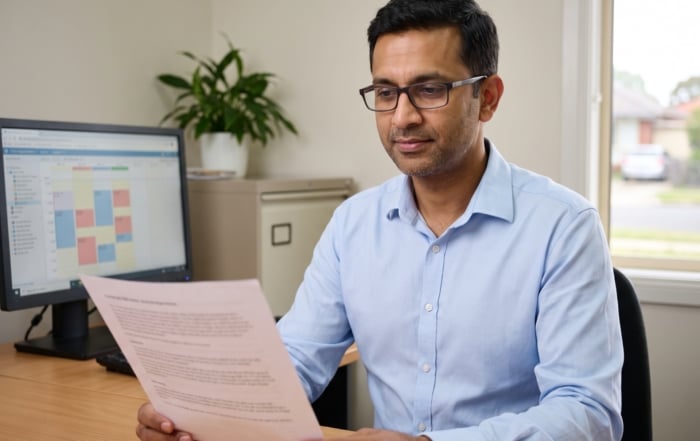
A clinical coder spends the day reading hospital records, assigning ICD-10-AM diagnosis codes and ACHI procedure codes to each admission, querying clinicians when documentation is unclear, and preparing finalised episodes for DRG grouping and audit. Most work quietly at a screen, alone or in a small coding team, from a hospital office or a home desk. This guide walks you through a realistic shift so you can picture the work for yourself.
The rhythm is steady, not frantic. Coders describe their days in terms of queues worked through, not crises handled. If you’re curious whether the day-to-day reality matches the role you’re imagining, The run through.
Morning routine: starting a coding shift
Most coders start their shift between 7:30 and 9:00 am, log in, and pick up a queue of separated admissions waiting to be coded. In a public hospital, that queue is generated by the patient administration system once a patient has been discharged and the medical record is ready. In private hospitals, the same pattern applies, often with tighter turnaround targets driven by billing timelines.
The first half hour is admin housekeeping. Coders check their email for responses to clinician queries they raised the day before. They scan team messages for any changes to coding guidance. They glance at the queue to see what’s in front of them for the day, which might be anything from a straightforward day-surgery list to a complex intensive-care stay spanning several weeks.
By mid-morning the first coffee has landed, the inbox is settled, and the coder picks the first record off the queue. From here the day becomes a rhythm of reading, looking up, assigning, and moving on.
First record of the day
A three-day admission for a planned laparoscopic cholecystectomy. The coder opens the scanned discharge summary, the operation report, the pathology result, and the medication chart. They’re looking for what brought the patient in, what was done, and anything else that affected the care. The first pass is just reading, no coding yet.
Reviewing case notes and patient records
Coders read the full medical record for every admission they code. That includes the discharge summary, the admission notes, the operation reports, pathology and imaging results, progress notes, medication charts, and anything else that documents what happened during the episode.
The goal is to build a clear picture of the principal diagnosis (the main reason the patient was admitted), any additional diagnoses that were treated or managed during the stay, and every procedure that was performed. Coders also watch for complications, adverse drug reactions, and comorbidities that affected care.
Reading records is a skill in itself. Handwriting, abbreviations, and clinician shorthand all take practice. Coders learn to spot what’s relevant, skim what isn’t, and follow the documentation trail when something is mentioned in one place but not confirmed elsewhere. For a straightforward day-surgery episode this might take ten minutes. A long intensive-care stay with multiple complications can take an hour or more.
Assigning ICD-10-AM diagnosis codes
Once the coder understands the episode, they open ICD-10-AM and assign a code for the principal diagnosis and every additional diagnosis that affected care. ICD-10-AM is the Australian modification of the World Health Organization’s International Classification of Diseases, currently at the Thirteenth Edition (2025) in use across Australian hospitals.
The lookup process has a clear shape. The coder starts in the ICD-10-AM Alphabetic Index, looks up the lead term for the condition (often the noun, for example “cholelithiasis” for gallstones), follows any modifiers to the most specific entry, and notes the suggested code. They then turn to the Tabular List and verify the code, reading any inclusion notes, exclusion notes, and instructional flags.
Some diagnoses require more than one code. A dagger-and-asterisk pair, for example, records a condition that has both an underlying cause and a specific manifestation. The Australian Coding Standards (ACS) then tell the coder how to sequence the codes, when to add additional codes, and how to handle complex scenarios like acute-on-chronic conditions or postoperative complications.
For a deeper walkthrough of how the books work together, see ICD-10-AM explained.
Assigning ACHI procedure codes
After diagnoses, the coder turns to procedures. The Australian Classification of Health Interventions (ACHI) is the companion classification to ICD-10-AM and lists every procedure that can be performed in an Australian hospital, from a simple cannulation through to complex cardiac surgery.
The process mirrors the diagnosis workflow. The coder reads the operation report (plus the anaesthetic record and theatre notes where relevant), identifies the procedure performed, looks up the lead term in the ACHI Alphabetic Index, follows it through to the most specific entry, and verifies the seven-digit ACHI code (shown as XXXXX-XX) in the ACHI Tabular List. The ACS again provides guidance on how to handle bilateral procedures, multiple procedures, aborted procedures, and other edge cases.
On a straightforward elective-surgery episode the procedure set is short and clear: the operation, the anaesthesia, and any imaging performed during the stay. On a complex admission there can be a dozen or more procedures to code, each with its own ACHI entry to find and verify.
Querying clinicians for clarification
When documentation is incomplete, ambiguous, or contradictory, the coder raises a clinician query. Queries are the profession’s formal way of asking “what do you mean?” without suggesting an answer. They’re written carefully, attached to the record, and sent to the treating team for a response.
A typical query might ask whether a noted “elevated troponin” reflected a documented cardiac event, whether a postoperative infection was considered a complication, or whether a condition listed in the discharge summary was actively treated during the stay. The clinician reads the query, checks the record, and either clarifies the documentation or confirms no change is needed.
Queries are a sign of good coding, not bad coding. Coders who query thoughtfully are trusted inside a hospital because they protect both the patient record and the hospital’s data integrity. A queue with zero queries is often a sign something is being guessed rather than checked.
A typical query
The discharge summary mentions “AKI” (acute kidney injury) but the progress notes only describe a transient rise in creatinine that resolved. The coder drafts a short query: “Was the AKI actively monitored or treated during this admission?” The query sits with the team until the treating consultant responds.
Grouping and DRG assignment
Once all diagnoses and procedures are coded, the episode is passed to a grouper tool that calculates the Australian Refined Diagnosis Related Group (AR-DRG). The DRG is the classification that determines how the hospital is funded for that episode under activity-based funding arrangements.
In most hospitals the grouper runs automatically on the coded data, so the coder doesn’t calculate the DRG by hand. What the coder does do is confirm the grouped result looks sensible for the episode. A short day-surgery stay should not be generating a high-complexity DRG. A long intensive-care stay should not be grouping as a minor admission. If something looks off, the coder reviews their codes, checks the sequencing, and either re-codes or queries the documentation.
This is where accurate coding becomes financially meaningful. A missed additional diagnosis can shift a DRG from low complexity to high complexity, which can change the funding for that episode by thousands of dollars. Coders aren’t paid to maximise funding, but they are paid to reflect the care that was delivered. When the coding is accurate, the funding follows.
Quality review and audit preparation
A portion of every coder’s week is spent on quality activities. Most coding teams run weekly peer-review sessions where coders swap a sample of recently coded episodes and check each other’s work. Some hospitals also have dedicated coding auditors who sample episodes at random and provide feedback.
Peer review is framed as professional development. The aim is to catch systematic patterns, not to police individual coders. A common finding might be that a particular diagnosis is being under-coded across the team because a new clinical pathway changed the way it gets documented. The fix is a team-wide update, not a reprimand.
Coders also prepare for external audits throughout the year. IHACPA publishes the classifications and the data quality standards, but the coding audits themselves are run by state health departments in public hospitals (programs such as the NSW Coding Audit Program and the Victorian ICD Coding Audits). Private hospitals are audited by their health funds and by internal compliance teams. In either case, the coder’s job is to keep the record defensible: every code traceable to the documentation, every query logged, every edit annotated.
Peer review session
Three coders meet for an hour over video. Each has brought two episodes for discussion, one they found straightforward and one they found tricky. They walk through the coding decisions, compare choices, and discuss any ACS that applied. Nobody is marked right or wrong. The session ends with a shared note in the team’s coding log.
What varies between hospitals, private, and remote roles
The core of the job is the same everywhere, but the setting changes the texture of the day. How three common coding environments differ.
The common thread across all three is the work itself. The queue, the books, the codes, the queries, the peer review. That’s what clinical coding looks like whether you’re in a capital-city tertiary hospital or working from a spare room in regional Victoria.
Is this the kind of day you’d enjoy?
The honest way to find out is to try a real coding task. TalentMed’s free Clinical Coding Challenge takes about 10 minutes. You work through a realistic Australian hospital episode, use the lookup process a working coder uses, and commit to an answer. TNo sign-up and no sales follow-up. If you finish and think “that felt natural”, that’s a strong signal. If you finish and think “that was tedious”, you’ve saved yourself 12 months and a few thousand dollars.
Ready to start training?
If the day described above sounds like your kind of work, the next step is a nationally recognised Diploma. The HLT50321 Diploma of Clinical Coding is TalentMed’s flagship qualification and the one Australian hospitals consistently ask for when hiring entry-level coders. It’s 100% online, self-paced, takes about 12 months, and you can start any day of the year.
Related reading
Explore further
Frequently asked questions
Want to find out more?
Speak to a TalentMed course adviser about HLT50321.
12 months, 100% online, flexible payment plans, daily intakes year-round.