Clinical Coding Course in Australia: The Complete 2026 Guide
Post Author:
TalentMed

The complete 2026 guide
Clinical Coding Course in Australia: The Complete 2026 Guide
Bachelor versus Diploma. Same role, same pay, fraction of the cost and time. A clinical coding course teaches the skills used to translate hospital medical records into the standardised codes that drive Australia’s health funding, statistics, and quality reporting. Two recognised qualifications lead to clinical coder employment in Australia: the Bachelor of Health Information Management (3 years full-time, indicative $30,000 to $45,000) and the Diploma of Clinical Coding HLT50321 (12 months self-paced online, $4,995 at TalentMed). Both lead to the same clinical coder roles. In most entry-to-mid-level coder positions, pay is the same regardless of which qualification opened the door. This guide compares both pathways, walks through what you’ll actually learn in the Diploma, shows what employers are asking for in real Seek job ads, and helps you pick the course that fits.
What clinical coding actually is
Clinical coding is the process of translating the narrative content of a hospital medical record into standardised diagnosis and procedure codes. Every admission, every operation, every documented condition gets a code. Those codes drive Australia’s hospital funding (through Activity-Based Funding and AR-DRGs), national health statistics, quality reporting, and the audits that keep the public and private hospital systems honest.
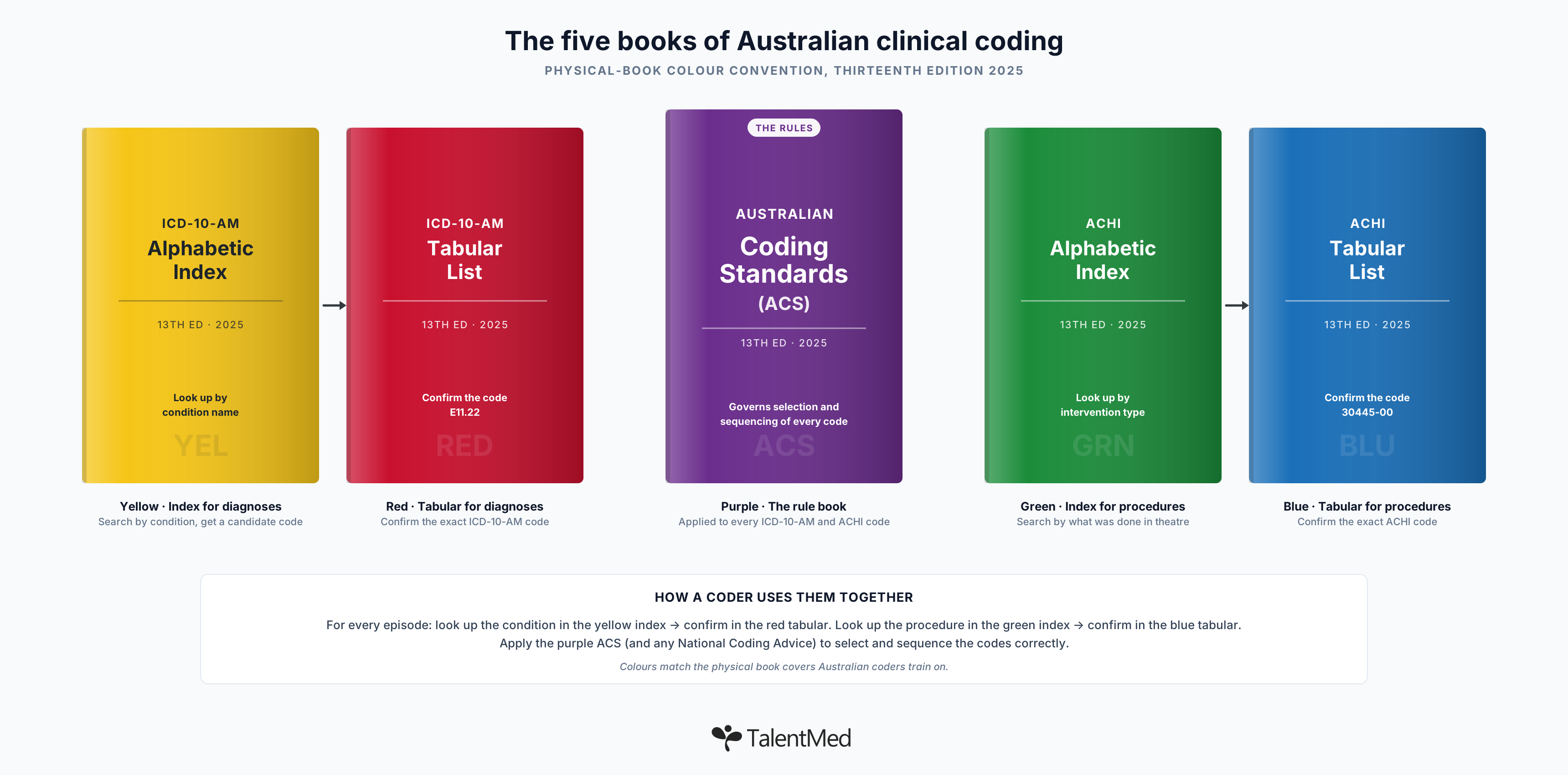
Australian clinical coders use three classifications, all currently in their 13th Edition (2025) and published by IHACPA:
- ICD-10-AM for diagnoses (the Australian Modification of the World Health Organization’s ICD-10)
- ACHI for procedures and interventions (the Australian Classification of Health Interventions)
- Australian Coding Standards (ACS) for the rules that govern how the codes are applied
Coders also navigate National Coding Advice (NCA), published quarterly by IHACPA via the Australian Classification Exchange (ACE) portal, which supplements the standards.
It is a precise, analytical role. Coders work from real medical records, applying the standards to land on the correct code combinations. The codes they produce flow through to hospital revenue, public-health surveillance, and clinical research. Coding accuracy matters because it shapes what hospitals get paid and how Australia understands its own health system.
If you are weighing this as a career, our overview of the clinical coder profession covers what coders actually do day to day.
The two pathways to becoming a clinical coder in Australia
There are two qualifications in Australia that lead to clinical coder employment. Most prospective coders only hear about one of them when they start researching, which costs them years and tens of thousands of dollars. Here is the honest comparison.
| Bachelor of Health Information Management | Diploma of Clinical Coding HLT50321 | |
|---|---|---|
| Duration | 3 years full-time | 12 months self-paced online |
| Indicative cost | $30,000 to $45,000 (varies by university and FEE-HELP eligibility) | $4,995 at TalentMed |
| Curriculum scope | Broad HIM: coding plus data governance, classification systems, health informatics, HIM leadership, statistics, epidemiology | Coding focused: ICD-10-AM, ACHI, ACS, with NCA navigation |
| Delivery | Campus or hybrid | 100% online, daily intakes 365 days a year |
| Entry requirements | Year 12 / ATAR or mature-age entry | None. No medical background required |
| Outcome roles | Clinical coder, plus broader HIM and leadership career path | Clinical coder |
| Government funding | FEE-HELP eligible | Payment plans only (HLT50321 is not VSL-eligible) |
The pay reality
This is the part most articles avoid. In most entry-to-mid-level clinical coder roles, pay is the same regardless of whether the coder holds a Bachelor of Health Information Management or a Diploma of Clinical Coding. Hiring managers assess coding competency, not which qualification opened the door. The role pays for the skill, not the badge.
Senior HIM roles are different. Roles like HIM Manager, Director of Health Information, and Clinical Information Manager typically prefer or require a Bachelor degree plus several years of experience. But those are HIM and management roles, not coding roles. If your goal is to code, the Diploma gets you there faster and cheaper.
You do not need a medical background to study the Diploma. Career-changers, nurses, allied-health professionals, and admin backgrounds all enter the field. The curriculum teaches the medical terminology and anatomy you need from the ground up.
What employers actually want
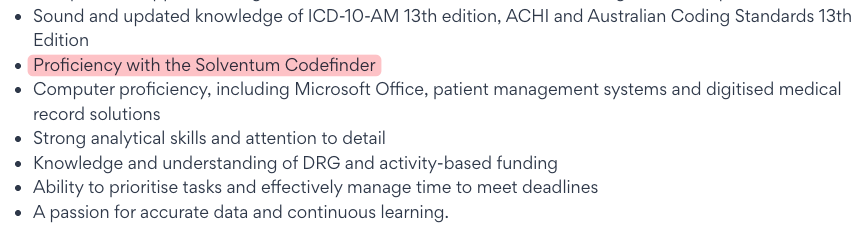
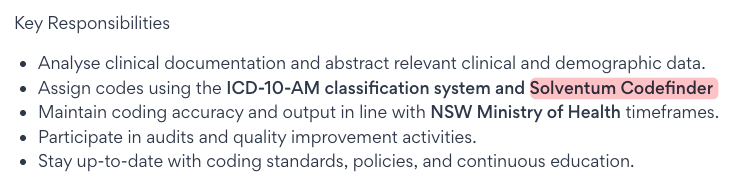
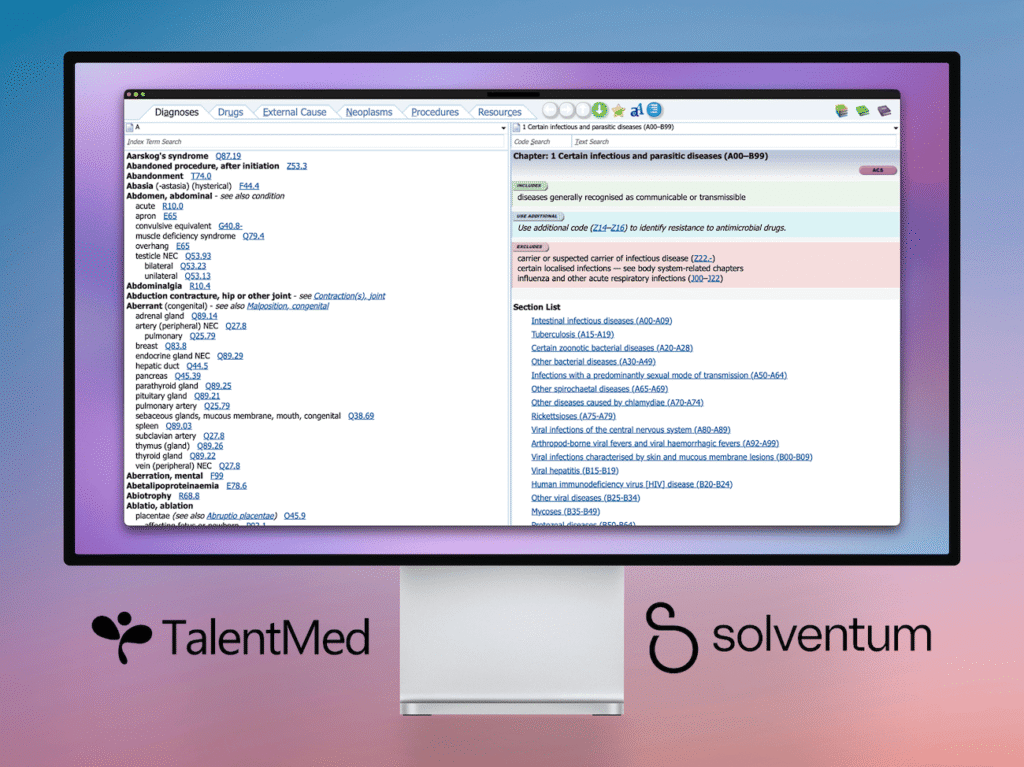
The qualifications above are the inputs. The outputs are the job ads. We pulled four recent listings from Seek to show what hiring managers are actually asking for. Two patterns repeat: Australian employers ask for HLT50321 by code, and many list Solventum Codefinder familiarity (the industry-standard coding software, formerly 3M Codefinder) as a desirable skill.


Two takeaways for prospective students:
- ‘HLT50321’ by code or ‘Diploma of Clinical Coding’ or ‘nationally-recognised Clinical Coding diploma’ is in the ad. Employers know what they want. The full code-and-title is the qualification benchmark for coder hiring across Australia.
- Solventum Codefinder appears across more and more job ads. Coders entering the workforce with hands-on Solventum experience start at billable speed faster than coders who have only seen the printed books.
Both points are addressed in the curriculum walk and the “Why TalentMed” sections below.
What you’ll learn in HLT50321
The Diploma walks you through four phases over 12 months. Each phase builds on the last, and the workplace simulation phase mirrors what coders actually do on day one of their first job.

Phase 1: Foundations
Medical terminology, anatomy, and body systems. The vocabulary every coder needs to read clinical records confidently. If you are coming from a non-medical background, this is where you build the language you will spend the rest of the course (and your career) using.
Phase 2: ICD-10-AM and ACHI
Index lookup, tabular verification, and code structure. You learn to read the books like a working coder reads them: lead-term lookup in the Alphabetic Index, verification in the Tabular List, application of includes and excludes notes, and the procedural conventions that govern ACHI. By the end of this phase you are coding straightforward admissions from end to end.
Phase 3: ACS and NCA
The Australian Coding Standards govern how the codes are applied. National Coding Advice (NCA) supplements the standards with quarterly updates published by IHACPA via the Australian Classification Exchange (ACE) portal. This phase teaches you to navigate both: which standard governs which scenario, when an NCA overrides a default, and how to keep current as the rules evolve.
Phase 4: Workplace simulation
Real coding scenarios, delivered through TalentMed’s coding-assessment LMS. (Note: TalentMed’s internal LMS-based coding-assessment tool is distinct from Solventum Codefinder, the industry product covered below.) Every assessment scenario is graded against the same standards used in workplace audits. By the end of this phase you have coded enough realistic admissions to walk into your first coder job knowing what to expect.
Audited from day one
Worth saying directly: clinical coders’ work is reviewed against ACS and NCA from the first day of their first job. Every state runs its own coding audit program (NSW Coding Audit Program, Victorian ICD Coding Audits, and Queensland equivalents) and every hospital coding department has internal review. The Diploma teaches that discipline directly, so the audit-readiness you bring to your first job is real, not theoretical.
For a deeper walk through ICD-10-AM, see our ICD-10-AM explainer. For ACHI, see ACHI explained. For the standards and NCA, see Australian Coding Standards: what every coder needs to know and our National Coding Advice guide.
What to look for in a clinical coding course
Six criteria separate a course that gets you employed from one that wastes a year. Apply these to any provider you are considering.
HLT50321 delivered by TalentMed meets all six. The next section walks through what is specific to TalentMed.
Why TalentMed for HLT50321
Four differentiators. Take them one at a time.
Provider cost spread for HLT50321
Indicative pricing across Australian providers, as of 2026. Pricing varies; check the live course page for current TalentMed pricing.
| Provider type | Indicative HLT50321 tuition |
|---|---|
| University-delivered Diploma | ~$9,000 |
| Other private RTO Diploma | ~$7,000 |
| TalentMed HLT50321 | $4,995 |
Realistic costs and payment options
Four pathways cover most students. Current pricing for each option lives on the course page.
- Pay upfront. Single tuition fee on enrolment. The simplest path if you have the funds available.
- ZipMoney. Up to 12 months interest-free, with weekly, fortnightly, or monthly repayments chosen by the student. Application and approval sit with ZipMoney under their terms.
- Employer-funded study. Many hospitals, GP practices, transcription companies, and allied-health providers use professional development budgets to sponsor staff upskilling. Ask your employer directly. We can provide a letter of support.
HLT50321 is not eligible for VET Student Loans. The Diploma of Practice Management HLT57715 is the TalentMed course that has VSL approval. For HLT50321, the four paths above are the routes.
Career outcomes after the Diploma
Graduates enter as Coder Trainees or Junior Coders. Most reach billable speed (the throughput hospitals expect from a working coder) within 3 to 6 months of supervised coding. Salary, progression, and workplace settings are covered in the supporting articles below rather than duplicated here.
- Clinical coder salary in Australia: what to expect in 2026
- Clinical coder career pathway: junior to consultant
- A day in the life of a clinical coder
- Remote clinical coding in Australia: the complete guide
- Clinical coding jobs in Australia: where they are and how to land one
Once you are working, the Clinical Coders’ Society of Australia (CCSA) offers voluntary professional recognition: CPD, networking, mentoring, and forum access. Membership is not required to work as a coder, but most coders join for the support and the standards updates.
Frequently asked questions
On this page
HLT50321
Diploma of Clinical Coding
- 12 months. 100% online. Self-paced.
- Daily intakes 365 days a year
- Solventum Codefinder optional add-on
- Australia’s best-value Diploma
Talk to a course adviser
Book a 15-minute call
Get answers to your specific situation. No pressure, no sales pitch.
Try the work
Free Clinical Coding Challenge
10 real coding scenarios. See how clinical coding actually works before you commit to the course.
Healthcare career news
Subscribe for monthly insights on clinical coding, course updates, and industry trends.