Cardiovascular System Medical Terminology: A Deep Reference
Post Author:
TalentMed
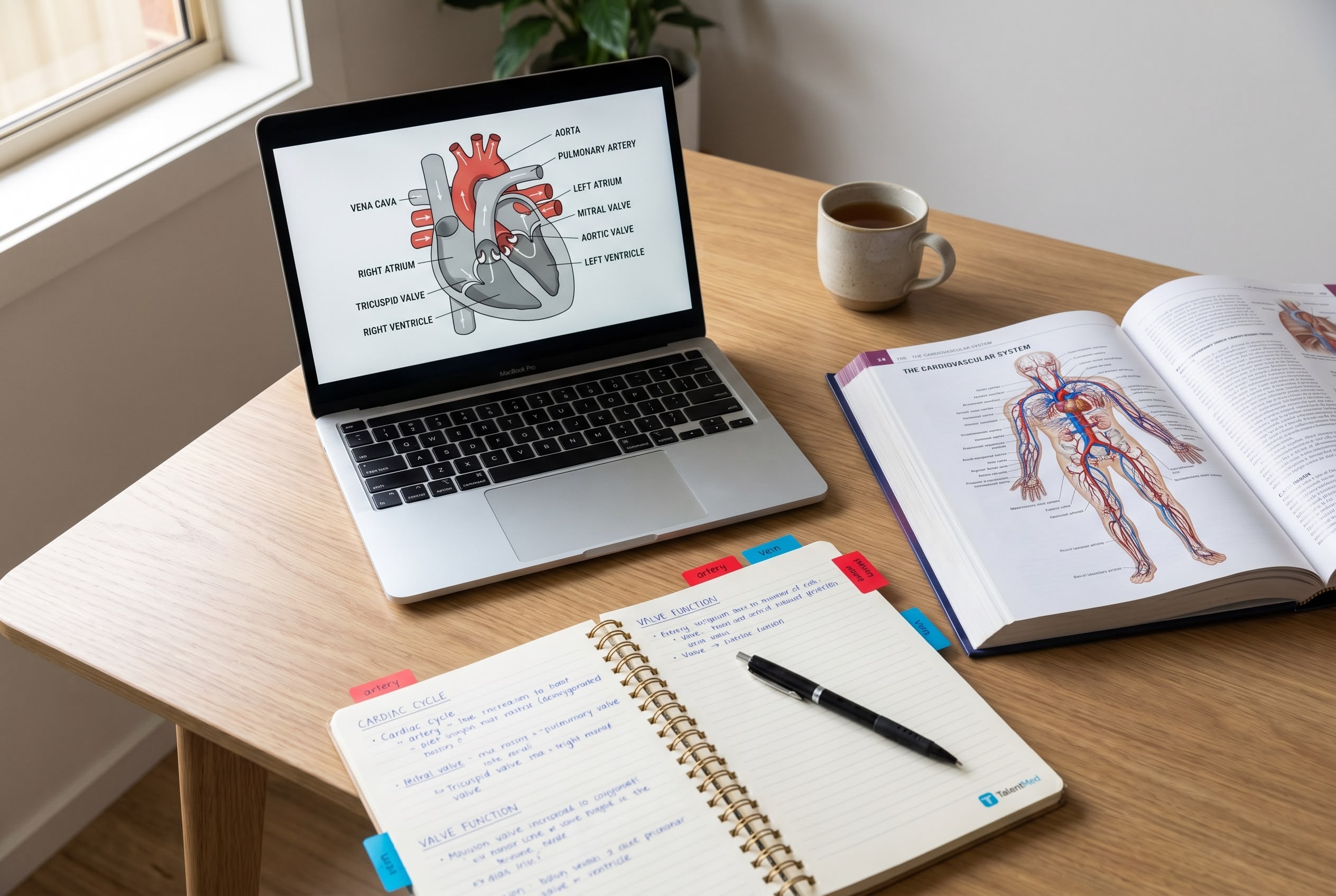
The Deep Reference
Cardiovascular System Medical Terminology: A Deep Reference
The cardiovascular system carries the heaviest concentration of specialised vocabulary in clinical practice. Heart anatomy, vessel anatomy, conduction physiology, ischaemic and structural conditions, interventional procedures, and a long list of drug classes all share a tight family of Greek and Latin roots. Once you can decode cardi-, angi-, arteri-, ven-, athero- and thromb-, every cardiology report becomes more readable.
This reference goes deeper than a general body-system list. It pairs anatomy with physiology, builds a working table of cardiovascular prefixes, roots and suffixes, then walks through the most common conditions, procedures and drug classes you will meet in admission notes, operation reports, discharge summaries, MBS billing and pathology results across Australian healthcare. Use it as a study companion and as a quick lookup.
Cardiovascular system at a glance
The cardiovascular system is a closed circuit: the heart pumps blood through arteries, capillaries and veins to every tissue and back. Think of it as four interlocking parts.
For a broader treatment of how cardiovascular roots fit alongside the other body systems, see medical terms by body system. The pillar at medical terminology covers the framework that ties this reference together.
Anatomy: heart and vessels terminology
Heart anatomy clusters around chambers, valves, layers and vessels. Knowing the correct name for each part lets you read echocardiogram reports, surgical operation notes and pathology reports without guessing.
Heart chambers and walls
| Term | Meaning | Where you meet it |
|---|---|---|
| atrium (plural: atria) | upper chamber that collects returning blood | echocardiogram reports, ECG findings (atrial fibrillation, atrial enlargement) |
| ventricle | lower chamber that pumps blood out | echo, cardiac MRI, heart-failure documentation |
| septum (interatrial, interventricular) | wall between left and right chambers | congenital defect documentation (atrial septal defect, ventricular septal defect) |
| endocardium | inner lining of the heart and valves | endocarditis (valve infection) |
| myocardium | muscular middle layer (the heart muscle) | myocardial infarction, myocarditis, cardiomyopathy |
| pericardium | outer fibrous sac enclosing the heart | pericarditis, pericardial effusion, pericardiocentesis |
| apex | pointed lower tip of the heart | apex beat, apical four-chamber view on echo |
| base | upper, broader portion where great vessels attach | anatomical descriptions, cardiac imaging |
Heart valves
| Valve | Position | Common conditions |
|---|---|---|
| tricuspid valve | between right atrium and right ventricle | tricuspid regurgitation, Ebstein anomaly |
| pulmonary valve (pulmonic) | between right ventricle and pulmonary artery | pulmonary stenosis, pulmonary regurgitation |
| mitral valve (bicuspid) | between left atrium and left ventricle | mitral stenosis, mitral regurgitation, mitral valve prolapse |
| aortic valve | between left ventricle and aorta | aortic stenosis, aortic regurgitation, bicuspid aortic valve |
Major vessels
| Vessel | Carries | Notes |
|---|---|---|
| aorta | oxygenated blood from left ventricle to body | largest artery; thoracic and abdominal sections |
| coronary arteries | oxygenated blood to the heart muscle itself | left main, left anterior descending (LAD), left circumflex, right coronary artery (RCA) |
| pulmonary arteries | deoxygenated blood from right ventricle to lungs | only arteries that carry deoxygenated blood |
| pulmonary veins | oxygenated blood from lungs to left atrium | only veins that carry oxygenated blood |
| superior vena cava (SVC) | deoxygenated blood from upper body to right atrium | central venous catheter target |
| inferior vena cava (IVC) | deoxygenated blood from lower body to right atrium | commonly imaged for volume status |
| arteriole | small artery feeding the capillary bed | main site of peripheral vascular resistance |
| capillary | microscopic exchange vessel | where oxygen, carbon dioxide and nutrients cross |
| venule | small vein draining the capillary bed | first step in venous return |
Physiology: how the heart works (key terms)
Cardiovascular physiology vocabulary describes the cycle of contraction and relaxation, how the conducting system fires, and how clinicians measure performance. These are the terms you meet in cardiology consults, ICU charts and exercise testing reports.
Cardiac cycle and performance
| Term | Meaning |
|---|---|
| systole | the contraction phase, when the ventricles eject blood |
| diastole | the relaxation phase, when the ventricles refill |
| preload | the volume in the ventricle at the end of filling (end-diastolic volume) |
| afterload | the resistance the ventricle pumps against (mainly aortic pressure) |
| stroke volume (SV) | volume of blood ejected with each beat |
| cardiac output (CO) | stroke volume multiplied by heart rate; total flow per minute |
| ejection fraction (EF) | percentage of end-diastolic volume ejected each beat; key heart-failure measure |
| contractility | intrinsic force of myocardial contraction |
| blood pressure (systolic / diastolic) | arterial pressure during contraction and relaxation; measured in mmHg |
| pulse pressure | difference between systolic and diastolic pressure |
| mean arterial pressure (MAP) | average pressure during one cardiac cycle; perfusion driver |
Conducting system and rhythm terms
| Term | Meaning |
|---|---|
| sinoatrial (SA) node | natural pacemaker in the right atrium |
| atrioventricular (AV) node | secondary pacemaker between atria and ventricles |
| bundle of His, Purkinje fibres | conducting fibres that carry the impulse through the ventricles |
| tachycardia | fast heart rate (over 100 beats per minute in adults) |
| bradycardia | slow heart rate (under 60 beats per minute in adults) |
| arrhythmia (dysrhythmia) | any abnormality of rhythm or rate |
| fibrillation | uncoordinated quivering of cardiac muscle |
| flutter | rapid but more organised rhythm than fibrillation |
| palpitation | patient-reported awareness of heartbeat (a symptom, not a diagnosis) |
| asystole | absence of cardiac electrical activity |
| sinus rhythm | normal rhythm originating from the SA node |
Common cardiovascular prefixes, roots and suffixes
This is the working table. Each entry decodes a slice of cardiology vocabulary. Pair these with general prefixes and suffixes (covered in common medical prefixes and suffixes) and most cardiology reports become readable.
Cardiovascular roots
| Root | Meaning | Example term | Example meaning |
|---|---|---|---|
| cardi-, cardio- | heart | cardiomegaly | enlargement of the heart |
| angi-, angio- | vessel (blood or lymph) | angiogram | imaging study of blood vessels |
| vas-, vasculo-, vaso- | vessel, duct | vasoconstriction | narrowing of a blood vessel |
| arteri-, arterio- | artery | arteriosclerosis | hardening of the arteries |
| ather-, athero- | fatty plaque, porridge-like deposit | atherosclerosis | plaque-driven hardening of the arteries |
| phleb-, phlebo- | vein (Greek) | phlebotomy | incision into a vein, blood draw |
| ven-, veno- | vein (Latin) | venous thromboembolism | clot formation in the venous system |
| atri-, atrio- | atrium (upper heart chamber) | atrioventricular | relating to the atria and ventricles |
| ventricul-, ventriculo- | ventricle (lower heart chamber) | ventriculography | imaging of a heart ventricle |
| aort-, aorto- | aorta | aortic stenosis | narrowing of the aortic valve |
| haemat-, haemato-, haemo- | blood | haematology | study of the blood and its disorders |
| thromb-, thrombo- | clot | thrombosis | formation of a blood clot in a vessel |
| embol-, embolo- | plug, travelling obstruction | embolism | sudden vessel blockage by a travelling clot or particle |
| isch-, ischo- | holding back, restriction | ischaemia | insufficient blood supply to tissue |
| steth-, stetho- | chest | stethoscope | instrument for listening to chest sounds |
| sphygm-, sphygmo- | pulse | sphygmomanometer | blood pressure cuff (pulse-pressure measurer) |
Cardiovascular prefixes and suffixes
| Affix | Meaning | Example term | Example meaning |
|---|---|---|---|
| tachy- | fast | tachycardia | abnormally fast heart rate |
| brady- | slow | bradycardia | abnormally slow heart rate |
| endo- | inside, within | endocarditis | inflammation of the inner heart lining |
| peri- | around | pericarditis | inflammation of the sac around the heart |
| myo- | muscle | myocarditis | inflammation of heart muscle |
| hyper- | excessive, high | hypertension | high blood pressure |
| hypo- | deficient, low | hypotension | low blood pressure |
| -itis | inflammation | vasculitis | inflammation of a blood vessel |
| -ectomy | surgical removal | endarterectomy | surgical removal of plaque from inside an artery |
| -otomy | surgical incision | thoracotomy | surgical incision into the chest wall |
| -ostomy | creation of an opening | colostomy (general term) | creation of a stoma; not cardiovascular but uses the same suffix |
| -graphy | recording, imaging | angiography | imaging of blood vessels |
| -gram | recorded image or tracing | electrocardiogram | recorded tracing of the heart’s electrical activity |
| -plasty | surgical repair, reshaping | angioplasty | repair or widening of a blood vessel |
| -pathy | disease | cardiomyopathy | disease of the heart muscle |
| -megaly | enlargement | cardiomegaly | enlargement of the heart |
| -stenosis | narrowing | aortic stenosis | narrowing of the aortic valve |
| -sclerosis | hardening | atherosclerosis | plaque-driven hardening of arteries |
| -emia, -aemia | blood condition | anaemia | low haemoglobin or red cell count in the blood |
| -rrhage, -rrhagia | excessive bleeding | haemorrhage | active or excessive bleeding |
Common conditions (with abbreviation references)
Cardiology has a heavy abbreviation load. The same condition is often written as a full term in admission notes and as an abbreviation in handover sheets, ward round summaries and discharge documents. Knowing both forms cuts decoding time. For the broader abbreviation reference, see medical abbreviations list and the warning list in dangerous abbreviations.
Ischaemic heart disease and acute coronary syndrome
| Term / abbreviation | Meaning |
|---|---|
| coronary artery disease (CAD) | narrowing of the coronary arteries by atherosclerotic plaque |
| ischaemic heart disease (IHD) | umbrella term for reduced coronary blood flow; overlaps with CAD |
| angina pectoris | chest pain from transient myocardial ischaemia, typically on exertion |
| unstable angina | angina at rest or rapidly worsening; an acute coronary syndrome |
| acute coronary syndrome (ACS) | umbrella term covering unstable angina, NSTEMI and STEMI |
| myocardial infarction (MI) | death of heart muscle tissue from prolonged ischaemia (heart attack) |
| acute myocardial infarction (AMI) | recently occurred or in-progress MI |
| ST-elevation MI (STEMI) | MI with ST-segment elevation on ECG; full-thickness myocardial damage |
| non-ST-elevation MI (NSTEMI) | MI without ST elevation; partial-thickness damage |
| silent ischaemia | ischaemia without typical chest pain (common in diabetes, in older patients) |
Heart failure and structural disease
| Term / abbreviation | Meaning |
|---|---|
| heart failure (HF) | inability of the heart to pump enough blood for the body’s needs |
| congestive heart failure (CHF) | heart failure with fluid build-up (oedema, pulmonary congestion) |
| HFrEF | heart failure with reduced ejection fraction |
| HFpEF | heart failure with preserved ejection fraction |
| cardiomyopathy | disease of the heart muscle (dilated, hypertrophic, restrictive) |
| myocarditis | inflammation of the heart muscle |
| endocarditis | infection or inflammation of the heart valves and inner lining |
| pericarditis | inflammation of the sac around the heart |
| pericardial effusion | fluid collection between the heart and pericardium |
| cardiac tamponade | compression of the heart by a large pericardial effusion |
| valvular heart disease | disease of one or more heart valves (stenosis or regurgitation) |
| congenital heart disease | structural heart abnormalities present at birth (ASD, VSD, tetralogy of Fallot) |
Rhythm disturbances
| Term / abbreviation | Meaning |
|---|---|
| atrial fibrillation (AF) | chaotic, uncoordinated atrial activity; irregular ventricular response |
| atrial flutter | rapid but organised atrial rhythm, often with a sawtooth ECG pattern |
| supraventricular tachycardia (SVT) | tachycardia originating above the ventricles |
| ventricular tachycardia (VT) | tachycardia originating in the ventricles; potentially life-threatening |
| ventricular fibrillation (VF) | chaotic ventricular activity; cardiac arrest if untreated |
| heart block (1st, 2nd, 3rd degree) | delayed or blocked conduction at the AV node |
| bundle branch block (LBBB, RBBB) | conduction block in the left or right bundle of His |
| premature ventricular complex (PVC) | extra beat from the ventricles, often felt as a skipped beat |
| long QT syndrome | prolonged QT interval on ECG, predisposing to dangerous arrhythmia |
Vascular and thromboembolic conditions
| Term / abbreviation | Meaning |
|---|---|
| hypertension (HTN) | persistently elevated blood pressure |
| hypotension | abnormally low blood pressure |
| atherosclerosis | plaque-driven hardening and narrowing of arteries |
| peripheral arterial disease (PAD) | atherosclerotic narrowing of arteries to the limbs |
| aneurysm | localised ballooning of an artery wall (commonly aortic) |
| aortic dissection | tear in the inner aortic wall with blood entering between layers |
| deep vein thrombosis (DVT) | clot in a deep vein, usually of the leg |
| pulmonary embolism (PE) | clot lodged in a pulmonary artery, typically broken off from a DVT |
| varicose veins | dilated, tortuous superficial veins, usually of the legs |
| chronic venous insufficiency | impaired venous return causing oedema and skin changes |
| cerebrovascular accident (CVA) | stroke; ischaemic or haemorrhagic |
| transient ischaemic attack (TIA) | brief stroke-like episode that resolves without infarct |
Common procedures and interventions
Cardiovascular procedures fall into three buckets: imaging, percutaneous (catheter-based) interventions, and open surgery. Knowing the suffix tells you which bucket: -graphy, -gram for imaging; -plasty, -ablation, stent placement for percutaneous; -ectomy, bypass for surgery.
Diagnostic and imaging procedures
| Procedure | What it shows |
|---|---|
| electrocardiogram (ECG, EKG) | tracing of the heart’s electrical activity at rest |
| echocardiogram (echo, TTE) | ultrasound of the heart; transthoracic by default |
| transoesophageal echocardiogram (TOE, TEE) | echo via a probe in the oesophagus, behind the heart |
| exercise stress test | ECG monitoring during exercise to look for ischaemia |
| stress echocardiogram | echo before and after exercise or pharmacological stress |
| Holter monitor | continuous 24 to 48 hour ECG recording |
| event monitor / loop recorder | ECG device worn for weeks to capture intermittent arrhythmia |
| coronary angiography | invasive imaging of the coronary arteries via cardiac catheter |
| CT coronary angiography (CTCA) | non-invasive CT imaging of the coronary arteries |
| cardiac MRI | magnetic resonance imaging of cardiac structure and function |
| nuclear myocardial perfusion scan | radionuclide imaging of myocardial blood flow |
Percutaneous (catheter-based) interventions
| Procedure | What it does |
|---|---|
| percutaneous coronary intervention (PCI) | catheter-based opening of a narrowed coronary artery |
| angioplasty | balloon dilatation of a narrowed vessel |
| coronary stent placement | insertion of a metal mesh tube to keep an artery open |
| cardiac catheterisation | insertion of a catheter into the heart chambers or coronary arteries |
| electrophysiology study (EPS) | catheter mapping of the heart’s electrical pathways |
| catheter ablation | radiofrequency or cryo destruction of arrhythmia-generating tissue |
| cardioversion | restoration of normal rhythm by electrical shock or medication |
| transcatheter aortic valve implantation (TAVI) | catheter-based replacement of the aortic valve |
| pacemaker insertion | implantation of a device that stimulates a slow or blocked heart |
| implantable cardioverter defibrillator (ICD) | implanted device that detects and treats dangerous arrhythmias |
Surgical procedures
| Procedure | What it does |
|---|---|
| coronary artery bypass graft (CABG) | surgical bypass of blocked coronary arteries with a graft vessel |
| valve replacement (aortic, mitral) | open-heart replacement of a diseased valve with a mechanical or tissue valve |
| valvuloplasty / valve repair | surgical or catheter-based repair of a valve |
| endarterectomy (carotid, peripheral) | open removal of plaque from inside an artery |
| aortic aneurysm repair (open, EVAR) | surgical or endovascular repair of an aortic aneurysm |
| pericardiocentesis | needle drainage of fluid from the pericardial sac |
| thrombectomy | removal of a clot from a vessel (mechanical or surgical) |
| heart transplant | replacement of the diseased heart with a donor heart |
Pharmacology basics for cardiovascular care
Cardiology medications cluster into a small number of classes that you meet again and again in admission notes, discharge summaries and MBS billing. Knowing the class tells you what the drug is doing, even when the brand name is unfamiliar.
Major drug classes
| Class | What they do | Common examples (generic names) |
|---|---|---|
| antihypertensives (umbrella term) | lower blood pressure | multiple classes below |
| ACE inhibitors | block angiotensin-converting enzyme; lower blood pressure, support failing heart | perindopril, ramipril, enalapril (suffix -pril) |
| angiotensin II receptor blockers (ARBs) | block angiotensin II receptors; similar effect to ACE inhibitors | candesartan, irbesartan, telmisartan (suffix -sartan) |
| beta blockers | block beta-adrenergic receptors; slow heart rate, lower BP, reduce angina | metoprolol, atenolol, bisoprolol (suffix -olol) |
| calcium channel blockers (CCBs) | block calcium influx; lower BP, reduce angina, control rate in AF | amlodipine, diltiazem, verapamil |
| diuretics | increase urine output; reduce volume and BP, treat heart failure congestion | frusemide (loop), hydrochlorothiazide (thiazide), spironolactone (potassium-sparing) |
| nitrates | dilate veins and coronary arteries; relieve angina | glyceryl trinitrate (GTN), isosorbide mononitrate |
| antiplatelets | reduce platelet aggregation; prevent arterial clots | aspirin, clopidogrel, ticagrelor |
| anticoagulants | slow the clotting cascade; prevent venous and atrial-fibrillation clots | warfarin, apixaban, rivaroxaban, dabigatran, heparin (IV/sc) |
| statins (HMG-CoA reductase inhibitors) | lower LDL cholesterol; reduce atherosclerotic risk | atorvastatin, rosuvastatin, simvastatin (suffix -statin) |
| antiarrhythmics | restore or maintain normal rhythm | amiodarone, flecainide, sotalol, digoxin |
| positive inotropes | increase contractility in acute settings | dobutamine, milrinone, adrenaline |
Class-by-class shorthand: -pril ACE inhibitors, -sartan ARBs, -olol beta blockers, -statin statins, -dipine calcium channel blockers (one subclass), -pine appears in some others. Suffix patterns are not perfectly consistent across all drug classes, but for cardiology they are a strong first hint.
Where you’ll see this terminology in practice
Cardiovascular vocabulary is one of the highest-frequency families in Australian healthcare admin and clinical work. The same terms surface across very different roles.
Other surfaces where this vocabulary shows up:
For a study plan that builds cardiovascular vocabulary in context, see how to learn medical terminology and the quick-reference medical terminology cheat sheet. The plurals reference at medical plurals and pronunciation guide covers tricky forms (atria, ventricles, embolus / emboli, thrombus / thrombi, septa). For body-position terms (anterior, posterior, lateral, medial) used in cardiology imaging reports, see anatomical position and directional terms.
Frequently asked questions
Want to find out more?
Enter your details below to receive a free information pack instantly.