Work From Home Careers in Australia: A Practical Guide for 2026
Post Author:
TalentMed
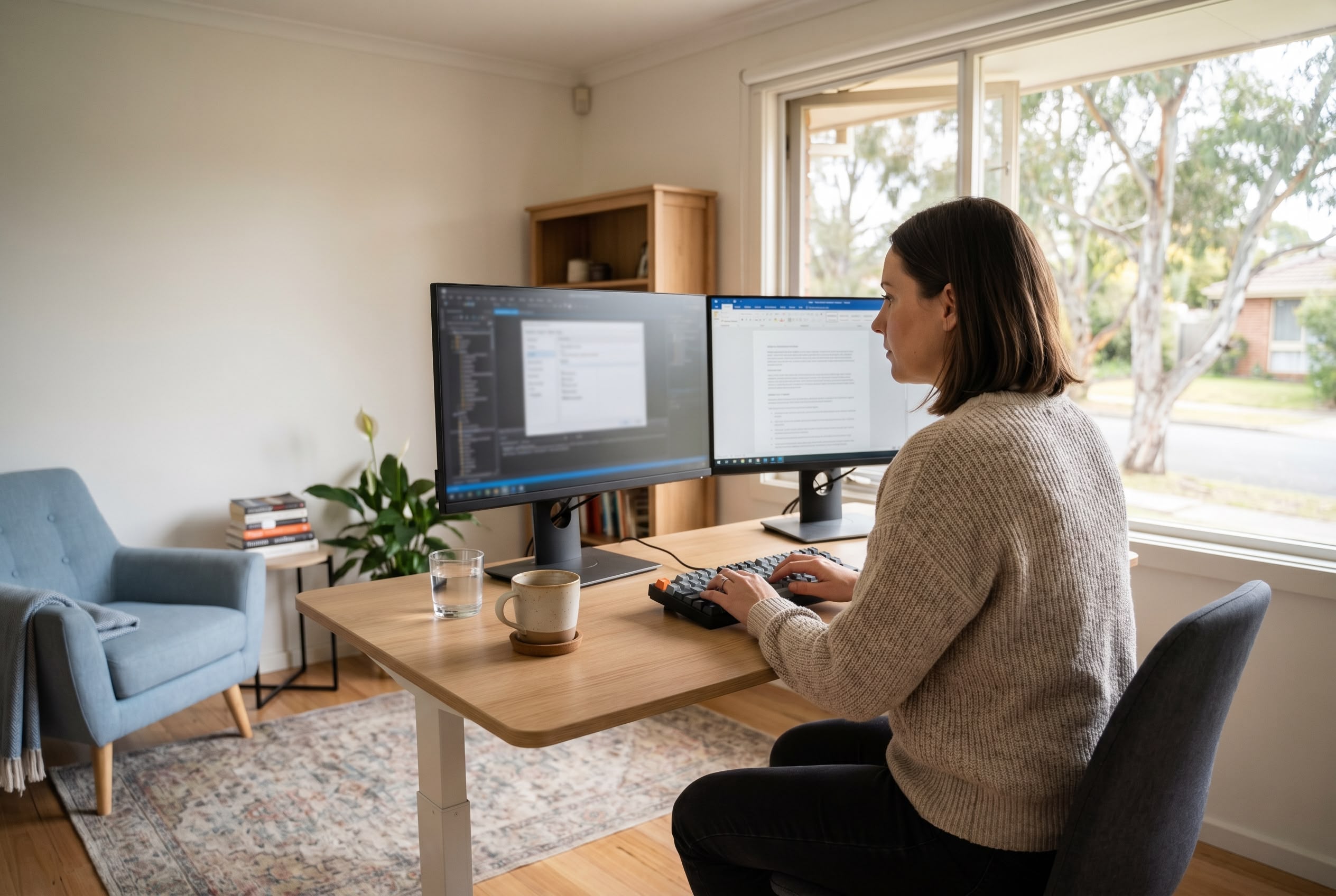
Work from Home Careers
Work From Home Careers in Australia: A Practical Guide for 2026
Most “work from home jobs Australia” articles list survey sites and gig platforms. The pay is low, the work is unstable, and the skills do not compound. A different path is to invest in a real, portable skill that earns more each year. This guide separates WFH gigs from WFH careers, sets out the properties of a sustainable remote career, and walks through medical transcription and clinical coding, two of the cleanest examples in Australia. Both are 100% remote-compatible by design, both reward speed and accuracy with permanently higher pay, and both are nationally recognised diploma pathways at TalentMed. Read this if you want a career, not a side hustle.
The phrase “work from home” stopped meaning anything specific somewhere around 2022. It now covers everything from a $4-per-hour survey site to a senior software engineer earning $180,000 from a home office in Hobart. The useful question is not whether a job can be done from home, because almost any office job can. The useful question is whether the job is built around remote work, pays a real wage, and gives you a skill that grows over time.
This guide takes that question seriously. It is written by an Australian registered training organisation that delivers two of the cleanest remote-compatible career paths in healthcare administration. For the broader career view of medical transcription, read the pillar guide on Medical Transcription in Australia. For the parallel pathway in clinical coding, read Clinical Coding in Australia.
The 2026 reality of working from home in Australia
Working from home in Australia in 2026 is normal, fragmented and quite different from the COVID-era picture. About one in three employed Australians does some of their work from home in a typical week, but the experience varies wildly between salaried hybrid roles, remote-first contractors, gig platforms, and skilled solo practitioners. Knowing where the legitimate WFH careers sit in that picture is the first useful step.
A few things have changed since 2020 that are worth naming out loud:
The thesis of this guide is simple. The bottom of the WFH market is crowded, low-paid, and getting more competitive every year. The top is heavily gated by experience. The best path for most people who do not already have a senior remote role is to invest 6 to 12 months building a real, portable skill that earns from home for the next 10 to 20 years.
WFH gigs versus WFH careers: the framing that matters
Most “work from home jobs” articles conflate two very different things: WFH gigs and WFH careers. They have different inputs, different income trajectories, and almost nothing else in common except the location of the desk. The single most useful question to ask yourself is which one you actually want.
| WFH gig | WFH career |
|---|---|
| Pay set by a platform or a low-bid market | Pay set by your skill, accuracy and speed |
| Income flat. The same gig pays the same in year 5 as year 1. | Income compounds. Year 2 typically pays 40 to 80% more than year 1 at the same hours. |
| Skill is platform-specific or low-skill (clicks, micro-tasks, basic admin) | Skill is portable, recognised, and yours forever |
| Time-to-first-dollar in days or weeks | Time-to-first-dollar in 6 to 12 months |
| Time-to-meaningful-income often never | Time-to-meaningful-income usually 12 to 18 months |
| Low risk, low ceiling. You will be in the same income position next year. | Higher upfront investment, far higher ceiling. Pay grows with the years. |
| Suits people who need a few extra dollars now and have no time horizon | Suits people who can invest 6 to 12 months for the next 10 to 20 years of remote income |
This is not a moral judgement. Survey sites and microtask platforms serve a purpose. People recovering from a major life event, students between semesters, or a partner needing a few extra dollars while a family settles into a new routine all use them. The mistake is to expect a gig to behave like a career, then be disappointed when 18 months later the income has not moved.
If you want a career, the first hour of investment goes into picking the right skill rather than the first task on the right platform. The next section sets out what makes a WFH career worth investing in.
Five properties of a sustainable work from home career
Not every “career” advertised as remote is actually built for remote work. Some only work-from-home occasionally, others tolerate it but punish it, and a few are designed around the home office. The careers that thrive remotely share five properties. Use these as a checklist when evaluating any WFH option.
Almost every “easy WFH job” listicle fails three or more of these tests. The careers worth investing in pass all five. Medical transcription and clinical coding both pass all five cleanly. So does qualified bookkeeping. So does specialised technical writing once you have built a niche. Survey sites fail at least four.
Genuine work from home careers worth considering in Australia
Here is a fair list of WFH careers that pass the five-property test. The pay ranges are typical Australian-market 2026 figures rather than guarantees. Each one rewards investment in a real qualification with a long tail of remote-friendly income. Pick from this list rather than the survey-and-listicle layer below it.
| WFH career | Typical entry | Pay range (qualified) | Remote fit |
|---|---|---|---|
| Medical transcription | 11288NAT Diploma of Healthcare Documentation, 12 months | $35 to $55 per hour at typical speed, output-based | Excellent. Designed for remote contracting. |
| Clinical coding | HLT50321 Diploma of Clinical Coding, 12 months | $70,000 to $95,000 salaried; remote contracts available | Excellent for experienced coders. Many roles fully remote. |
| Virtual bookkeeping (BAS-qualified) | Cert IV in Accounting and Bookkeeping plus BAS agent registration, 9 to 18 months | $40 to $70 per hour | Excellent. Cloud accounting is remote by default. |
| Qualified online tutoring | Subject expertise plus Working with Children Check; Cert IV TAE for paid teaching | $30 to $60 per hour | Strong. Evening and weekend hours. |
| Specialised freelance writing or editing | Niche-building over 1 to 3 years; subject-matter expertise helps | $50 to $120 per hour after 2 to 3 years | Strong. Higher feast-and-famine variance. |
| Software or web development | 12 to 24 months self-taught or boot camp; portfolio-driven hiring | $60 to $120 per hour for contracting | Excellent. The most established remote profession. |
| Virtual administration / EA | 1 to 3 months; office-admin background helps | $25 to $40 per hour at junior level, growing with reputation | Strong, but real-time meetings often required. |
| Quality auditing (healthcare) | BSB50920 Diploma of Quality Auditing, 12 months | $80,000 to $110,000 salaried; consulting auditors WFH | Mixed. Some site-based work; consulting auditors fully remote. |
The first two on this list (medical transcription and clinical coding) are TalentMed’s specialist domain. The other six are credible career paths and you should pick whichever actually fits your interests, background and realistic time investment. Recommending only your own products is not useful advice.
If you are drawn to numbers and finance, qualified bookkeeping is excellent and we know good RTOs that deliver Cert IV programs. If you have a teaching personality, Cert IV TAE plus a niche subject is a real career. If you have or could build coding aptitude, software development is the highest-paying remote work in this country. None of these are TalentMed products and we are not pushing you toward any of them, just naming them honestly.
Where TalentMed sits in this list is on the healthcare-administration line: medical transcription, clinical coding, healthcare quality auditing, and the entry-level medical terminology unit. The next sections walk through the two strongest WFH-fit pathways in detail.
Medical transcription as the case study WFH career
Medical transcription is the textbook example of a WFH career that ticks every property in the checklist above. Australian medical transcriptionists convert clinicians’ dictated audio (consultation notes, operative reports, discharge summaries, specialist letters) into written records, working from home on output-based contracts to the AAMT Australian Style and AHDI Book of Style standards. The 11288NAT Diploma of Healthcare Documentation is the nationally recognised qualification.
Run medical transcription through each of the five properties:
| Property | How medical transcription scores |
|---|---|
| Skill compounds | Typing speed, medical vocabulary, formatting accuracy and AI-edit fluency all build with practice. Speed at year 2 is typically 30 to 50% higher than at year 1, with no rate change required. |
| Asynchronous | Dictation files are uploaded by clinicians during the day; transcribed documents are returned by an agreed turnaround (often 24 to 48 hours). Almost no real-time coordination required. |
| Output-based pay | Almost universally per-line or per-minute of audio. Your speed and accuracy directly determine income. A flare-up day or sick child does not cost the week. |
| Employer breadth | Public hospital pools, private specialists, transcription companies (Spectramedi, Medicaltrans, others), medico-legal practices. Multiple realistic clients across the country. |
| Recognised qualification | 11288NAT is on training.gov.au and recognised across the Australian health sector. Portable between states, between employers and across career breaks. |
The realistic income trajectory in the first 18 to 24 months looks like this:
| Stage | What you are doing | Realistic income picture |
|---|---|---|
| Months 1 to 6 | Foundation phase: medical terminology, anatomy, AAMT formatting, building typing speed from 40 to 60 wpm, building with practice. | Nil. Course study only. |
| Months 6 to 12 | Specialisation phase: report types, AI-edit workflow, contractor and quality-assurance skills. First paid practice work toward end. | Modest first-contract income in last 1 to 2 months as speed reaches contractor thresholds. |
| Months 12 to 18 | Settling into regular work. Speed continuing to build through 70 wpm. Report-type breadth expanding. | Equivalent of part-time admin income, output-based. |
| Year 2 onwards | Mature contractor. Speed at 40 to 70 words per minute, building with practice. Diversified clients. | Equivalent of $35 to $55 per hour at typical speeds, output-based. |
Read this honestly. There is no income for the first 6 months, and modest income for another 6 after that. The pay does not become serious until the diploma is finished and the first contracts are running. What you are buying with the year is a remote-by-design career that earns at $35 to $55 per hour in year two and continues to grow, against the alternative of $4 per hour on surveys for the rest of your life.
For the full pay context, read Medical Transcriptionist Salary in Australia. For the day-to-day reality of the job, see A Day in the Life of an Australian Medical Transcriptionist. For the entry route, read How to Become a Medical Transcriptionist in Australia.
Another TalentMed pathway worth considering: clinical coding
Medical transcription is one excellent WFH career path. There is a closely-related second pathway worth considering, especially if heavy daily typing is not your strongest suit. Clinical coding is structured analysis rather than typing, equally remote-friendly, similar pay range, and a parallel 12-month diploma at TalentMed. Both careers serve the Australian health sector. Both are output-based and asynchronous. The daily work feels different.
The HLT50321 Diploma of Clinical Coding is TalentMed’s flagship qualification for clinical coders. Coders read inpatient medical records and assign standard codes (ICD-10-AM for diagnoses, ACHI for procedures, with the Australian Coding Standards governing how codes are sequenced). The codes drive hospital activity-based funding, statistical reporting, and clinical research. It is judgement work, not data-entry work.
Run clinical coding through the same five-property test:
| Property | How clinical coding scores |
|---|---|
| Skill compounds | Code-set fluency, classification logic, complication-coding patterns and audit-grade accuracy all build with episodes coded. Year 2 coders work materially faster and cleaner than year 1. |
| Asynchronous | Records are coded against turnaround targets, not real-time. Many remote coders work flexible hours and own their pace. |
| Output-based or salary | Salaried roles ($70k to $95k+) plus growing remote contracting market for experienced coders. Less strictly piecework than transcription, but capacity-based. |
| Employer breadth | Every public and private hospital in Australia employs coders. State health departments, large private operators (Ramsay, Healthscope, Healthe Care), medical insurers and audit consultancies all hire. |
| Recognised qualification | HLT50321 on training.gov.au; the Clinical Coders’ Society of Australia (CCSA) supports the profession with CPD and networking. |
The honest comparison between the two pathways:
| Aspect | Medical transcription (11288NAT) | Clinical coding (HLT50321) |
|---|---|---|
| Daily work | Listen to dictation, type the document, format to AAMT standard, edit AI drafts | Read medical records, look up codes in classifications, sequence per Australian Coding Standards, audit your own work |
| Primary skill | Typing speed and clinical-document accuracy | Pattern recognition, classification logic, attention to medical detail |
| Best for personalities who | Like flow-state typing, prefer execution over investigation, like steady output | Like puzzles, prefer analysis over typing, comfortable with ambiguity and rules |
| Course duration | 12 months self-paced | 12 months self-paced |
| Time to first paid work | 9 to 12 months (output-based contracts ramp gradually) | 10 to 14 months (entry roles often a junior salaried position) |
| Mature pay range | Equivalent of $35 to $55 per hour at speed | $70k to $95k+ salaried; experienced contractors comparable on hourly basis |
| Remote work fit | Almost always 100% remote from day one | Many junior roles are hospital-onsite or hybrid; remote roles common after 1 to 2 years experience |
| Equipment | Foot pedal, headphones, NBN broadband | Reliable computer, classification access (TalentMed students get optional Solventum Codefinder add-on), broadband |
| Career trajectory | Senior contractor, quality-assurance editor, medico-legal specialist | Senior coder, audit specialist, clinical documentation improvement, hospital coding manager |
The most useful framing: if the idea of typing 7 hours a day energises you (some people love this; the flow state is real), medical transcription is the cleaner WFH fit because the work is built around the typist. If the idea of solving small puzzles all day, with much less keyboard volume, sounds better, clinical coding is the cleaner fit, with the caveat that fully remote roles often want 1 to 2 years of hospital-onsite experience first.
Both careers serve essentially the same audience profile (people who want a stable, skilled, healthcare-administration career compatible with home-based work). They funnel into different daily realities. For the deeper view of the clinical coding option, read Clinical Coding in Australia (the pillar) and Remote Clinical Coding in Australia for the WFH-specific version. For the salary picture, see Clinical Coder Salary Australia. For the entry pathway, see How to Become a Clinical Coder.
How to choose between medical transcription, clinical coding and a low-commitment entry point
Picking between two adjacent careers can feel impossible from the outside. The decision framework below maps your real-world preferences and constraints to the most likely fit. It also names the third option (a low-cost entry-level unit) for readers who want to test-drive healthcare administration before committing 12 months. Use this as a starting point, then book a call with a course adviser to talk through anything specific.
| If you… | Look at | Why |
|---|---|---|
| Want fully remote work from day one | Medical transcription (11288NAT) | Almost universally 100% remote contracting from the first paid job. Very little employer-onsite expectation. |
| Want a stable salary with a clear career ladder | Clinical coding (HLT50321) | Junior coder roles are usually salaried at hospitals and grow into senior positions. Pay ceiling higher than mature MT. |
| Like flow-state typing and steady output rhythm | Medical transcription | The work is the typing. Long focused sessions, headphones in, foot pedal under the desk. |
| Like solving puzzles and rule-based analysis | Clinical coding | The work is judgement: which code, which sequence, why. Different rhythm from typing-driven work. |
| Have a typing speed limitation (RSI history, hand condition) | Clinical coding | Code lookup and selection involves far less keyboard volume than transcription. Easier on hands. |
| Need income to start ramping in under a year | Medical transcription | First paid contracts often start in the last 1 to 2 months of the diploma. Coding salaries usually wait until full graduation. |
| Are unsure healthcare administration is for you and want a low-commitment test | BSBMED301 Interpret and Apply Medical Terminology Appropriately | A single nationally recognised unit (not a Diploma). Short, low fee. If you enjoy the language and concepts, you know the longer Diploma will fit. If not, you have lost very little. |
| Already work in healthcare admin and want to specialise | Either Diploma; both will accelerate your career | Existing knowledge of medical environments shortens the learning curve in both. Read the cluster to compare. |
| Need income next month, not next year | Neither Diploma is the right choice | Both require 9 to 12 months of study before meaningful income. Practically: take a short-term role first, then study while working. |
| Are recovering from a major life event and need flexibility, not commitment | Start with BSBMED301 or wait | Diplomas reward consistent study time. If your headspace is not there yet, neither pathway will land. The unit is a low-stakes way to dip in. |
BSBMED301 Interpret and Apply Medical Terminology Appropriately is the unit we usually recommend to readers who want a low-commitment way to test whether healthcare administration is the right career direction. It is a single short course rather than a Diploma. Many students who finish BSBMED301 enrol into either 11288NAT or HLT50321 the following month with confidence that the topic suits them. Many others discover it is not for them and have not lost a year of life. Either outcome is fine.
If you are still unsure after reading this section, the next sensible step is a 15-minute conversation with a TalentMed course adviser. The book-a-call link is in the sidebar. There is no enrolment pressure on these calls; their job is to help you make the right call for your situation, including telling you when neither course is the right fit.
Setup checklist for working from home successfully
The right home setup matters more for sustained WFH careers than for office work. Bad ergonomics costs you injury time. Bad broadband costs you contracts. A bad focus environment costs you the speed gains that compound your income over years. Get the basics right early and the rest takes care of itself.
Total starting setup is in the $200 to $500 range if you are starting from a working laptop, plus the optional course-specific extras. These are tax-deductible setup costs once you start contracting. Skip the expensive ergonomic monitor arms and standing desks for now; build the kit progressively as the income builds.
The non-equipment side matters at least as much as the equipment side. Set realistic expectations with anyone you live with about your work hours, agree how interruptions are handled, and protect at least one focus block per day. The remote workers who succeed long-term are the ones who treat this as a real job, not a “from-bed” optional activity.
Train with the 11288NAT Diploma of Healthcare Documentation
The 11288NAT Diploma of Healthcare Documentation is TalentMed’s nationally recognised qualification for medical transcription, the textbook example of a real WFH career. Studied around real life: kids at home, day jobs, health constraints, anything else. Completion typically lands within 12 months at about 15 hours per week.
If clinical coding looks like the better fit after reading the comparison above, the parallel pathway is the HLT50321 Diploma of Clinical Coding. Same self-paced delivery, same daily intakes, same flexible payment options.
Related reading
Frequently asked questions
TalentMed Pty Ltd, RTO 22151. Pay ranges, timelines and study-pattern guidance in this article are typical Australian-market expectations rather than guarantees; individual experience varies by typing speed at start, study consistency, household demands, and the specific contracts and roles available. The 11288NAT Diploma of Healthcare Documentation and HLT50321 Diploma of Clinical Coding are nationally recognised qualifications delivered by TalentMed and other registered training organisations on their scope; check training.gov.au for the full list. Pricing and intake details on the 11288NAT course page and HLT50321 course page.
Want to find out more?
Enter your details below to receive a free information pack instantly.