Funded Healthcare Training for Women in Rural Australia (Farm Household Allowance)
Post Author:
TalentMed
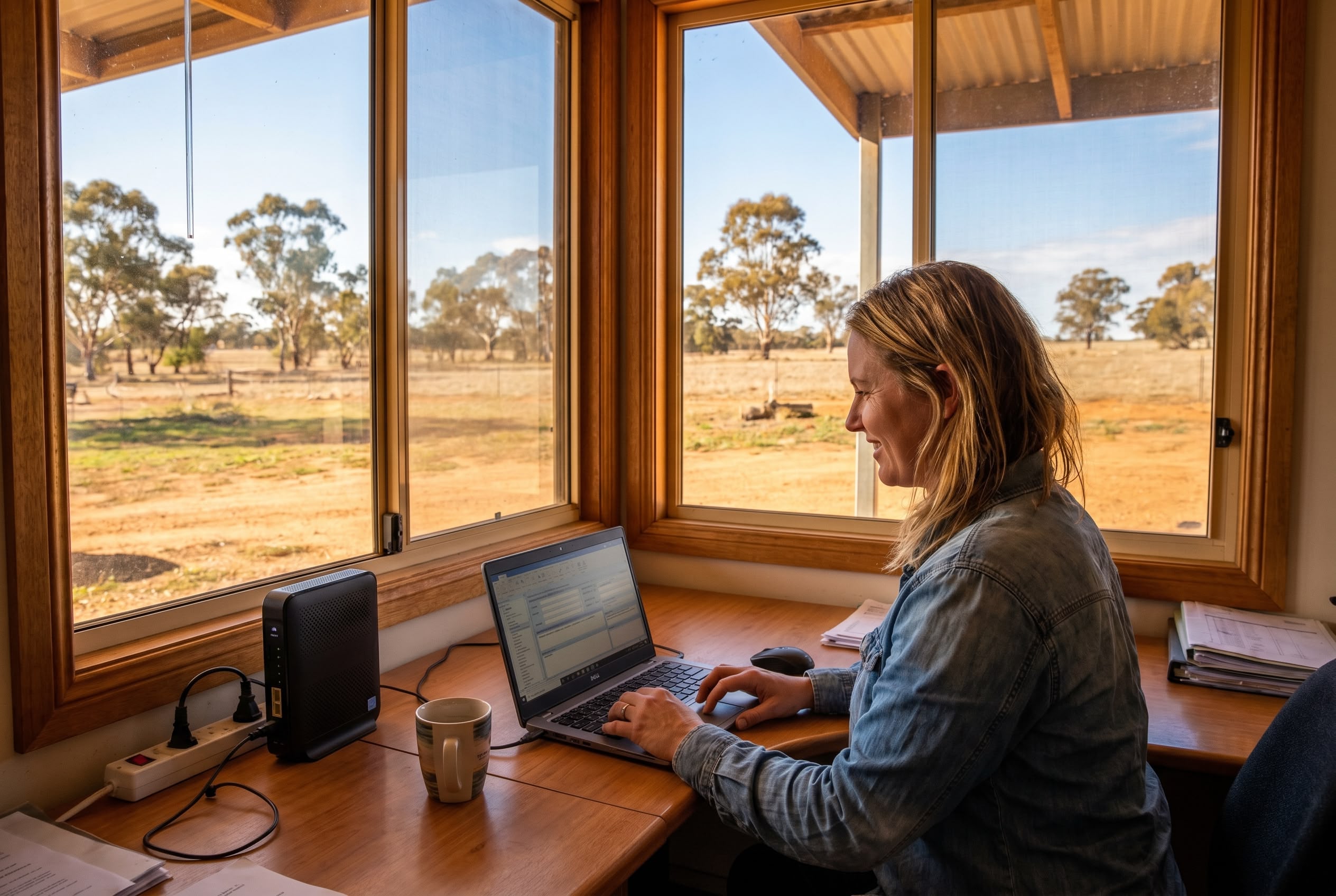
FHA-funded healthcare training
Funded Healthcare Training for Women in Rural Australia (Farm Household Allowance)
Drought, low commodity prices, and a tough season can stretch a farm income to breaking point. This guide is for rural women, partners on family farms, and women in remote agricultural communities who want a flexible, location-independent income stream that works from the homestead. It explains what the Farm Household Allowance Activity Supplement may fund, how nationally recognised AQF Diplomas from TalentMed (RTO 22151) fit the eligibility picture, and which pathways most rural women find practical.
If you receive Farm Household Allowance through Services Australia, you may be eligible for an Activity Supplement to help cover the cost of approved training that improves your prospects of earning an income. The Activity Supplement is administered by Services Australia, not by TalentMed. Eligibility, the amount, and the approval process are determined by your Services Australia case manager. What we can say with confidence is that TalentMed’s Diplomas are nationally recognised AQF Level 5 qualifications delivered by an Australian RTO (RTO 22151), which is the kind of accredited training the Activity Supplement is designed to fund. Whether your application is approved, and for how much, comes down to your case manager and your circumstances. Our FHA-funded study guide walks through the conversation and the paperwork in plain language.
Online study works extraordinarily well for rural women, but only when connectivity is sorted, only when the household understands study time is real time, and only when the pathway you pick suits the property’s seasonal rhythm. We’ll cover three TalentMed pathways that suit rural Australia and the situations where we’d ask you to slow down before enrolling. Official FHA program details, current Activity Supplement amounts, and eligibility rules sit on the Services Australia website; we link there throughout rather than restating numbers that change.
Why rural Australian women look for healthcare admin work
The cohort of rural Australian women considering healthcare admin work has a recognisable shape. They are often the partner on a family farm, doing the books and chasing the kids’ school runs. They have practical literacy and a working knowledge of paperwork because farming runs on paperwork. What’s missing is a way to convert those skills into income that doesn’t require driving 90 minutes each way to a regional centre or moving off the property entirely.
The pressure points are consistent. Drought and commodity-price volatility make farm income unreliable. Childcare in rural Australia is patchy at best, which rules out commute-to-town work for the years children are pre-school age. Distance from regional employment centres means the realistic radius for traditional jobs is narrow. And tHarder thing to name: the desire to contribute economically to the household while also having a working identity that is yours.
Healthcare administration suits this picture because it has been digitised faster than almost any other admin sector. Hospitals, GP clinics, and allied-health practices run on digital records, dictated reports, and electronic billing. The work that supports those systems (particularly medical transcription) can be done from a kitchen table at the homestead with a reliable internet connection and a quiet hour or two. None of these pathways is a get-rich-quick proposition. They are real career qualifications that take 12 months for a Diploma, less for a single unit, paying reasonable Australian salaries or output-based rates. For a household trying to bring in $30,000 to $50,000 of supplementary income while one partner runs the farm, they fit. For a household looking for $200,000 in year one, they don’t.
What the Farm Household Allowance Activity Supplement covers
The Farm Household Allowance is a Services Australia payment for farmers and farming families experiencing financial hardship. It supports the household through tough seasons while encouraging steps that improve future financial circumstances, including study, training, and professional advice. The Activity Supplement is a component of the FHA program. If your case manager approves, it can be applied towards approved training that improves your prospects of earning an income. The current Activity Supplement amount, the lifetime cap, and the rules around what counts as approved training sit on the Services Australia FHA page. Those numbers change, so we don’t repeat them here.
The Activity Supplement is not a payment in your pocket. It works through reimbursement or direct payment to the training provider. Approved training generally means accredited courses delivered by an RTO, TAFE, or university where the qualification is on the Australian Qualifications Framework. TalentMed’s Diplomas (HLT50321 Diploma of Clinical Coding, 11288NAT Diploma of Healthcare Documentation, BSB50920 Diploma of Quality Auditing, HLT57715 Diploma of Practice Management) are AQF Level 5 nationally recognised qualifications under our RTO 22151 registration. BSBMED301 Interpret and Apply Medical Terminology Appropriately is a single nationally recognised unit. All of these are the kind of training the Activity Supplement is built to fund, but eligibility for your specific application is a Services Australia decision.
Quick reference for what the FHA Activity Supplement is and isn’t:
| What it is | Who it’s for | What it can fund | How to claim |
|---|---|---|---|
| A component of the Farm Household Allowance program administered by Services Australia. Built to support farming families to improve their long-term earning capacity. | People currently receiving Farm Household Allowance. You typically need to be on the FHA payment first; the Activity Supplement is then layered on top when relevant. | Approved accredited training, professional advice, and other activities your Services Australia case manager agrees will improve your financial outlook. Nationally recognised AQF Diplomas from an RTO are the typical fit. | Through your Services Australia case manager. The conversation usually starts with your Financial Improvement Agreement (FIA) and the training you want to undertake. The provider invoices the training; the case manager approves the payment. |
If you’re already on FHA, the conversation to start is with your Services Australia case manager. Tell them which TalentMed course you’re considering and ask whether the Activity Supplement can be applied. Our FHA-funded study guide walks through that conversation step-by-step, including the documents you’ll typically need. We can issue invoices and confirmation of enrolment in the format case managers ask for, which simplifies the paperwork from their end. TalentMed cannot tell you whether you’re eligible for FHA itself, or whether the Activity Supplement will be approved for your circumstances. The eligibility call is your case manager’s.
The 3 main pathways for rural women
From the five courses TalentMed offers, three suit rural women in particular. They are sequenced below by how often we see them chosen by women in regional and remote Australia.
Two TalentMed courses (HLT50321 Diploma of Clinical Coding and BSB50920 Diploma of Quality Auditing) also suit some rural women, but the day-to-day work patterns of medical transcription, medical terminology, and practice management map most cleanly onto the rural-property reality. We focus on those three below.
Pathway 1: Medical transcription (11288NAT Diploma of Healthcare Documentation)
This is the lead choice for rural women, and it isn’t close. Medical transcription is the work of converting dictated audio from doctors and specialists (consultations, operation notes, discharge summaries) into accurate written records. The 11288NAT Diploma of Healthcare Documentation is the nationally recognised AQF Level 5 qualification that prepares you for the role, and TalentMed is the only RTO delivering it.
100% online and remote. Medical transcriptionists in Australia work from home as a near-universal default. Audio comes through a secure platform, the typed report goes back the same way, and you never set foot in the hospital or clinic. The 11288NAT course is delivered the same way: online and self-paced, no in-person classes or placements. A reliable internet connection and a quiet desk are the entire workspace.
Output-based pay that flexes with the season. Most medical transcription work in Australia is paid per audio minute or per line, not per clock hour. During seeding, calving, harvest, or shearing, you can dial back to two hours a day or take a fortnight off. During quieter months, you can ramp up. The income flexes with the season the way farm income does, and you keep the agency or practice relationship as long as the quality stays high.
Schedule-flexible to a degree no other healthcare admin role offers. A typical medical transcription job has a turnaround window (often 24 hours, sometimes 48 or 72) rather than a “be at your desk by 9am” expectation. That window is the unlock. School run? Cattle to move? The work is still there at 9pm, and it still counts. For mothers of school-age children, this is the feature that makes the pathway viable when straight commute work is not.
Low setup cost. A reliable laptop, a transcription-grade headset, a foot pedal (around $200), and a quiet corner of the homestead. That’s the equipment list.
The income picture, honestly. Australian medical transcription pay rates vary by employer, complexity, and turnaround. You build to billable speed over the first 3-6 months after graduation. The first paid work is typically below your eventual rate while you prove your turnaround and accuracy. By month 12 of working, most graduates have a reliable client or two. It’s a craft career: it pays better as you get faster and more accurate. Salary detail is on the 11288NAT course page.
11288NAT runs over 12 months, 100% online, with daily intakes 365 days a year. The medical transcription pillar covers the career end-to-end. The return-to-work after maternity leave spoke overlaps closely with the rural-women situation if you’re rebuilding income after time at home with young children.
Pathway 2: Medical terminology (BSBMED301)
BSBMED301 Interpret and Apply Medical Terminology Appropriately is a single nationally recognised unit of competency, not a Diploma. We mention it second because for many rural women it’s a more sensible first move than enrolling straight into a Diploma.
It tests whether the territory suits you. Some people love medical vocabulary and find it satisfying to learn the system of prefixes, suffixes, and root words that lets you read any clinical record on first sight. Others find it dry. BSBMED301 lets you find out which camp you’re in over a few weeks of self-paced study, before committing to a 12-month Diploma. Finish BSBMED301 and you’re well-positioned to move into 11288NAT, HLT57715 Practice Management, or HLT50321 Clinical Coding with the foundational vocabulary already covered.
It’s the right shape while FHA paperwork is still moving. Activity Supplement decisions can take time. Connectivity upgrades take time. Family logistics take time. BSBMED301 is short and self-paced, so you can start it without committing to a full year of study while the bigger pieces fall into place. Some rural women self-fund BSBMED301 from household savings, sit on it for a few months, then move into a Diploma once the Activity Supplement is approved and connectivity is sorted.
It’s low cost. BSBMED301 sits at a much lower price point than any TalentMed Diploma. Current pricing is on the BSBMED301 course page. Even households not pursuing Activity Supplement funding can usually find the BSBMED301 fee from a normal budget.
What BSBMED301 is not: a standalone passport to a healthcare admin job. Employers in medical transcription, clinical coding, and practice management generally want to see a Diploma-level qualification. BSBMED301 is the test-drive and foundation course; it works best as the first step on a path, not the last. The medical terminology you build also benefits HLT57715 if practice management ends up being the right fit, and helps with the day-to-day of any healthcare admin role.
Pathway 3: Practice management (HLT57715)
HLT57715 Diploma of Practice Management suits a different rural-woman profile. It’s the right course for women who live within commuting reach of a regional GP clinic, hospital, allied-health practice, or rural multi-purpose health service, and who want to step into a leadership role inside one of those teams. Practice managers run the business side of a healthcare practice: rosters, billing, RACGP standards compliance, Medicare and DVA claiming, accreditation cycles, complaints handling, and HR. The work happens in the practice, not at the kitchen table. That’s the trade-off.
Two reasons to flag HLT57715 on a rural-funding article. First, regional and remote Australia has a persistent shortage of capable practice managers, and the shortage gets worse the further you are from a capital city. Smaller rural clinics are often run by a GP-owner doing practice-management work in the gaps between consultations, which isn’t sustainable. A trained practice manager in a regional town is a valuable team member with a stable salaried role.
Second, HLT57715 is VET Student Loans (VSL) eligible, as is BSB50920 Diploma of Quality Auditing. VSL is a government-backed loan (separate from FHA) that lets eligible students defer the tuition fee. Repayment starts once your income reaches the compulsory repayment threshold and is paid through the tax system. A 20% loan fee applies on top of the tuition. Eligibility is set by the Australian Government, not TalentMed. For rural women who are not on FHA but want to retrain into HLT57715, VSL is a separate path worth knowing about.
HLT57715 is delivered 100% online and self-paced over a typical 12 months (some students complete in as little as 6). The Diploma teaches the content from the ground up: AGPAL/QPA accreditation, NSQHS Standards where relevant, RACGP standards, Medicare billing fundamentals, and the people-management side that’s often the hardest part of the role. The practice management pillar covers the day-to-day. The honest constraint for rural women: there has to be a healthcare practice within reach. If your nearest clinic is 90 minutes’ drive each way, 11288NAT is the better pathway. If your nearest regional centre has a GP clinic or allied-health practice, HLT57715 lines up well.
Which pathway fits your situation?
This is the table to read first if you’re impatient. Match the row that best describes you against the recommended pathway. None of these are absolute, but they reflect what we see most often.
| Your situation | Best fit | Why |
|---|---|---|
| Rural property, partner runs the farm, you want a flexible second income from home, reliable internet | 11288NAT Healthcare Documentation | Output-based pay, fits seasonal rhythm, 100% online study and 100% online work |
| Rural town with a regional GP clinic or hospital within commute, you want a leadership role with a salary | HLT57715 Practice Management | Regional Australia is short of practice managers; VSL-eligible; salaried position |
| Not yet sure healthcare admin is right for you, want a low-commitment first step | BSBMED301 Medical Terminology | Self-paced single unit; foundational vocabulary; low cost; tests whether the territory suits you |
| FHA Activity Supplement still being assessed, want to start something small in the meantime | BSBMED301 Medical Terminology | Low cost means you can self-fund without waiting; counts as healthcare admin foundations regardless of which Diploma you progress to |
| Confident, sole-trader minded, want to build a billable transcription roster as fast as possible | 11288NAT Healthcare Documentation | Direct path to billable work, output-based pay rewards motivated graduates, no detour through a foundation unit needed |
| Already on FHA, case manager has flagged you for the Activity Supplement, you have reliable internet, you want a Diploma not a single unit | 11288NAT or HLT57715 (depending on remote-vs-clinic preference) | Both are AQF Level 5 Diplomas from RTO 22151. They are the kind of accredited training the Activity Supplement is designed to fund (eligibility decision is your case manager’s) |
| Internet is unreliable, no Sky Muster Plus or Starlink available, mobile broadband patchy | None yet. Sort the connectivity first | Online study and online healthcare admin work both require a stable connection. Patchy internet is the wrong moment to start any of these courses |
| Looking for income within the next 4 weeks; can’t wait for study to complete | None of these are right at this stage | All three pathways have a runway. Diploma to billable work is 12-15 months minimum. Look at short-term options, then come back to study when the immediate pressure eases |
If your situation crosses several rows, talk to a TalentMed course adviser before enrolling. The book-a-call link in the sidebar gets you 15 minutes with someone who has had this conversation many times with rural women in similar circumstances.
What does not work
The In practice to “is online study the right move right now?” is sometimes no. Here are the situations where we’d ask you to slow down rather than enrol.
If your internet or connectivity is unreliable, online study won’t work. Sort that first. This is the single most important thing to get right. TalentMed’s platform streams video lectures and depends on a working connection. A medical transcription job depends on a working connection every day you want to bill. If your current internet drops out for hours, struggles to load video, or fails during weather, the right first step is a connectivity upgrade (Sky Muster Plus, Starlink, or strong 4G/5G fixed-wireless), not a course enrolment.
FHA Activity Supplement isn’t guaranteed. Eligibility for FHA and for the Activity Supplement are Services Australia decisions, dependent on your circumstances. We’ve seen rural women enrol assuming the Activity Supplement will cover the fee, only to find their case manager doesn’t approve. If FHA funding is the difference between studying and not, get the case-manager conversation finished and the approval in writing before enrolling.
It’s not a get-rich-quick path. Medical transcription rates start below your eventual rate; the first 3-6 months after graduation are the slowest as you build speed and a client base. Practice management is salaried so more predictable, but you have to find the role first, and rural roles are sometimes part-time. None of these will replace a full farm income in year one.
Study time is real time. 12 months of self-paced Diploma study works out to roughly 10-15 hours a week. On a working farm, those hours have to come from somewhere. The households where this works best have an explicit conversation up front about whose responsibilities shift to make room. The ones where it goes wrong squeeze study into “spare time” that doesn’t actually exist.
If you’d prefer to leave the property to work, this isn’t your article. 11288NAT in particular is built for women who want to stay on the property. Our healthcare careers pillar covers broader career-change options without the homestead constraint.
Connectivity practicalities
The practical question: what internet do I actually need?
NBN Sky Muster Plus. The NBN Co satellite service is the default for most properties beyond fixed-line coverage. Sky Muster Plus removed the daily data caps on common activities like video calls and most streaming. For students on TalentMed’s online platform, it’s generally enough. It also handles the day-to-day audio download and report upload pattern of medical transcription, although latency on calls can be noticeable.
Starlink. Starlink (low-earth-orbit satellite from SpaceX) became widely available in regional Australia from 2022. Speeds and latency are generally better than Sky Muster. Hardware is a one-off cost; the monthly plan sits higher than Sky Muster but lower than some 4G/5G options. For rural women planning to make medical transcription their core income, Starlink has changed the realistic picture for many properties.
4G or 5G fixed-wireless. If you’re within reach of a Telstra, Optus, or TPG mobile tower, fixed-wireless using a directional antenna can deliver excellent throughput at low latency. A local installer can advise on tower visibility before you assume satellite is the only option.
What you need. TalentMed’s learning platform is comfortable on 10-15 Mbps download. For working medical transcription, you’ll want a stable 5-10 Mbps upload during business hours. Patchy peak-hour service is workable for study; it gets in the way of paid transcription work. The connectivity choice is the load-bearing decision. Don’t enrol assuming the connection will be sorted “soon”.
Next step: read TalentMed’s FHA-funded study guide
This article has covered the three TalentMed pathways most rural women choose, where each fits, and the connectivity reality of online study from the homestead. The next read, if FHA Activity Supplement funding is part of your plan, is our dedicated FHA-funded study guide. It walks through the case-manager conversation step-by-step, lists the documents we can issue (confirmation of enrolment, invoices in the format Services Australia accepts, evidence of RTO 22151 registration), and answers the questions case managers most often ask. This article is about which course; the FHA guide is about how to fund it.
If you’re already past the case-manager conversation and ready to enrol, the course pages have the practical details: 11288NAT Diploma of Healthcare Documentation, BSBMED301 Interpret and Apply Medical Terminology Appropriately, HLT57715 Diploma of Practice Management. The book-a-call link in the sidebar gets you a 15-minute conversation with a course adviser. For official FHA program details and current Activity Supplement amounts, the source of truth is the Services Australia FHA page.
Frequently asked questions
Related career-change pathways
This article is part of TalentMed’s healthcare careers cluster covering 10 Australian career-change pathways.
- ADF Transition into Healthcare Admin: Adjacent: government-funded study pathways for veterans.
- Alternatives to a Nursing Degree for School Leavers: For rural Year 12 students considering admin pathways.