AI Scribes and the Future of Healthcare Documentation Work in Australia
In 2026 the TGA and RACGP confirmed a qualified human must review and sign off every AI-scribe note. What that means for healthcare documentation careers.
Post Author:
TalentMed

If you are weighing up a career in healthcare documentation, you have probably seen the headlines: AI scribes are now in thousands of Australian consulting rooms, quietly turning a conversation between a doctor and patient into a clinical note. It is fair to ask whether there is still a future in this kind of work. The short answer is yes, and the reason sits in the fine print of how Australia regulates these tools.
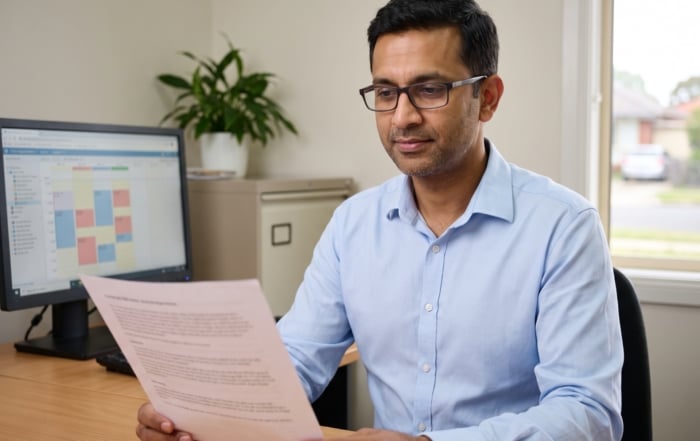
In 2026 both the Therapeutic Goods Administration (TGA) and the Royal Australian College of General Practitioners (RACGP) made the same point in different words: an AI scribe can draft a note, but a qualified human still has to read it, correct it, and take responsibility for it. That single rule is reshaping what documentation work looks like, and it is opening room for people who understand medical records and healthcare documentation properly.
What actually changed in 2026
AI scribes use ambient listening to capture a consultation and generate a draft note, letter, or summary. They have spread quickly across Australian general practice and specialist clinics. Two pieces of guidance in the past year set the rules of the road.
In February 2026 the TGA confirmed that ambient AI scribes sit outside the medical device framework, on one condition: the clinician reviews and signs off on every output. The logic is that a scribe produces a draft, not a clinical decision. The moment software starts interpreting information to suggest a diagnosis or a treatment, it can cross into Software as a Medical Device territory and must be listed on the Australian Register of Therapeutic Goods.
The RACGP got there first. In October 2025 it published its first formal guidance on AI scribes, and the core instruction was plain: every note an AI scribe generates must be reviewed, edited where needed, and approved by the treating clinician before it becomes part of the medical record. The Australian Health Practitioner Regulation Agency (AHPRA) backs this up by holding the registered practitioner personally accountable for any AI output that lands in a patient record.
Why a human still has to own every note
Modern AI scribes are good. Reported error rates sit at roughly one to three percent. The catch is the kind of errors they make. Instead of the obvious typos a tired typist might leave, AI scribes produce hallucinations (details that were never said), critical omissions (something important left out), misattribution (a symptom credited to the wrong person), and contextual misinterpretation (a phrase taken the wrong way). Those errors are harder to spot precisely because the rest of the note reads smoothly and confidently.
That is why the rules insist on a human in the loop. Patient consent is also required before a scribe is used, and the Australasian Institute of Digital Health released governance guidance in July 2025 to help practices set this up safely. None of this is optional politeness. It is the structure that keeps a clinical record trustworthy, and it depends on someone with documentation skill checking the output.
The work is shifting, not disappearing
This is the part that matters if you are thinking about it as a career. The work is moving up the value chain.
Ten years ago, healthcare documentation was largely about speed and accuracy at the keyboard, turning dictated audio into clean text. That skill still counts, but the centre of gravity is moving toward something harder to automate: reviewing a draft against the source, catching the omission the machine missed, formatting a report to a recognised standard, protecting the integrity of the record, and knowing enough medical terminology to tell when something does not add up.
A person who only types is exposed to automation. A person who understands report structure, medical language, editing, and quality assurance becomes the safeguard the whole system now legally requires. The demand is moving toward documentation specialists, medical editors, and quality reviewers, not away from them. If you want to see how the tools and the role fit together, our guide to AI in medical transcription in Australia and our comparison of the medical scribe and medical transcriptionist roles both go deeper.
What this means if you are thinking about training
The 11288NAT Diploma of Healthcare Documentation teaches the skills an AI scribe cannot sign off on for itself: medical terminology, anatomy and physiology, the structure of different report types, editing and proofreading to professional standards, and the quality checks that keep a record accurate. It is delivered 100% online and self-paced over 12 months, with daily intakes so you can start any time.
You are not training to compete with an AI scribe. You are training to do the part of the job the law reserves for a qualified human. To see the units, current fees, and flexible payment options, explore the 11288NAT Diploma of Healthcare Documentation.
Frequently asked questions
TalentMed Pty Ltd is a registered training organisation, RTO 22151. This article is general information, not career or regulatory advice.
11288NAT
Diploma of Healthcare Documentation
100% online and self-paced over 12 months. Start any time.
Prefer to talk it through?
Book a free, no-obligation call with a TalentMed course adviser about the Diploma of Healthcare Documentation.
More for medical transcriptionists
Healthcare documentation news
Monthly insights on medical transcription, documentation, and work-from-home health roles.