From Nursing to Healthcare Quality Auditor: A Practical Career Change Pathway
A practical pathway for Australian registered nurses moving into healthcare quality auditing. Why nurses make excellent auditors, which clinical skills transfer, what to learn, and the realistic timeline through the BSB50920 Diploma of Quality Auditing.
Post Author:
TalentMed

Career Change
From Nursing to Healthcare Quality Auditor: A Practical Career Change Pathway
If you’re a registered nurse looking to step out of bedside care without leaving healthcare, moving into healthcare quality auditing is one of the most natural pivots available in Australia. The clinical eye, the documentation discipline, the framework literacy, the comfort sitting with hard conversations: these are the exact skills quality auditors use every day. The BSB50920 Diploma of Quality Auditing layers the formal audit methodology on top, and most nurses are in their first internal audit role within 12 to 24 months.
This guide walks through why nurses make excellent auditors, which clinical skills transfer directly, what new skills you’ll need to build, the realistic transition timeline, the lifestyle and pay tradeoffs, and the first roles to apply for. It’s written specifically for RNs and ENs experiencing burnout, scope creep, or the slow grind of shift work, and considering a sustainable next chapter that still uses your clinical brain.
Why nurses make excellent healthcare quality auditors
Most healthcare quality auditors in Australia come from a nursing background, and tClear reason for that. Audit work is fundamentally about checking whether real-world care matches what the standards, policies and care plans say should happen. Nurses already do that, every shift, with every patient. The pivot is less a career change and more a re-application of skills you’ve already mastered, into a different working pattern with different rewards.
Three things make nurses unusually well suited to quality auditing:
Hospitals, aged care providers and NDIS services actively seek nurses for quality coordinator roles because of this transferability. The job ad will often say “registered nurse with audit or accreditation experience preferred” precisely because employers know an experienced nurse can be ready to run an internal audit cycle inside a few months, where a non-clinical hire would take a year.
For the wider context of healthcare quality auditing in Australia, see our complete guide to healthcare quality auditing.
Skills that transfer directly from nursing
The transferable skill set is broader than most nurses realise. The pivot framing in interviews and on the CV is half the battle: name the skill in audit language, give a clinical example, and the recruiter sees the fit straight away.
| Nursing skill you already have | How it lands as an auditor |
|---|---|
| Clinical assessment. Triage, head-to-toe assessment, deteriorating-patient detection. | Audit observation. Walking a ward and noticing what doesn’t match the documented process. The same noticing brain. |
| Documentation discipline. Care plans, progress notes, medication charting, incident reports. | Evidence trails. Audit findings only stand up if the evidence file is meticulous. Nurses are already trained to that standard. |
| Care plan and policy literacy. Reading and applying clinical pathways, hospital policy, drug protocols. | Standards literacy. Reading and applying NSQHS, Aged Care Quality Standards, NDIS Practice Standards, RACGP. Same skill, different documents. |
| Stakeholder communication. Patients, families, doctors, allied health, managers. | Audit interviews and meetings. Opening meetings, evidence interviews, closing meetings, corrective-action workshops. |
| Handling difficult conversations. Breaking bad news, end-of-life discussions, escalation to a senior clinician who disagrees. | Delivering audit findings. You’ll tell senior clinicians and managers things they don’t want to hear, while keeping the working relationship intact. |
| Incident reporting and RCA participation. Open Disclosure, root cause analysis, sentinel event reviews. | Investigation methodology. RCA is methodologically very close to audit. The mindset transfers directly. |
| Risk recognition. Falls risk, pressure injury risk, medication-error risk. | Risk-based audit planning. ISO 19011 audit programs are built around risk; nurses already think in those terms. |
| Time management under load. Eight patients, four families, three medications due, one deteriorating. | Audit-cycle scheduling. Annual audit plan, evidence collection windows, reporting deadlines, accreditation survey prep. |
The clinical and emotional resilience nurses build during their hospital years is also a quiet asset. Audit isn’t easy work, the findings are often uncomfortable for the people on the receiving end, and you’ll spend a lot of time inside difficult-to-discuss subjects (medication errors, pressure injuries, restrictive practices, infection-control breaches). Most non-clinical hires struggle with that emotional weight. Nurses generally don’t.
Skills you’ll need to build
Three skill clusters are not part of standard nursing education and will need deliberate study. None of them are difficult, but you’ll need to invest the time. BSB50920 covers the audit-method cluster directly; the other two come from on-the-job exposure and self-study.
If you’re studying BSB50920, the audit-method cluster is built into the diploma. The regulatory and reporting clusters come from a mix of the diploma’s case studies, your own reading of the NSQHS Standards or the Aged Care Quality Standards, and the first 6 to 12 months in your starter audit role.
Internal auditor as the first step
Almost every nurse moving into quality auditing starts in an internal role, not an external one. Internal auditors are employees of the audited service, with a continuous-improvement remit and a rolling annual audit plan. External auditors work for accrediting agencies (ACHS, AGPAL, QPA, BSI, QIP) and consult to client services on point-in-time accreditation surveys.
The reason internal comes first is methodical: external auditing requires substantial audit experience already in place, plus Lead Auditor certification and accrediting-agency surveyor pathways that typically need 2 to 5 years of internal audit work as a prerequisite. Trying to skip internal and start external is rarely viable, and it’s also not advisable. The internal years are where you build the audit-cycle muscle memory: planning a year of audits, sampling records, writing findings, presenting at quality and safety committees, watching corrective actions work or fail.
For the full breakdown of the two pathways, including scope, working pattern, independence requirements and pay structures, see our dedicated guide to internal vs external healthcare auditor pathways.
Common internal entry titles to search:
How long does the transition take
Most nurses transitioning to a first internal audit role take 12 to 18 months from the day they enrol in BSB50920. The biggest variable is whether you can build governance exposure inside your current nursing role at the same time, which most nurses can.
| Stage | Typical timeframe |
|---|---|
| Build governance exposure in current nursing role (committee, RCA, accreditation evidence work, NSQHS self-assessment lead on a Standard) | 3 to 12 months alongside study |
| Complete BSB50920 Diploma of Quality Auditing | About 12 months part-time, online, self-paced |
| Apply for first internal audit role (often while still in clinical role with the diploma listed as in progress on the CV) | 1 to 6 months from application to offer |
| First role to confident independent auditor | 12 to 18 months in role |
| External surveyor pathway with an accrediting agency (if interested) | 2 to 5 years after first internal role |
Nurses already inside quality-adjacent work (clinical risk managers, NUMs running unit-level audits, infection prevention nurses, accreditation leads) can move faster, sometimes within 6 to 9 months, because most of the experience is already there. The diploma simply formalises the credential employers ask for.
What BSB50920 teaches alongside your clinical experience
The BSB50920 Diploma of Quality Auditing is the qualification healthcare employers ask for in quality auditor and quality coordinator job ads. It maps directly to the audit-cycle work you’ll do day one: planning, conducting, reporting and following up on management-system audits aligned to ISO 19011.
For nurses specifically, the diploma covers the gaps that clinical training doesn’t:
BSB50920 is nationally recognised on the National Register and sits at AQF Level 5. TalentMed delivers it 100% online and self-paced specifically so working nurses can complete it on shift work and in study leave. Most nurses study evenings, weekends and rostered days off, and finish in about 12 months.
If you’d like the full course breakdown including units, fees, intake schedule and payment options, see the BSB50920 course page. For payment, TalentMed offers a 3-instalment plan, upfront tuition, ZipMoney and employer-funded study (many health services use professional development budgets to sponsor staff into BSB50920).
Pay and lifestyle tradeoffs
The honest version of the pay conversation: entry-level quality coordinator roles are often broadly comparable to a senior clinical RN base, sometimes slightly above and sometimes slightly below depending on sector, employer and location. Where the role gets financially compelling is the trajectory: senior quality manager, group quality manager, head of clinical governance and external surveyor work all sit well above the standard nursing pay ceiling.
For current pay benchmarks across hospital, aged care, NDIS and consulting, see our healthcare quality auditor salary guide. The lifestyle differences are often the bigger factor in the pivot decision than the dollar amount:
First quality roles to target
Nurses pivoting into audit have a strong field of starter roles to choose from. The right first role depends on which sector you’ve worked in clinically, because that’s where your clinical credibility and standards literacy is highest.
For the full job-market breakdown including where roles are advertised, salary signals to look for, and how to interpret a quality auditor job description, see our guide to healthcare quality auditor jobs in Australia. For a sense of the rhythm of the work week, see a day in the life of a healthcare quality auditor.
How to position the CV: list BSB50920 (or BSB50920 in progress) at the top of the qualifications section. Frame nursing experience as governance experience: name the standards you’ve worked under, the audits or accreditation rounds you’ve contributed to, the RCAs you’ve participated in, and any committee roles. Recruiters reading CVs need to see the audit fit in the first ten seconds.
Train with TalentMed: BSB50920 Diploma of Quality Auditing
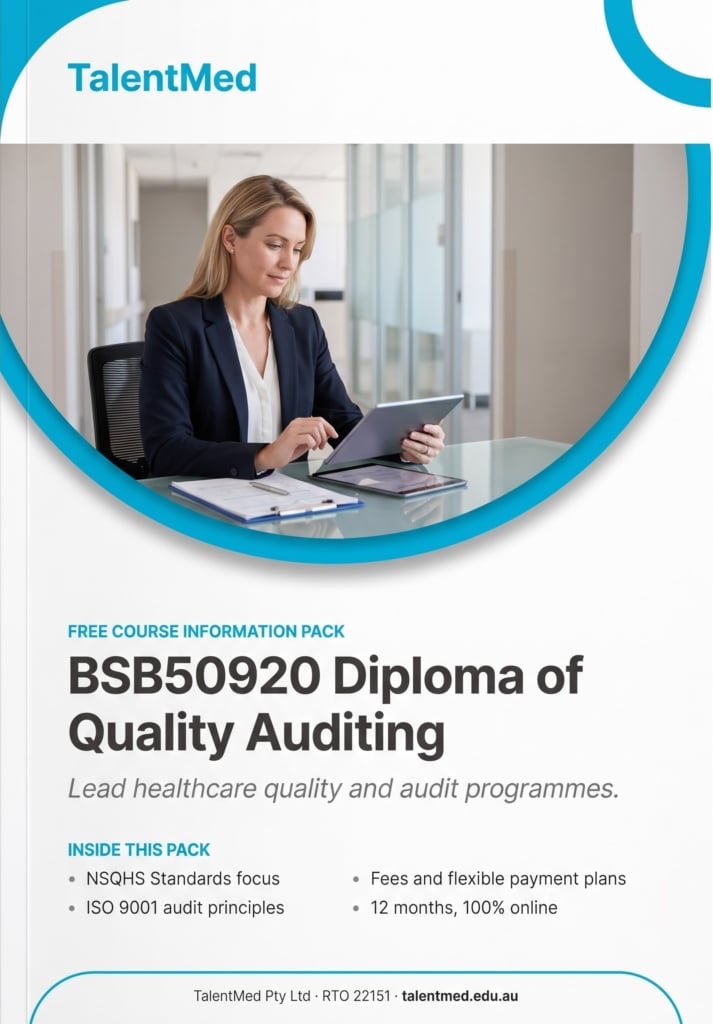
The BSB50920 Diploma of Quality Auditing is TalentMed’s nationally recognised pathway from nursing into healthcare quality auditing. Healthcare-aligned case studies, audit-method depth, and the option to study around shift work.
Frequently asked questions
TalentMed Pty Ltd, RTO 22151. The BSB50920 Diploma of Quality Auditing is nationally recognised on the National Register. Always confirm current course duration, fees, payment options and intake details on the course page before enrolling.