What is a Clinical Coder? The Profession Explained
Post Author:
TalentMed

The profession explained
What is a Clinical Coder? The Profession Explained
A clinical coder is a trained health information professional who reads patient medical records and translates the documented care into standardised alphanumeric codes drawn from ICD-10-AM, ACHI, and the Australian Coding Standards (ACS). Those codes drive hospital funding, national health datasets, and the continuity of patient care across Australia. Without clinical coders, public and private hospitals could not be paid for the care they deliver, and the country’s health-data infrastructure would lose its single most important input.
If you have been searching for a healthcare career that offers genuine intellectual challenge, strong job security, and the option to work from home, the clinical coding profession is one of the most underrated paths in Australian health.
What is a clinical coder?
A clinical coder reads patient medical records and assigns the codes that classify every diagnosis and every procedure delivered during an episode of care. The codes come from two nationally maintained classifications and one rule book.
Together, these classifications form the foundation of Australia’s clinical coding system. The Independent Health and Aged Care Pricing Authority (IHACPA) maintains and publishes them, with quarterly National Coding Advice (NCA) supplementing the standards between editions. State health departments run audits in public hospitals; health funds and internal compliance teams audit private hospitals.
Clinical coders are not doctors or nurses. They sit inside the Health Information Management (HIM) team, usually after the patient has been discharged, and read every relevant note, report and result to assign the codes that reflect what was actually documented and treated.
What does a clinical coder do day-to-day?
A clinical coder’s day is structured around episodes of care. An episode is everything that happens between a patient’s admission and discharge, including diagnoses identified, procedures performed, comorbidities managed, and complications that affected the care delivered. The coder works through one episode at a time, in a consistent order, every time.
The typical workflow begins with the discharge summary, which gives the clinical narrative in one place. The coder then confirms the principal diagnosis against the admission notes and emergency department record, reads every operation and procedure report, scans the progress notes, pathology and imaging, and drafts a code list. Before finalising, the coder verifies every code in the Tabular List, applies the relevant ACS guidance, queries the clinician if anything is unclear, and lets the grouper calculate the AR-DRG (currently version 12.0) from the final code set.
Across a shift, an experienced coder might work through 20 to 30 day-surgery episodes, or a much smaller number of complex inpatient admissions. The mix of work depends on the hospital’s case-mix and the coder’s experience level. Entry-level coders in their first 12 months typically work at about half the experienced pace while they build accuracy and speed together.
The work is quiet, methodical, and intellectually demanding. Every episode is different, and the rules are dense enough that no two days repeat themselves.

Where do clinical coders work in Australia?
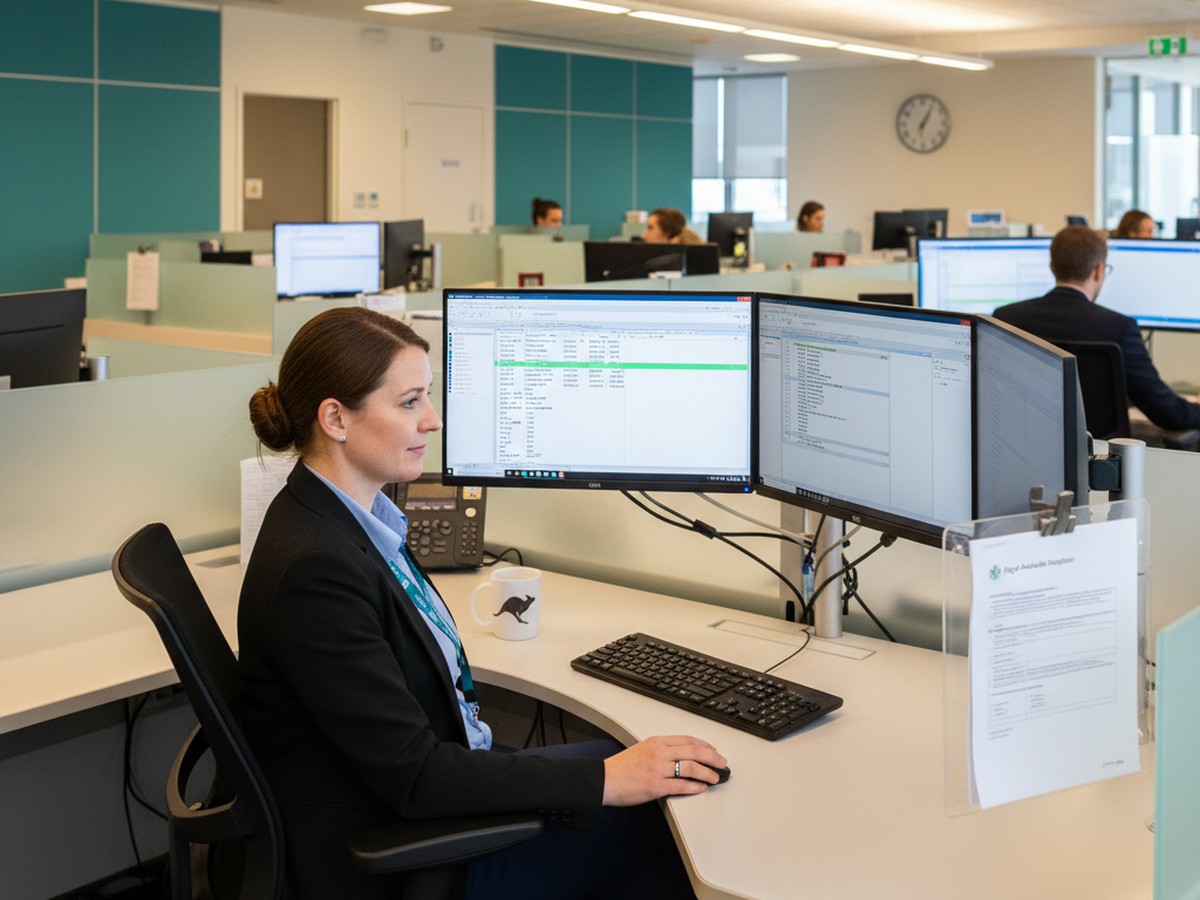
Clinical coders work across every part of the Australian hospital system, plus a growing number of remote, government, and aged-care settings. One of the most appealing aspects of this career is the wide range of settings open to qualified coders.
Why are clinical coders important to Australian healthcare?
Clinical coders are the professionals whose work directly determines how Australian hospitals are funded, how state and national health policy is shaped, and how patient histories travel between facilities. Most Australians have never heard of the role, yet the entire activity-based-funding model of Australian public hospitals depends on coder accuracy.
That mix of financial impact, public-policy weight, and clinical relevance is why hospitals take clinical coding seriously and why qualified coders are in steady demand year after year.
What classifications do clinical coders use?
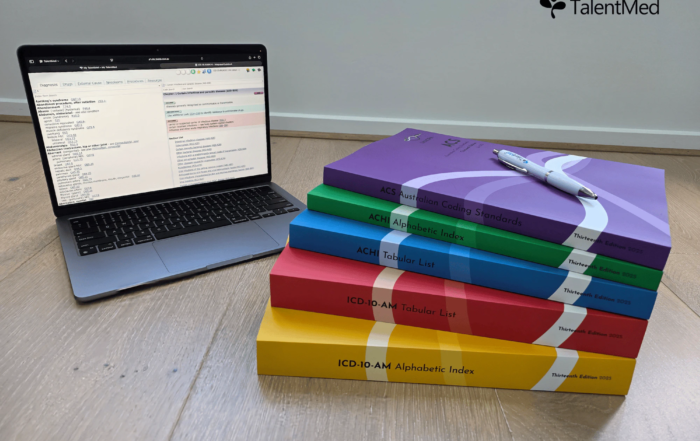
Australian clinical coders work with three companion publications: ICD-10-AM, ACHI, and the ACS, all currently in their 13th Edition (2025) and maintained by IHACPA. They are designed to be used together, not in isolation.
ICD-10-AM is the diagnosis classification. Lookups begin in the Alphabetic Index (the yellow book), where the coder finds the lead term, navigates any sub-terms, and identifies a candidate code. The code is then verified in the Tabular List (the red book) where inclusion notes, exclusion notes, and instructional flags either confirm the choice or redirect to a more specific entry. Skipping the Tabular verification is one of the most common coding errors.
ACHI is the procedure classification. The same two-stage lookup applies: Alphabetic Index (the green book) to find the lead term, then Tabular List (the blue book) to verify and read the notes. ACHI codes capture surgical procedures, anaesthesia, imaging, allied health interventions, and many therapeutic treatments.
The ACS (the purple book) sits above both classifications and tells the coder how to apply them. ACS guidance covers principal-diagnosis selection, additional-diagnosis criteria, sequencing rules, and dozens of clinical-scenario standards (sepsis, diabetes, neoplasms, postoperative complications, and more). Quarterly National Coding Advice (NCA) supplements the ACS between editions through IHACPA’s ACE portal.
For deeper guides, see the ICD-10-AM guide, the ACHI guide, and the Australian Coding Standards guide.
What is the difference between clinical coding and medical coding?
In Australia, “clinical coding” is the standard term for the profession; “medical coding” is the American term for similar work using a different classification. The two roles share a goal (translating clinical documentation into standardised codes for funding, reporting and research) but they use different rule books, different code sets and feed into different healthcare-funding systems.
Australian clinical coders work with ICD-10-AM, ACHI and the ACS, all maintained by IHACPA, and feed the AR-DRG grouper for activity-based funding. American medical coders work with ICD-10-CM and CPT, maintained by the US National Center for Health Statistics and the AMA, and feed Medicare Severity DRGs (MS-DRGs) for US Medicare. The conventions are different too: ICD-10-CM uses 7th-character extensions for episode-of-care that ICD-10-AM does not use, and laterality is captured differently in each system.
If you are searching from Australia and you mean “the role that codes hospital records using ICD-10-AM,” the correct term is clinical coder. For the full breakdown, see clinical coding vs medical coding.
How do you become a clinical coder?
The path into clinical coding in Australia is a nationally recognised diploma, followed by an entry-level role and then on-the-job mentoring inside a hospital coding team. No prior healthcare qualification is required.
The industry-standard entry credential is the HLT50321 Diploma of Clinical Coding, which TalentMed delivers 100% online. The diploma covers medical terminology, anatomy and physiology, the structure of ICD-10-AM and ACHI, the ACS, and the practical workflow of coding realistic Australian hospital episodes. It is the qualification most public and private hospitals list in their clinical coder job advertisements.
From graduation, most coders start in a junior or trainee coder role in a public or private hospital, often coding day-surgery episodes first while they build speed and accuracy. After 12 to 24 months, many move into more complex caseloads or remote-coding arrangements. For the full pathway, see the clinical coding pillar guide.
What are the career paths from clinical coding?
Clinical coding is the entry point into a much broader Health Information Management career. The classifications, the workflow, and the relationships with clinicians and analysts all transfer into related roles as a coder gains experience.
Common career paths include senior clinical coder, coding auditor (working with state coding-audit programs), clinical coding educator (training new coders), data analyst (turning coded datasets into hospital-performance reports), and Health Information Manager (running the HIM team that includes coding). Some experienced coders also move into vendor roles working on encoder software, or into private-hospital compliance teams. For a full breakdown of the pathway, see the clinical coding career pathway.
Train as a clinical coder with HLT50321
The HLT50321 Diploma of Clinical Coding is TalentMed’s nationally recognised qualification for the profession described in this article. You learn ICD-10-AM, ACHI and the ACS on realistic Australian hospital episodes, practise the systematic record-review workflow, and develop the habits experienced coders rely on every day. The diploma is 100% online, self-paced, takes about 12 months, and you can start any day of the year.
Related reading
Explore further
Frequently asked questions
Compare clinical coding courses
Choosing a clinical coding course in Australia? Our complete guide compares the Bachelor of Health Information Management against the Diploma of Clinical Coding HLT50321, with cost, duration, and career-outcome breakdowns: Clinical Coding Course in Australia: The Complete 2026 Guide.
Want to find out more?
Speak to a TalentMed course adviser about HLT50321.
12 months, 100% online, flexible payment plans, daily intakes year-round.