ICD-10-AM Explained: A Clinical Coder’s Introduction
ICD-10-AM is the Australian Modification of ICD-10, the classification Australian clinical coders use for every hospital diagnosis. Here is a plain-English introduction.
Post Author:
TalentMed

Classifications Explained
ICD-10-AM Explained: A Clinical Coder’s Introduction
ICD-10-AM is the Australian Modification of the World Health Organization’s ICD-10 classification. It is the standard Australian clinical coders use to translate every hospital diagnosis into a nationally recognised alphanumeric code. Published by IHACPA and currently in its Thirteenth Edition 2025, ICD-10-AM sits at the heart of Australia’s activity-based hospital funding, national health statistics and clinical research.
This guide explains what ICD-10-AM is, who publishes and maintains it, how the two books work together, how to look up a code step by step, the conventions you’ll meet in everyday practice, and the common mistakes new coders make. For the broader picture of what a career in clinical coding involves, start with our pillar, Clinical Coding in Australia: the complete guide. This article is written for career changers exploring the field, new HLT50321 students finding their feet, and anyone who wants a clear introduction to Australia’s diagnosis classification.
What is ICD-10-AM?
ICD-10-AM, the International Statistical Classification of Diseases and Related Health Problems, 10th Revision, Australian Modification, is the classification Australian hospitals use to code every diagnosis recorded in a patient’s episode of care. It is an adaptation of the World Health Organization’s ICD-10, modified to reflect Australian clinical practice, terminology and reporting needs.
ICD-10-AM is one component of a five-book system. It always works alongside ACHI (the Australian Classification of Health Interventions, for procedures) and the Australian Coding Standards (ACS) (the rules governing code selection and sequencing). Together these three classifications produce a coded episode that determines AR-DRG assignment and therefore hospital funding.
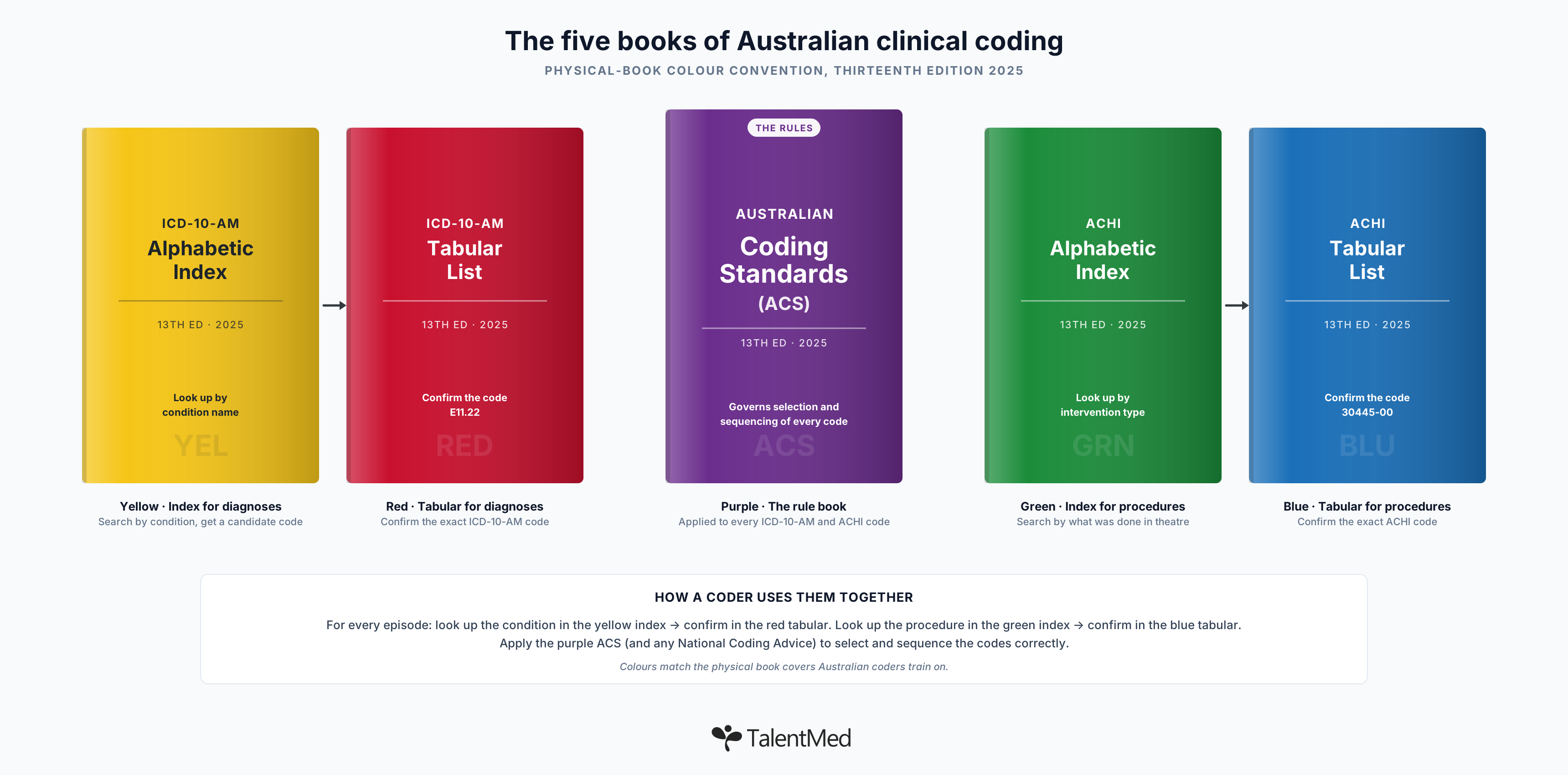
Australian coders recognise the books by their cover colours. For ICD-10-AM itself, that means yellow for the alphabetic index and red for the tabular list. We use those colours throughout this guide so the convention becomes second nature.
Who publishes and maintains ICD-10-AM?
ICD-10-AM is published and maintained by the Independent Health and Aged Care Pricing Authority (IHACPA), the Australian Government agency responsible for national health pricing and classifications. IHACPA was renamed from the Independent Hospital Pricing Authority (IHPA) on 1 July 2022 when aged-care pricing functions were added. The publishing lineage is: National Centre for Classification in Health (NCCH) and then the National Casemix and Classification Centre (NCCC, University of Wollongong); the Australian Consortium for Classification Development (ACCD) from July 2013; IHPA; then IHACPA from 1 July 2022.
IHACPA runs the classification through a structured edition cycle. Each new edition is developed through public consultation with coders, clinicians, state and territory health departments, and researchers, then released on a scheduled date with implementation guidance for hospitals. Between editions, IHACPA publishes National Coding Advice (NCA) to clarify how a standard should be applied. Both ACS and the current NCA are mandatory: NCA provides binding interim guidance between ACS editions and must be applied alongside the standards, not as optional commentary.
The professional body Australian coders associate with is the Clinical Coder’s Society of Australia (CCSA), which provides credentialling, professional development and a voice on classification consultation.
The two books explained: yellow index and red tabular
ICD-10-AM is split into two books: the yellow alphabetic index and the red tabular list. You always start in the yellow, and you always verify in the red. Using only one of the two is the single most common error new coders make.
The yellow alphabetic index is organised by lead term. Lead terms are usually the disease name, the condition, or the main word in the diagnostic phrase. Under each lead term sits a set of indented modifiers (the “essential modifiers” that change the code) with candidate codes beside them. The yellow index is how you navigate from a written diagnosis to a candidate code.
The red tabular list is organised by chapter, block and category, listing every valid ICD-10-AM code with its full description, inclusion notes, exclusion notes, and any instructional notes at chapter, block or category level. The red is where you confirm the candidate code is correct, read the surrounding notes, and pick up any additional codes required.
Both books are currently in their Thirteenth Edition 2025 and are most commonly accessed by Australian coders through digital coding software bundled with the HLT50321 Diploma, rather than as physical books. The digital software mirrors the structure of the printed books exactly, so the index-then-tabular discipline still applies.
ICD-10-AM code structure and format
An ICD-10-AM code is an alphanumeric sequence: one letter, two digits, a decimal point, and up to two further digits. For example, E11.21 is a valid ICD-10-AM code (Type 2 diabetes mellitus with diabetic nephropathy). The letter identifies the chapter, the first two digits the category, and the characters after the decimal point provide the specific clinical detail.
ICD-10-AM is organised into 22 chapters, each covering a body system, a type of condition, or a purpose such as external causes. Each chapter is divided into blocks of related categories, each category into subcategories, and each subcategory into the specific codes coders assign in practice. Chapters begin with a short introduction and a set of notes that apply across the chapter, and blocks and categories can carry their own notes. Those notes are part of the code, not optional commentary.
Common ICD-10-AM chapters Australian coders meet early include:
The structure matters because a code can be invalid if you stop too early. For example, a three-character category like E11 (Type 2 diabetes mellitus) is almost never the final code; the coder must go to the four- or five-character level to describe the complication or specify that it is without complications.
How to look up an ICD-10-AM code step by step
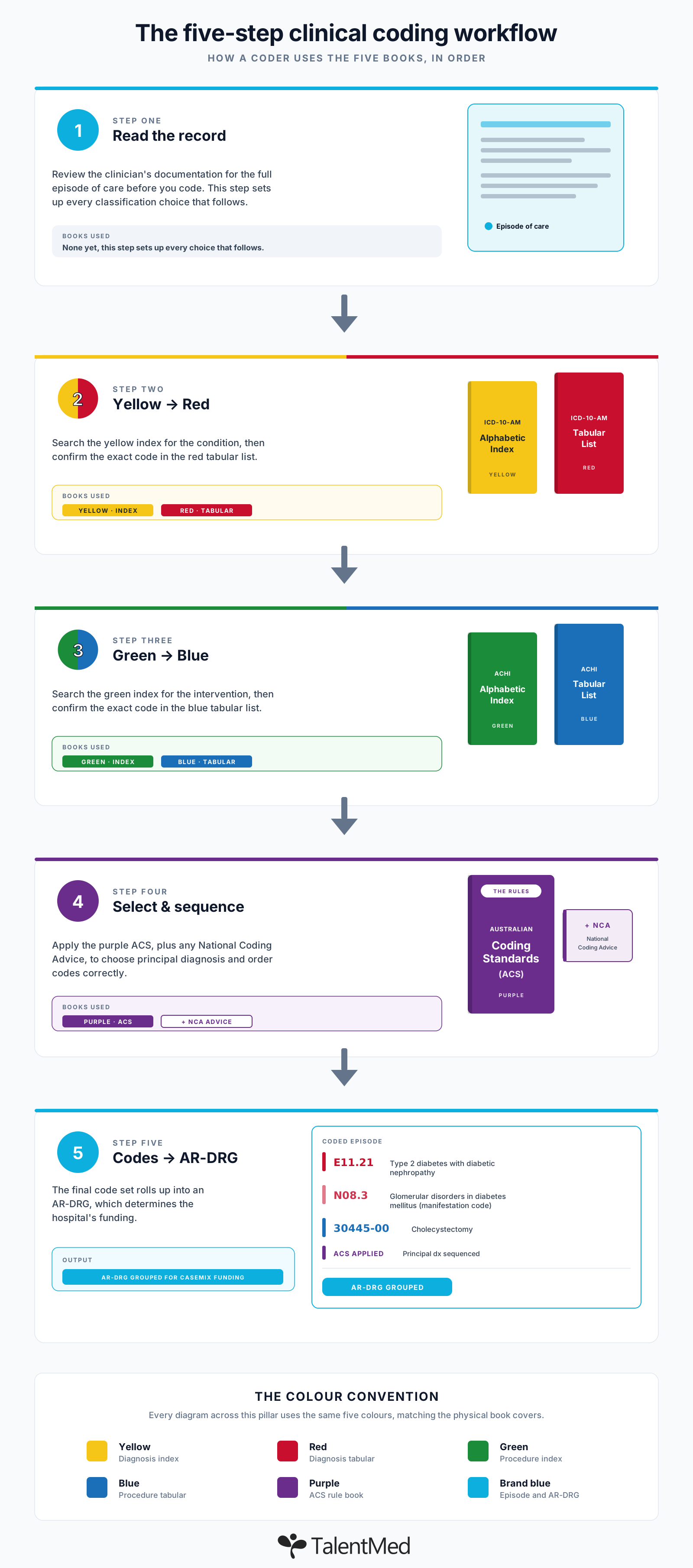
Every ICD-10-AM code assignment follows the same five-step path: identify the lead term, look it up in the yellow index, note the candidate code, verify and extend in the red tabular, then apply the ACS to sequence. Let’s walk through a real example.
Say the documentation reads: “Patient admitted for management of type 2 diabetes with diabetic nephropathy.”
- 1Identify the lead term. The lead term is usually the disease name, not the body system. Here it is Diabetes, not nephropathy.
- 2Turn to the yellow alphabetic index and find Diabetes. Follow the essential modifiers in order: type 2 → with → nephropathy.
- 3Note the candidate code. The yellow index points you to a candidate such as E11.21. At this point you have a lead, not a final code.
- 4Verify in the red tabular list. Look up E11.21, read the full description, check chapter, block and category notes, and confirm the code matches the documented condition. In this case the tabular includes a “use additional code” instruction, so you also assign N08.3 for the glomerular disorder (diabetic nephropathy) as the manifestation code. This is a classic example of the multiple-coding convention.
- 5Apply the Australian Coding Standards. Decide whether the diabetes is the principal diagnosis (per ACS 0001), confirm the additional diagnoses are clinically significant (per ACS 0002), and sequence the codes correctly.
The discipline of always starting in the yellow index and always verifying in the red tabular is non-negotiable. A candidate code from the index that isn’t verified in the tabular is a guess, not a coded diagnosis.
Common ICD-10-AM conventions
ICD-10-AM uses a handful of conventions that appear throughout the red tabular list. Learning them early saves hours of confusion later.
The most distinctive is the dagger and asterisk convention. A code marked with a dagger (†) identifies an underlying disease (the aetiology), and a code marked with an asterisk (*) identifies its manifestation in a particular body system. When a condition is documented as both, both codes are assigned, with the dagger code sequenced first. The classic teaching example is tuberculous meningitis: a dagger code for the tuberculosis and an asterisk code for the meningitis manifestation. The two codes are a pair, not alternatives.
Other conventions you’ll meet constantly:
These notes live at chapter, block, category and code level. A note at the chapter level applies to every code in the chapter, so you read downwards from the top. Skipping the chapter introduction is a reliable way to miss an instruction that changes the code.
ICD-10-AM Thirteenth Edition 2025: what’s current
The current edition of ICD-10-AM in Australia is the Thirteenth Edition 2025, published by IHACPA. ACHI and the Australian Coding Standards are also in their Thirteenth Edition 2025 and are used in lockstep with ICD-10-AM.
Edition-to-edition changes typically include new codes for emerging conditions, refinements to existing categories where clinical practice has evolved, updates to chapter and category notes, and revisions to the standards to clarify sequencing or principal-diagnosis selection. When IHACPA releases a new edition, hospitals update their coding software, train their coders on the changes, and apply the new classification from the implementation date onwards.
For the authoritative change log between editions, refer directly to IHACPA’s release notes. The important practical point for new coders is to check which edition your employer has implemented and make sure your reference materials and digital-software version match.
How ICD-10-AM fits with ACHI and ACS
ICD-10-AM answers the question “what was wrong?” ACHI answers “what was done?” and the ACS governs how both are applied. Every coded episode uses all three.
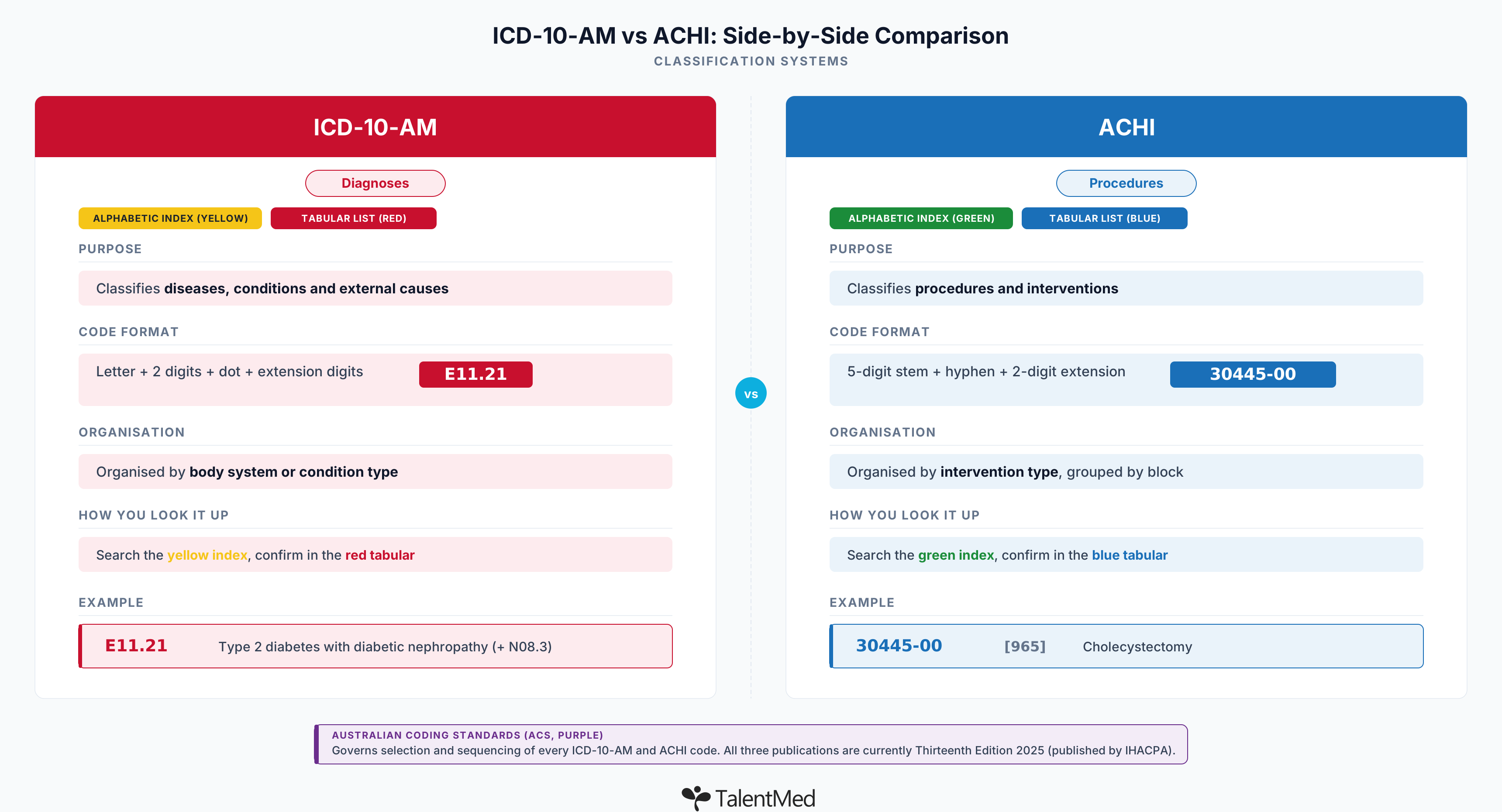
ICD-10-AM codes are alphanumeric (one letter plus digits). ACHI codes are 7 characters long, built from a 5-digit MBS-derived stem plus a 2-digit extension (for example, 30445-00), organised into blocks identified by a 3-digit block number. They use different indexes (yellow and red for diagnoses, green and blue for procedures), but both require the same index-then-tabular discipline. The Australian Coding Standards sit above both, answering questions like “which condition is the principal diagnosis?” (ACS 0001) and “is this additional diagnosis clinically significant enough to code?” (ACS 0002).
Strong ICD-10-AM fluency is also the single biggest driver of clinical coder pay in Australia and of success in the hospital coding job market. For a deeper look at the other two classifications, see ACHI: the Australian Classification of Health Interventions and Australian Coding Standards: what every coder needs to know.
Common mistakes beginners make
Most early-career coding errors cluster around a small number of habits. If you recognise these patterns in yourself, you can fix them quickly.
Learning ICD-10-AM through HLT50321
Australian coders learn ICD-10-AM through our HLT50321 Diploma of Clinical Coding, a 12-month, 100% online qualification designed around real Australian coding scenarios using integrated digital coding software.
Not sure whether this kind of detail suits your brain? Try our 10-minute Clinical Coding Challenge, or read Is clinical coding right for you? for five honest signs you’d thrive. The Diploma introduces ICD-10-AM structure and conventions alongside anatomy, physiology and medical terminology, then builds coding competence through scenario-based assessments that mirror real hospital episodes. Students learn to navigate the yellow index and red tabular efficiently, apply the Australian Coding Standards correctly, and recognise the conventions and patterns that make experienced coders fast. Because the digital coding software is embedded in the course, you train on the same kind of tools you’ll use on the job.
If you’re considering starting with a lighter introduction, BSBMED301 Interpret and apply medical terminology appropriately is our short-course unit that teaches the medical language you’ll need before or during the Diploma. It is a useful entry point, though it does not qualify you to code in a hospital on its own.
Related reading
Start here
Frequently asked questions
Want to find out more?
Speak to a TalentMed course adviser about HLT50321.
12 months, 100% online, flexible payment plans, daily intakes year-round.