How to Become a Healthcare Quality Auditor in Australia
How to become a healthcare quality auditor in Australia: 5 practical steps, the frameworks to learn, the BSB50920 Diploma of Quality Auditing pathway, and a realistic 12 to 24 month timeline.
Post Author:
TalentMed

Career Pathway
How to Become a Healthcare Quality Auditor in Australia
To become a healthcare quality auditor in Australia, you need solid working knowledge of the NSQHS Standards, audit methodology grounded in ISO 19011, and a nationally recognised qualification such as the BSB50920 Diploma of Quality Auditing. Most auditors enter the role from clinical backgrounds (nursing, midwifery, allied health) or healthcare administration after building 1 to 3 years of governance, risk or accreditation exposure inside a health service.
This guide walks you through the five practical steps from “interested in audit” to “first audit role”, the frameworks you need to learn, the qualifications that get you shortlisted, and the realistic timeline. It’s written for nurses pivoting to governance, allied health professionals adding compliance skills, and hospital, aged care or NDIS administrators formalising an audit pathway.
What does a healthcare quality auditor actually do?
A healthcare quality auditor independently checks whether a health service is meeting its safety, governance and clinical-care obligations under a recognised standard. The work blends documentation review, on-site observation, staff interviews, data analysis and report writing. Findings go to executive committees, boards and (for external audits) accrediting agencies, and they drive corrective action to close any gaps.
Day to day, an auditor might review medication-management records against NSQHS Standard 4, observe a clinical handover against Standard 6, interview a nurse unit manager about risk-register escalation, then draft findings ready for the next clinical governance committee. The work sits at the intersection of clinical knowledge, regulatory frameworks and the practical reality of how care is delivered.
For the wider context (frameworks, accreditation cycles, sector breakdown, and how internal and external auditing differ), see our complete guide to healthcare quality auditing in Australia.
Where healthcare quality auditors work
Quality auditor roles exist across every Australian healthcare sector that carries an accreditation obligation. The five biggest employers are public hospital networks, private hospital groups, residential and home aged care, NDIS providers, and accrediting agencies that send external auditors out to client sites.
| Sector | Typical employer + setting |
|---|---|
| Public hospitals | NSW Local Health Districts, Queensland Health HHS, Victorian health services, WA Country and Metro Health, SA LHNs, TAS THS. Quality coordinator, quality and risk officer, accreditation lead. |
| Private hospital groups | Ramsay Health Care, Healthscope, St Vincent’s Health Australia, Epworth, Cabrini, Mater. Group quality manager and on-site quality coordinator roles. |
| Aged care | Residential and home care providers across the country. Demand has climbed since the Royal Commission and the Strengthened Standards. |
| NDIS-registered providers | Disability service providers required to maintain NDIS Practice Standards registration. Quality and compliance, internal audit, restrictive practice authorisation. |
| Accrediting agencies + consultancies | ACHS, AGPAL, QPA, BSI, QIP, Global-Mark, plus boutique audit consultancies. Mostly external surveyor or contract auditor roles. |
Most auditors start in one sector and move across two or three over their career. A common path is to begin as a quality coordinator inside a public hospital, move into a group-level role with a private operator, then later move to external surveying with an accrediting agency.
The 5-step pathway from clinician (or admin) to quality auditor
The pathway from “I’m interested in audit” to “I’m employed as one” is well-trodden. It typically takes 12 to 24 months if you’re already working in healthcare, and it doesn’t require leaving your current role to start.
- 1Build healthcare context and governance exposure. Volunteer for accreditation rounds, join the clinical risk committee, take on incident-investigation or root-cause-analysis work in your current role.
- 2Learn the frameworks. NSQHS Standards 2nd edition for hospitals, Aged Care Quality Standards (Strengthened Standards from 1 November 2025) for aged care, NDIS Practice Standards for disability, RACGP 5th edition for general practice, and ISO 9001 + ISO 19011 for the underlying audit method.
- 3Get qualified. The BSB50920 Diploma of Quality Auditing is the qualification employers consistently ask for. It maps directly to the audit-cycle skills you’ll be using day one.
- 4Land your first audit role. Most first roles are internal: quality coordinator, quality and risk officer, accreditation coordinator, or compliance auditor. External surveyor roles typically come 2 to 5 years later, once you’ve built audit experience.
- 5Continuing development. Lead Auditor certifications (often through ISO 9001 / ISO 19011 routes), accrediting-agency surveyor pathways (ACHS, AGPAL), and ongoing CPD on framework updates keep you current and unlock senior pay bands.
Step 1: Build healthcare context and governance exposure
Audit roles rarely go to candidates with no healthcare background. The good news is that most experienced clinicians and administrators already have more relevant exposure than they realise, they just haven’t framed it as audit experience yet.
Activities that build credible audit exposure inside your current role:
If you’re an aged care registered nurse, lead a self-assessment against one of the Strengthened Standards. If you’re a practice manager, run an internal audit against a single RACGP criterion. If you’re a hospital ward clerk or administrator, volunteer to maintain the audit evidence file for a Standard your unit is responsible for. All three give you concrete examples to talk about in interviews.
Step 2: Learn the frameworks
The frameworks aren’t optional reading, they’re the working vocabulary of the role. You don’t need to memorise every Action, but you do need to know what each Standard covers, who it applies to, and how they overlap.
Where to read each framework directly:
Step 3: Get qualified with BSB50920
The BSB50920 Diploma of Quality Auditing is the nationally recognised qualification employers ask for in healthcare quality auditor job ads. It maps directly to the audit-cycle work you’ll do day one: planning, conducting, reporting and following up on management-system audits aligned to ISO 19011.
BSB50920 covers:
Alternative pathways exist (university post-graduate certificates in clinical governance, employer-led internal training, ISO Lead Auditor courses), but BSB50920 is the most direct fit for someone moving from clinician or administrator into a healthcare quality role. It’s nationally recognised on the National Register, sits at AQF Level 5, and combines the audit methodology with the soft skills (interviewing, reporting, stakeholder engagement) that audit work actually demands.
Step 4: Land your first audit role
Most first audit roles are internal, not external. Internal roles let you build the documentation, observation and reporting reps that external auditors need before agencies will put them in front of client sites. Common entry titles to search for on Seek, LinkedIn and HealthcareLink:
What to put in your CV:
For interviews, expect scenario questions (“how would you approach an audit of medication management on an acute ward?”), framework knowledge (“which Standard covers clinical handover?”), and behavioural questions about diplomacy and independence (“describe a time you delivered a difficult finding to a senior clinician”). Knowing the relevant framework Action numbers cold is a fast-track signal that you’re ready.
Step 5: Continuing development
Once you’re in your first role, the next 2 to 5 years are about deepening framework expertise and unlocking senior pay bands. Common development pathways:
Skills employers actually look for
Beyond framework knowledge and a diploma, employers look for a specific cluster of soft skills. Quality auditing is investigative, regulatory, and people-facing all at once.
How long does the pathway take?
Most people moving from clinician or administrator to first audit role take 12 to 24 months. The biggest variable is whether you can build governance exposure inside your current role at the same time as studying, which most people can.
| Stage | Typical timeframe |
|---|---|
| Build governance exposure in current role (committee, RCA, accreditation evidence work) | 3 to 12 months alongside study |
| Complete BSB50920 Diploma of Quality Auditing | About 12 months part-time, online |
| Apply for first internal audit role | 1 to 6 months from application to offer |
| First role to confident independent auditor | 12 to 18 months in role |
| External surveyor pathway with an accrediting agency | 2 to 5 years after first internal role |
For people already inside healthcare governance (existing quality coordinators looking to formalise their qualification, hospital clinical risk managers, aged care quality leads), the timeline is shorter because most of the experience is already in place. The diploma simply confirms the formal credential.
Internal versus external auditor pathways at a glance
Most auditors start internal and either stay or move into external work later. Internal auditors are employees of the audited service, typically with a continuous-improvement remit and a rolling annual audit plan. External auditors work for accrediting agencies or consultancies, conducting point-in-time accreditation surveys against frameworks like NSQHS or the Aged Care Quality Standards.
The skills overlap heavily, but the working pattern, independence requirements and pay structure differ. For a deep-dive on which pathway suits which personality, see the healthcare quality auditing pillar‘s “Internal versus external auditors” section.
Train with TalentMed: BSB50920 Diploma of Quality Auditing
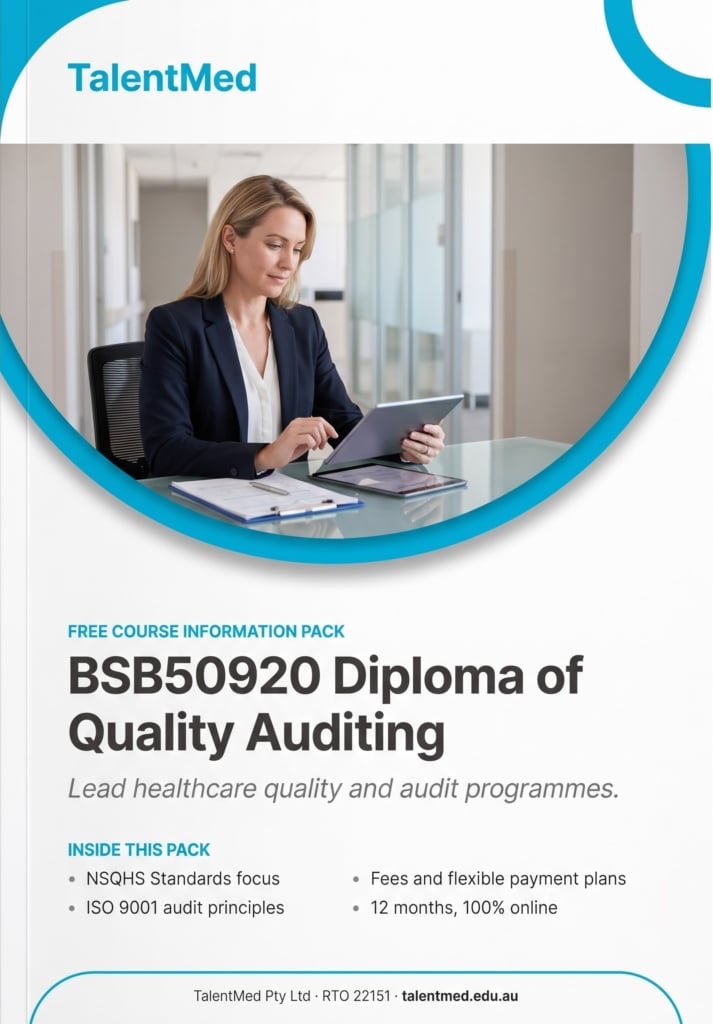
The BSB50920 Diploma of Quality Auditing is TalentMed’s nationally recognised pathway for moving into healthcare quality auditing. It’s 100% online, self-paced, and built around healthcare-aligned case studies so the audit-cycle skills transfer directly to your first role.
Frequently asked questions
TalentMed Pty Ltd, RTO 22151. The BSB50920 Diploma of Quality Auditing is nationally recognised on the National Register. Always confirm current course duration, fees and intake details on the course page before enrolling.
For context on why demand for healthcare quality auditors is at a record high in Australia, read The Rise of the Healthcare Quality Auditor.