The Halloween clinical coding challenge
Post Author:
TalentMed
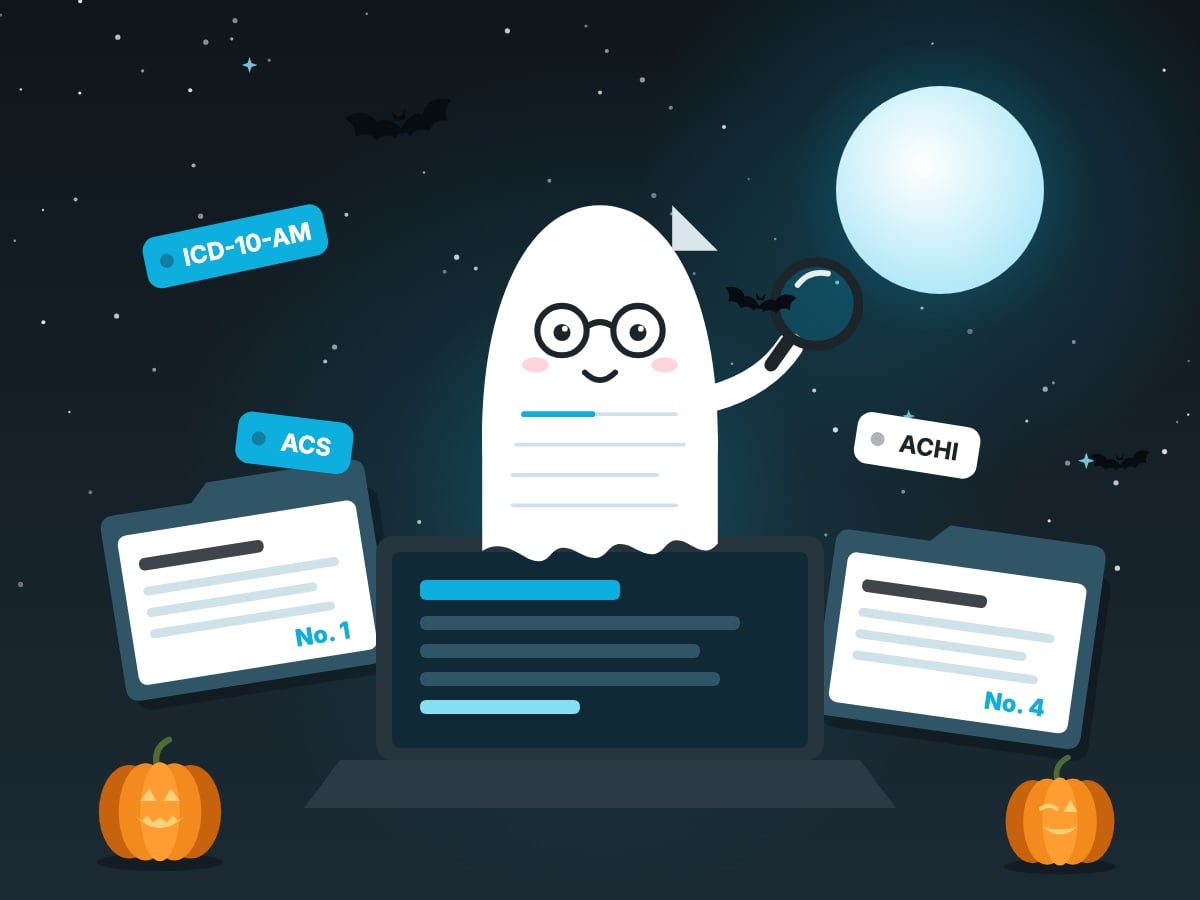
Halloween 2026 challenge
The Halloween clinical coding challenge
The Halloween clinical coding challenge invites you to take the night shift at TalentDred Medical Centre, 666 Shadow Street, Hellbourne VIC 3000, where four invented patient records are waiting on Dr Letitia Grimm’s desk with real ICD-10-AM rules behind them. Read each chart, assign the codes you think are right, and get instant feedback on every one. You need no experience; a reader who has never opened a codebook can still play, and will finish knowing what a clinical coder actually does.
Dr Grimm, Night Shift Physician, has had a busy Halloween. Poppy Witchell, an eight-year-old witch, came in off the footpath with a lolly bag mystery. A fifteen-year-old ghost hunter fell through the floor of a house with a reputation. Jack Lantern lost a carving competition to a pumpkin with attitude. Wanda Wolferton’s costume was so convincing that the party host’s dog lodged a formal complaint. The medicine is all handled; what she needs now is a coder, and the four charts are neatly stacked and waiting.
How to play
Each chart gives you a patient record from the ward: the presenting problem, history, findings, procedures and discharge summary. Your job is to code it the way a coder would, using ICD-10-AM 13th Edition and ACHI 13th Edition. Assign the principal diagnosis first, then any additional diagnoses, then the external cause code, then the place of occurrence and activity codes where they apply, and finally any procedures, each followed by its anaesthetic code.
Use your own codebooks or coding software while you play, because that is how the work is done at a real coding desk. Type each code and the tool tells you straight away whether it belongs in that episode. Full worked answers, with the reasoning behind every code, appear once you subscribe to TalentMed’s monthly clinical coding newsletter.
What’s in the details
Each chart was chosen because it hides a trap, and none of them involve the supernatural. They are the traps coders meet on real records every working day, whatever the date on the admission stamp.
- Dramatic statements from a patient or a relative can point you towards a code the record never supports. One patient blamed a ghost for a fall, and one triage note mentions a werewolf. Coders code the documented diagnosis and the documented mechanism, not the most memorable sentence in the notes.
- Places can also be something other than what they look like. Place of occurrence codes carry Excludes notes, and one of these episodes lands somewhere quite different from where a casual reader would file it.
- Sequencing matters as much as selection. In one chart, two injuries share a single site, and ACS 1917 is firm about which one is listed first. The visible wound is not always the lead code.
- Knowing what not to code is the quietest trap, and each chart tests a different case: skin sutures over a deeper injury, a booster given before the admission began, prophylactic antibiotics, and a well-controlled pre-existing condition that needed no extra care during the stay.
Learn to code for real
If the challenge was fun and you would like to do this for a living, the HLT50321 Diploma of Clinical Coding is the qualification built for exactly that. TalentMed Pty Ltd (RTO 22151) delivers it 100% online and self-paced over 12 months, with daily intakes and no classroom attendance. You train on authentic medical records through online simulated workplace exercises delivered on the My TalentMed Interactive Learning Portal, and the qualification is nationally recognised.
Frequently asked questions
Want to find out more?
Speak to a TalentMed course adviser about HLT50321.
12 months, 100% online, flexible payment plans, daily intakes year-round.