5 Essential Skills Every Aspiring Clinical Coder Needs
Discover the five essential skills every aspiring clinical coder needs to succeed. From medical terminology to attention to detail, learn what employers look for.
Post Author:
TalentMed
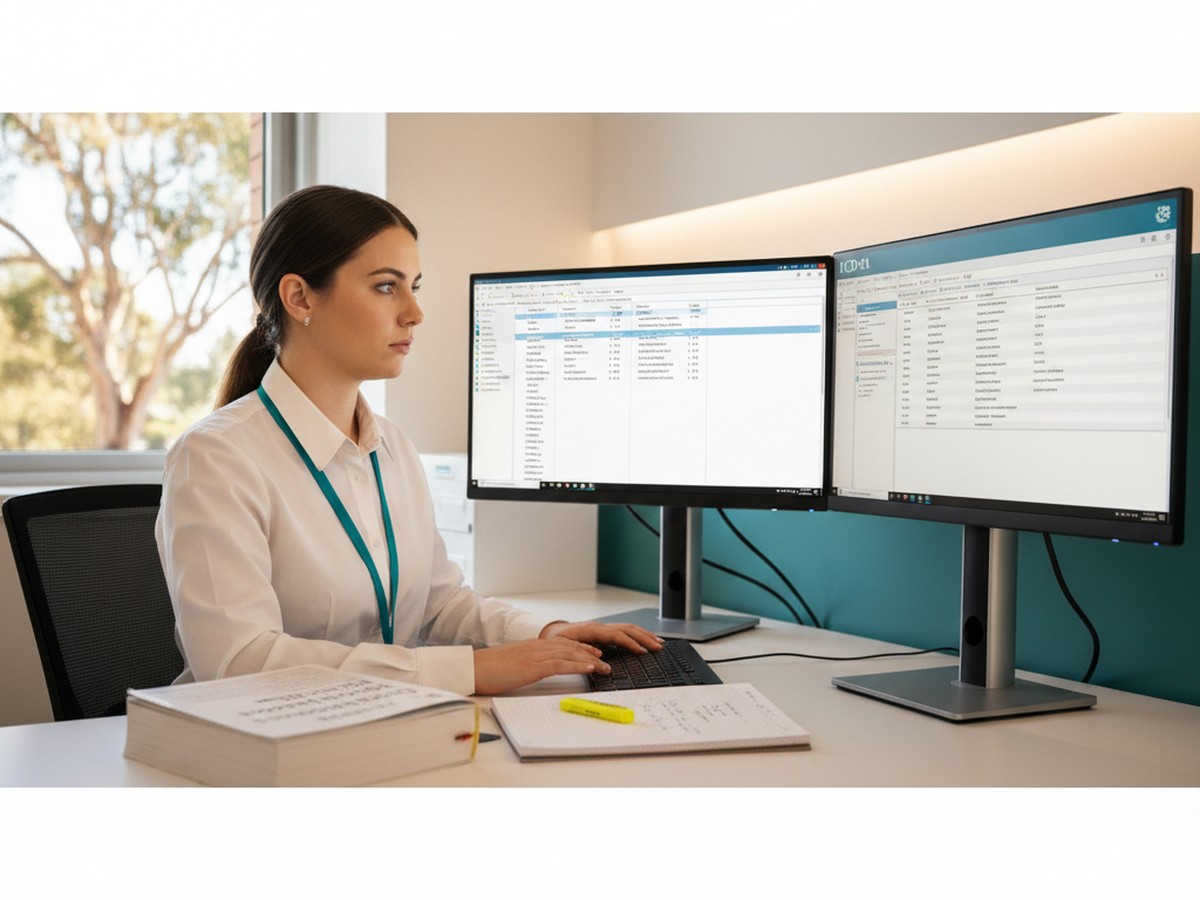
You’re exhausted. The long shifts, the emotional weight of bedside care, the feeling that your expertise deserves more recognition and more flexibility. If you’ve been quietly Googling “work from home healthcare jobs” or “how to get out of clinical nursing,” you’re not alone. Thousands of Australian healthcare professionals make the same search every year.
What many of them discover: clinical coding is a rewarding, flexible career path within the Australian health system. But it’s also widely misunderstood. It’s not data entry. It’s not administrative grunt work. Clinical coding is a highly specialised, intellectually demanding profession that sits at the intersection of clinical medicine and hospital funding.
To thrive as a clinical coder, you need a very specific set of skills. The great news? If you already work in healthcare, you likely have more of these skills than you realise. These are the five essential skills every aspiring clinical coder needs, and how TalentMed’s HLT50321 Diploma of Clinical Coding helps you build every single one.
Why These Skills Matter for Your Coding Career
Clinical coding is not the kind of profession where you can learn on the job through trial and error. The stakes are too high. Every coded patient episode directly affects hospital funding through Australia’s Activity Based Funding (ABF) model, feeds into national health data collections, and influences how resources are allocated across the health system. Inaccurate coding costs hospitals real money and can compromise the integrity of the clinical data that governments rely on for health policy decisions.
That is why building the right foundation of skills early in your training is so important. Aspiring coders who invest in developing strong medical terminology, attention to detail, classification knowledge, communication skills, and adaptability from the outset build a stronger foundation for their coding career, entering the workforce more confident and better prepared.
In short, the five skills outlined below are not abstract ideals. They are the practical, measurable competencies that employers actively look for when hiring graduate coders, and the same competencies that separate coders who plateau early from those who build long, rewarding careers.
Skill 1: Medical Terminology and Anatomy Knowledge
Clinical coders work directly with patient medical records: discharge summaries, operation reports, pathology results, and specialist consultation notes. If you can’t read and interpret clinical language confidently, you simply can’t code accurately.
Understanding medical terminology and human anatomy isn’t just helpful; it’s essential. When a surgeon documents a “right hemicolectomy with primary anastomosis” or a physician notes “community-acquired pneumonia with associated type 2 respiratory failure,” the coder must understand exactly what happened clinically before they can assign the correct ICD-10-AM and ACHI codes.
Why does this matter? Because the ICD-10-AM (International Statistical Classification of Diseases and Related Health Problems, 10th revision, Australian Modification) is built around precise clinical concepts. A coder who misreads “septicaemia” as interchangeable with “sepsis” or confuses “cellulitis” with a superficial skin wound can cause a cascade of incorrect coding decisions. Incorrect codes change the Diagnosis-Related Group (DRG) assigned to a patient episode, and that directly affects how much funding a hospital receives from IHACPA under the Activity Based Funding (ABF) model.
How the HLT50321 Diploma builds this skill: TalentMed’s diploma programme includes dedicated units covering medical terminology, human body systems, and disease processes. You’ll learn to read clinical notes the same way a doctor does, with confidence and precision.
Skill 2: Meticulous Attention to Detail
In clinical coding, a single incorrect digit is not a minor typo. It can have serious financial and clinical consequences.
Consider this real-world scenario: A patient is admitted with a hip fracture and also has Type 2 diabetes mellitus, which is managed during the admission. The coder must identify both the principal diagnosis (the hip fracture) and the relevant complication or comorbidity (the diabetes). If the diabetes is missed as an additional diagnosis, the DRG assignment changes. The hospital may receive thousands of dollars less in funding for that episode than it is legitimately owed.
Now multiply that across hundreds of patient episodes per week. The financial and clinical data integrity stakes are enormous. Coders must comb through every page of a medical record, sometimes 40 or 50 pages, and capture every clinically relevant diagnosis and procedure. Nothing can be assumed. Nothing can be skipped.
Attention to detail also applies to Australian Coding Standards (ACS) compliance. Each coding decision must be defensible according to the ACS rules published by IHACPA (the Independent Health and Aged Care Pricing Authority). The standards are precise, and so must the coder be.
How the HLT50321 Diploma builds this skill: Through authentic case-based assessments using simulated medical records, students practise applying coding rules under realistic conditions, building the habit of thoroughness from day one.
Skill 3: In-Depth Knowledge of ICD-10-AM, ACHI, and the ACS
This is the technical core of clinical coding. The three reference systems every Australian clinical coder must master are:
Without deep knowledge of all three systems, a coder cannot function. These aren’t tools you can “look up as you go.” You need to understand the underlying logic and structure of each classification to apply them correctly in complex cases.
Knowledge of DRG (Diagnosis-Related Group) logic is also critical. Every coded episode is ultimately grouped into a DRG, which determines hospital funding under the IHACPA’s national pricing framework. Understanding how diagnosis and procedure codes interact to produce a DRG is what separates a competent coder from an exceptional one.
How the HLT50321 Diploma builds this skill: The diploma is specifically structured around ICD-10-AM, ACHI, and ACS mastery. Students work through each classification system progressively, applying real coding rules to progressively more complex clinical scenarios. By the time you graduate, this knowledge is second nature.
Skill 4: Professional Communication Skills
Many people picture clinical coding as a purely solitary, screen-based role. The role is more nuanced and more interesting than that.
When a medical record contains ambiguous, incomplete, or contradictory clinical documentation, a coder cannot simply guess or make assumptions. They must raise a formal clinical query with the treating clinician. This might involve contacting a busy surgeon to clarify whether a complication was present on admission, or asking a physician to confirm the specific type of heart failure documented in a patient’s notes.
This requires real communication skill. Clinicians are time-poor. A well-written, precise clinical query gets a quick, useful response. A vague or poorly worded query gets ignored or creates confusion. Coders who communicate well maintain positive working relationships with medical staff and consistently produce higher-quality, more defensible coded data.
Communication skills also matter when coders present audit findings, explain coding decisions to management, or participate in clinical documentation improvement (CDI) programmes. CDI is a growing area of Australian healthcare where coders actively work with clinicians to improve the quality of medical record documentation, directly improving data quality and funding outcomes.
How the HLT50321 Diploma builds this skill: The diploma includes units on workplace communication in healthcare settings, giving students the confidence and professional vocabulary to query clinicians effectively and collaborate across multidisciplinary teams.
Skill 5: Adaptability and a Commitment to Continuous Learning
Healthcare never stands still, and neither do the coding standards.
IHACPA regularly releases new editions of the ICD-10-AM/ACHI/ACS classification, incorporating new diseases, updated clinical terminology, revised coding rules, and new procedure codes for emerging surgical techniques. Each edition brings changes that coders must learn and apply from the effective date.
Beyond classification updates, the broader Australian health information sector is also shifting. Electronic Health Records (EHRs) are now standard across most public hospitals. Computer-Assisted Coding (CAC) technology, powered by artificial intelligence, is being adopted in larger health networks. Casemix funding models continue to evolve under IHACPA’s national hospital pricing framework. Coders who stay curious, attend professional development events, and actively engage with the Clinical Coders’ Society of Australia (CCSA) are the ones who thrive.
The best clinical coders view each classification update not as a burden, but as evidence that their profession is dynamic, respected, and central to how Australia funds and manages its health system.
How the HLT50321 Diploma builds this skill: TalentMed’s programme is delivered online with flexible pacing, modelling the self-directed learning habits you’ll rely on throughout your career. You’ll also be introduced to the CCSA and the professional development resources available to qualified coders.
Do You Have What It Takes? Self-Assessment Checklist
Work through this list carefully. If you tick even three or four of these boxes, you may be readier than you expect:
Frequently Asked Questions
Ready to Start Your Clinical Coding Career?
You don’t need to have all five skills perfectly in place before you start. That’s exactly what the HLT50321 Diploma of Clinical Coding is for.
TalentMed’s fully online, nationally recognised diploma builds your medical terminology knowledge, your technical coding expertise, and your professional communication skills, all in a flexible, self-paced format designed for working adults. If you’re a nurse considering a change, a medical administrator ready to step up, or a school leaver with a passion for healthcare, this diploma is your pathway in.
Enquire today and speak with one of our friendly course advisors about whether the HLT50321 Diploma of Clinical Coding is right for you.