Coding Obstetric Admissions: A Clinical Coder’s Guide
Post Author:
TalentMed
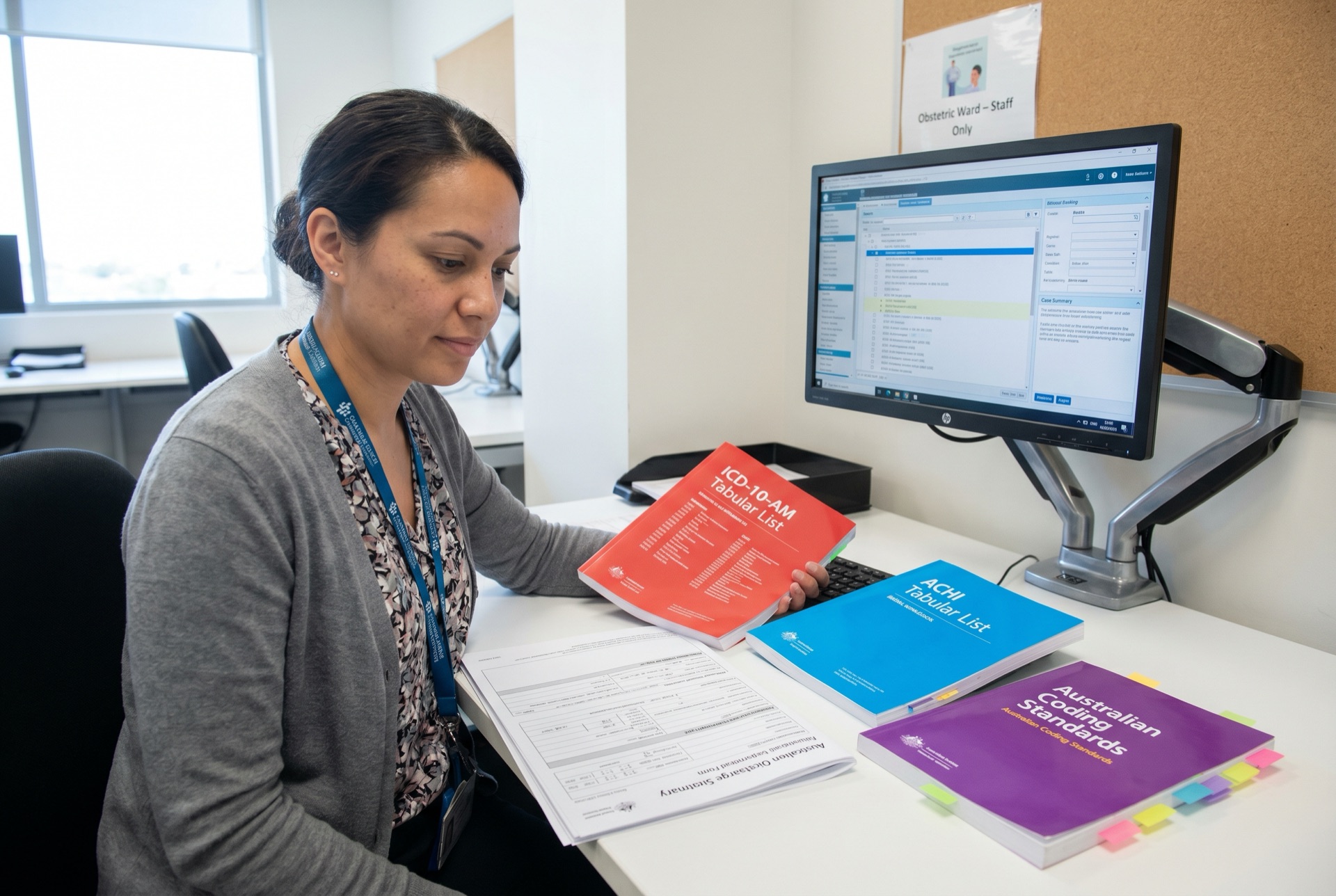
Clinical Coding Practice
Coding Obstetric Admissions: A Clinical Coder’s Guide
Obstetric admissions are among the most rule-bound episodes in Australian clinical coding. Chapter 15 of ICD-10-AM, Pregnancy, childbirth and the puerperium (O00-O99), takes precedence whenever a condition relates to pregnancy, and a dedicated family of Australian Coding Standards (ACS 1500-1552) governs principal diagnosis selection, delivery codes, outcome-of-delivery codes, and the ACHI interventions that go alongside them. Get the framework right and obstetric episodes are straightforward. Miss a mandatory secondary code or misread the antenatal/delivery distinction and the whole episode misgroups.
This guide explains how Australian coders approach obstetric admissions: the Chapter 15 precedence rule, how ACS 1500 decides principal diagnosis in a delivery episode, the O80-O84 delivery block, mandatory Z37 outcome-of-delivery codes, ACHI procedure codes for delivery interventions, multiple gestations, antenatal complications, and the common mistakes that show up in audits. It is written for HLT50321 students and practising coders who want a grounded reference for Chapter 15 episodes.
Chapter 15 takes precedence
When a condition relates to pregnancy, childbirth or the puerperium, the first place an Australian coder looks is Chapter 15 of ICD-10-AM (O00-O99). Codes from that chapter take precedence over equivalent codes from other chapters for the same condition, because Chapter 15 captures the obstetric context that funding, research and quality data depend on.
Chapter 15 covers conditions that occur exclusively or predominantly in pregnant patients (what the standards call obstetric conditions and complications), plus a framework for handling nonobstetric conditions that complicate pregnancy. A condition that can occur in any patient is classified as complicating pregnancy when it is associated with an increased risk of adverse fetal or maternal outcome. ACS 1521 Conditions and injuries in pregnancy sets out three mutually exclusive categories for nonobstetric conditions: nonobstetric conditions complicating pregnancy, nonobstetric conditions not complicating pregnancy, and nonobstetric injuries and poisoning in pregnancy. Each category has a different coding approach.
The puerperium is the 42-day period following delivery, including delivery of the placenta. Conditions arising in that window are governed by ACS 1548 Puerperal or postpartum condition or complication and also sit within Chapter 15’s scope. Reading the record to decide whether a condition is obstetric, nonobstetric complicating pregnancy, nonobstetric not complicating pregnancy, or a puerperal complication is the opening move on every obstetric episode.
Principal diagnosis in obstetric episodes (ACS 1500)
ACS 1500 General guidelines for obstetric episodes of care sets out the sequencing logic that decides whether a delivery code or a condition code sits in the principal diagnosis position. The standard resolves what, from outside, can look like a chicken-and-egg problem between the admission reason and the delivery event.
ACS 1500 directives for principal diagnosis selection in obstetric episodes:
The distinction between Directives 1.1 and 1.2 is the most audited point in obstetric coding. The test is the intent of the admission. If the patient was admitted to deliver, the delivery code leads. If the patient was admitted for a condition and delivery then occurred during the episode, the condition code leads and the delivery code follows as an additional diagnosis. ACS 1500 applies the same logic to antenatal episodes of care with delivery.
The O80-O84 delivery block
Block O80-O84 in Chapter 15 contains the delivery codes that describe the method of delivery. Each code in the block pairs with a matching ACHI intervention code or codes. ACS 1505 Delivery and assisted delivery codes spells out those pairings in its Table 1, which is the reference every hospital coder uses for obstetric episodes.
The O80-O84 categories, at a glance:
ACS 1505 also handles the awkward cases. For a failed delivery intervention, the coder assigns the ACHI code for the failed intervention (for example failed vacuum extraction) plus an assisted-delivery ICD-10-AM code such as O83, unless the delivery proceeded to forceps or vacuum extraction (in which case O81 applies) or to caesarean section (O82). Where applicable, O66.5 Failed application of vacuum extractor and forceps, unspecified is also assigned. Interventions performed during or following labour and delivery, such as a postpartum suture or manual removal of placenta, attract their own additional ACHI codes (Directive 1.3).
Z37 outcome of delivery is mandatory
Every delivery episode carries a Z37 Outcome of delivery code as an additional diagnosis. ACS 1500 lists Z37.- in the family of codes that do not need to meet the usual ACS 0002 Additional diagnoses criteria, which means it is assigned on every delivery episode regardless of whether it affected patient management.
Z37 has subdivisions for the usual outcome scenarios: single live birth, single stillbirth, twins both liveborn, twins one liveborn and one stillborn, twins both stillborn, and higher-order multiples with equivalent live-born and stillborn combinations. The coder follows the Instructional note at block O80-O84 Delivery in the Tabular List to pick the correct Z37 subcategory based on the recorded outcome.
Stillbirth is coded factually through Z37 rather than avoided. The Z37 outcome code sits alongside any obstetric complication codes and any codes for the cause of stillbirth where documented. The clinical record is the source of truth; the coder captures what happened without euphemism.
Other codes that do not need to meet ACS 0002 criteria in an obstetric episode, per ACS 1500, include O09.- Duration of pregnancy as per the Tabular List Instructional notes, O30.- Multiple gestation, O60.- Preterm labour and delivery (where onset of labour or delivery occurs before 37 completed weeks gestation), Z22.3 Carrier of other specified bacterial diseases (to identify a group B Streptococci carrier), Z29.1 Prophylactic immunotherapy (to identify anti-D administration, paired with ACHI 92173-00 [1884]), and prophylactic vaccination or immunisation codes. These act as contextual modifiers the Australian dataset depends on.
Worked example 1: elective caesarean for breech presentation
Documentation reads: “Patient admitted at 39+2 weeks gestation for elective lower segment caesarean section. Indication: persistent breech presentation confirmed on ultrasound. Uncomplicated caesarean performed under spinal anaesthesia. Live male infant delivered in good condition. Patient and newborn discharged day 3.”
Applying ACS 1500 and ACS 1505:
- 1Identify the intent of the admission. The admission was for delivery (elective caesarean). ACS 1500 Directive 1.1 applies: assign a code from block O80-O84 as the principal diagnosis.
- 2Select the O80-O84 code. Single caesarean delivery: O82 Single delivery by caesarean section.
- 3Code the reason for the intervention. Persistent breech is the indication. Per ACS 1506, care or intervention before the onset of labour for malpresentation takes a code from O32, specifically O32 Maternal care for known or suspected malpresentation of fetus.
- 4Assign the mandatory Z37 outcome of delivery. Single live birth: Z37.0.
- 5Assign the ACHI procedure code. Caesarean section intervention from block [1340] Caesarean section. The specific caesarean code within the block is chosen from the operative documentation, which is why reading the operation report is part of the coder’s workflow.
The principal diagnosis is O82. The additional diagnoses include O32 (reason for the caesarean) and Z37.0 (outcome of delivery). The ACHI code captures the caesarean intervention. Verify each code against the current ICD-10-AM 13th Edition Tabular List and the ACS 1505 Table 1 mappings before finalising the episode.
Worked example 2: antenatal admission for pre-eclampsia with delivery
Documentation reads: “Patient admitted at 36 weeks gestation with severe pre-eclampsia (BP 165/110, proteinuria, headache). Stabilised with antihypertensives. After 48 hours, clinical decision made to induce labour. Vaginal delivery of a healthy live infant at 36+3 weeks. Patient discharged day 5 on ongoing antihypertensive therapy.”
Applying ACS 1500:
This is the canonical ACS 1500 Directive 1.2 pattern. A pregnant patient admitted for management of a condition, delivering during the same episode, takes the condition as principal with the delivery as additional. Assessors use this pattern routinely in HLT50321 questions.
Worked example 3: twin delivery with mixed methods
Documentation reads: “Patient admitted in established labour at 38 weeks gestation with dichorionic diamniotic twin pregnancy. First twin delivered spontaneously (vertex). Second twin (breech presentation) delivered by caesarean section after failure to progress. Both infants liveborn. Discharged day 4.”
Applying ACS 1500, ACS 1505 and ACS 1506:
Multiple gestation episodes often involve more than one method of delivery, separate malpresentation codes per fetus where relevant, and a single Z37 outcome code that reflects the combined outcome. Read the operative and delivery notes carefully before finalising the ACHI coding for each twin.
Puerperal and postpartum care (ACS 1548)
The puerperium is the 42-day period following delivery, including delivery of the placenta. ACS 1548 governs how conditions and care in that window are coded, including the special-case Z39.0- Postpartum care and examination immediately after delivery subcategory.
Key ACS 1548 directives for the puerperal period:
The 42-day puerperal window is the pivot point for many ACS 1548 decisions. A condition arising on day 44 postpartum is coded using the same framework as any other admission (apply ACS 0001 Principal diagnosis). Inside the 42-day window, the puerperal framework applies and the coder reads ACS 1548 carefully.
Common mistakes in obstetric coding
Obstetric audit findings cluster around a handful of recurring patterns. Recognising them cuts a large slice of the error rate.
These patterns repeat across hospitals and across cohorts of trainee coders. The fix is the same in every case: read the documentation for the admission intent first, apply ACS 1500 Directive 1.1 or 1.2 deliberately, then add the mandatory secondary codes (Z37, O09, O30, O60 where applicable) before finishing the episode.
Obstetric healthcare-related complications
Where a complication arises due to surgical or medical care during pregnancy, childbirth or the puerperium, ACS 1500 sets out a specific approach that differs from the general healthcare-related complication rules.
Per ACS 1500 Directive 3.1, the coder assigns a code from Chapter 15 for the obstetric healthcare-related complication by following the Alphabetic Index. Where no appropriate Chapter 15 code exists, a code from another chapter is assigned in accordance with ACS 1904 Complications of surgical or medical care. Directive 3.2 adds that external cause and place of occurrence codes are not assigned for the healthcare-related complication where the external cause concept is already captured in the Chapter 15 code.
A haematoma of a caesarean section wound, for example, is coded to O90.2 Haematoma of obstetric wound, via the Alphabetic Index entry Haematoma / caesarean section wound. No external cause code is assigned because the concept is included in the Chapter 15 code. Directives 3.1 and 3.2 apply not only to delivery episodes but also to antenatal and postpartum episodes.
Perineal trauma and episiotomy (ACS 1551)
Perineal grazes, lacerations and episiotomies have their own standard, ACS 1551 Obstetric perineal grazes and perineal lacerations.
For an obstetric perineal graze or laceration that requires repair by suture, a code from category O70 Perineal laceration during delivery is assigned, graded by degree (first, second, third or fourth). Third and fourth degree lacerations involve the anal sphincter and require additional clinical care. Where repair is required but not performed due to patient choice or transfer to another facility, a code from category Z53 Persons encountering health services for specific procedures, not carried out is assigned instead.
An episiotomy attracts the ACHI code 90472-00 [1343] Episiotomy. Where an episiotomy is extended by a spontaneous laceration, a code from O70 is assigned alongside the episiotomy ACHI code to capture both events. Where a traumatic laceration is extended by an episiotomy to facilitate delivery, both events are again coded. Read the operative note carefully: the sequence of events determines which codes apply.
Premature rupture of membranes (ACS 1552)
ACS 1552 Premature rupture of membranes, labour delayed by therapy covers the specific scenario where tocolytic drug therapy is used following preterm premature rupture of membranes.
Tocolytic agents include beta-agonists (for example salbutamol), calcium channel blockers (for example nifedipine), magnesium sulphate, nitric oxide donors (for example glyceryl trinitrate patches) and prostaglandin synthetase inhibitors (for example indomethacin). Where drug therapy is given with the aim of stopping contractions or delaying labour following preterm premature rupture of membranes, ACS 1552 directs the coder to assign O42.2 Premature rupture of membranes, labour delayed by therapy. O42.2 may be assigned alongside O42.0 Premature rupture of membranes, onset of labour within 24 hours where both conditions are documented.
Steroids administered to mature the newborn’s lungs are not tocolytics and do not drive the O42.2 assignment on their own. The trigger is documented tocolytic therapy with the aim of delaying labour.
Sensitive documentation: stillbirth and pregnancy loss
Stillbirth, neonatal death and pregnancy loss are coded factually through the Chapter 15 framework. The coder’s role is to capture what the clinical record documents, using the appropriate Z37 outcome code and any associated Chapter 15 condition codes.
Z37 subdivisions include stillbirth outcomes for single and multiple deliveries. The coder follows the Tabular List Instructional note at block O80-O84 to select the specific Z37 code that matches the documented outcome. Associated Chapter 15 codes capture the cause of stillbirth or fetal death where documented. Termination of pregnancy is coded under ACS 1511 Abortion/termination of pregnancy, which sits outside the main delivery framework and has its own directives.
The coding task is purely classificatory. Euphemism, omission or softening of the record distorts the national dataset and removes information that quality and research teams depend on. Read the record, apply the standards, and code what is there.
Learning obstetric coding through HLT50321
Australian clinical coders learn Chapter 15, ACS 1500 and the obstetric family of standards through our HLT50321 Diploma of Clinical Coding, a 12-month, 100% online qualification built around real Australian coding scenarios.
Obstetric coding sits in the middle of the HLT50321 sequence, after students have learned the core ICD-10-AM/ACHI structure and the general ACS. Graded exercises introduce the Directive 1.1 versus Directive 1.2 distinction, the O80-O84 to ACHI mappings, Z37 outcome codes, and the puerperal framework. Students work episodes from realistic discharge summaries using integrated digital coding software so the workflow mirrors a working hospital coder’s day.
Australia’s best-value Diploma of Clinical Coding includes daily intakes 365 days a year, flexible payment plans, and a graded assessment pathway that builds obstetric coding judgement the way it actually develops: one episode at a time, with the Australian Coding Standards open.
Related reading
Start here
Frequently asked questions
Want to find out more?
Speak to a TalentMed course adviser about HLT50321.
12 months, 100% online, flexible payment plans, daily intakes year-round.