Medical Transcription Jobs from Home in Australia 2026
Post Author:
TalentMed
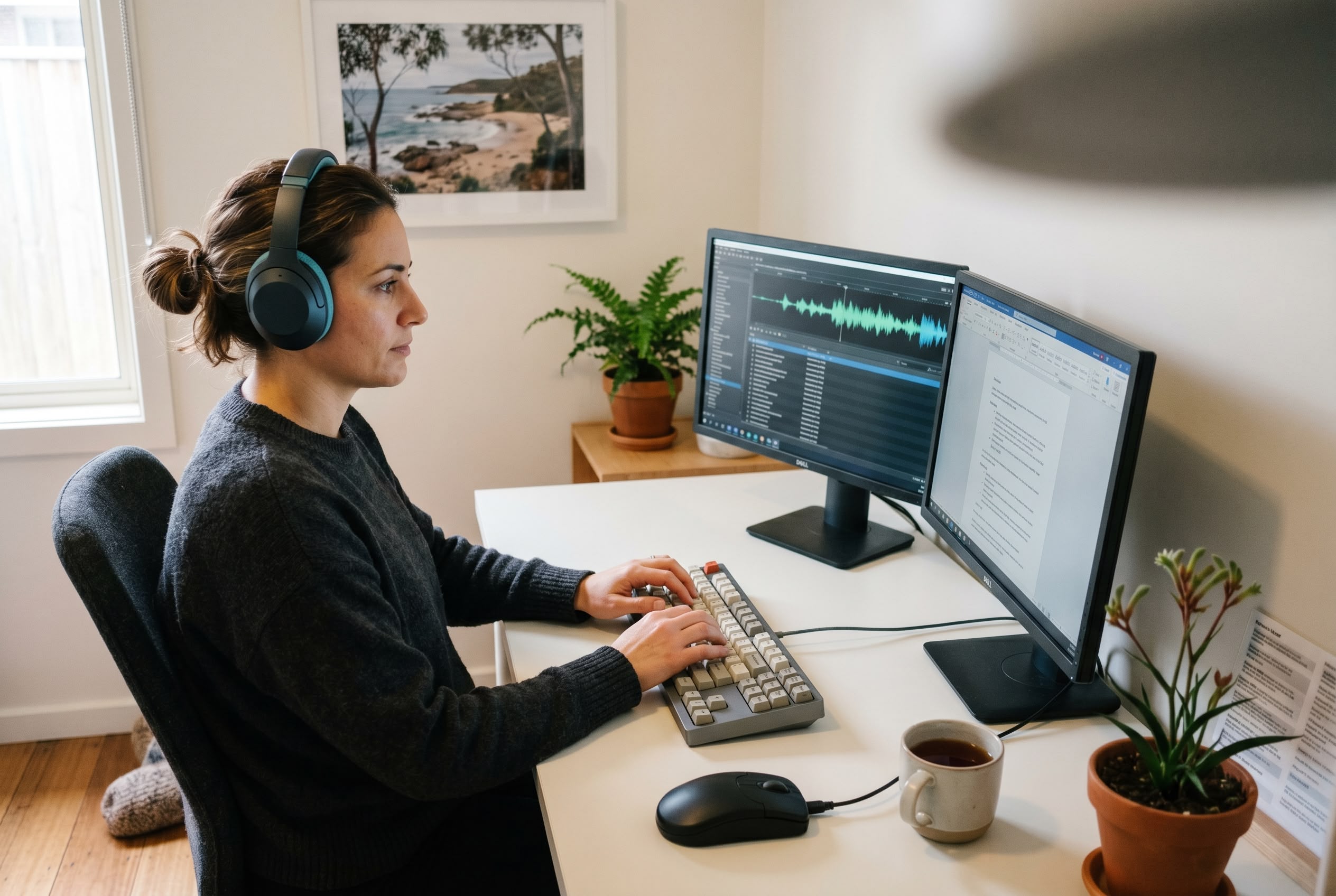
Working From Home
Medical Transcription Jobs from Home in Australia 2026
Yes, medical transcription is one of the few healthcare careers in Australia that is portable to working from home, and the work-from-home pool is the largest part of the profession. Most Australian medical transcriptionists work remotely for outsourced transcription companies, private specialist clinics, or as independent contractors. Productive transcriptionists typically earn $52,000 to $78,000 a year working from home, with senior reviewers and AI editors reaching $70,000 to $85,000 and beyond. New entrants almost always start through a transcription company or hospital outsourcing pool, build experience, then optionally move to in-house clinic roles or independent contracting.
This article covers what work-from-home medical transcription actually involves in 2026, where to find the jobs, what equipment and software you need, the realistic income and workload picture, the honest pros and cons, and how AI is reshaping the role. The 11288NAT Diploma of Healthcare Documentation is built specifically for the at-home transcription workflow, so the closing section explains how the qualification maps to the role.
What working from home as a medical transcriptionist actually involves
A typical work-from-home medical transcriptionist in Australia logs in at the start of a shift, picks up dictated audio from a queue, transcribes each report into the client’s required format, runs a self-quality check, and submits the finished document. The work is overwhelmingly solo, deeply focused, and structured around productivity targets rather than meeting attendance. Most home-based transcriptionists set their own hours within a contracted weekly volume, which is one of the genuine appeals of the role.
The day looks different across the four main employer types in Australia. Outsourced transcription companies route audio from many clinical clients into a central queue and you pull from it; pay is usually per line or per minute. Private specialist clinics route a single team’s dictation directly to you; pay is usually salaried or per minute. Hospital records departments mix on-site and remote work with shift-based productivity targets. Independent contractors work for two or three direct clinical clients on agreed turnaround windows, billing per line or per audio minute. The shape of the day varies; the core task does not.
Where to find work-from-home medical transcription jobs in Australia
Most work-from-home medical transcription jobs in Australia are listed on Seek and Indeed AU under “medical transcriptionist”, “healthcare documentation specialist” or “medical typist”, filtered to “remote” or “work from home”. A smaller pool comes through direct outreach to outsourced transcription companies and private specialist clinics that don’t always advertise. The common pattern for new entrants is to apply broadly to outsourced companies first, build six to twelve months of independent production, then approach private clinics or set up as an independent contractor.
The table below summarises the main places Australian medical transcription jobs from home are listed. Not every employer posts every role publicly; warm outreach to transcription companies that match your specialty interest often beats waiting for a Seek listing.
| Channel | What you find here | Best for |
|---|---|---|
| Seek (seek.com.au) | Outsourced transcription companies, hospital records department roles, occasional in-house specialist clinic listings. Filter on “remote” or “work from home”. | Most active job pool. Set up daily email alerts for “medical transcription” + remote. |
| Indeed AU (au.indeed.com) | Strong overlap with Seek plus some smaller employers and contract roles. Often lists per-line rates in the body text. | Cross-checking pay rates and finding less-advertised contractor briefs. |
| LinkedIn Jobs | Larger transcription companies, hospital network records roles, occasional QA-editor positions. Good for senior roles. | Mid-career and senior moves; building professional network with sector recruiters. |
| Direct outreach to transcription companies | The largest hidden pool. Many Australian transcription companies hire continuously without always advertising. | Building a long-term pipeline. Send a targeted enquiry with a sample transcript, typing test result and availability. |
| Private specialist clinics | Cardiology, surgery, oncology, pathology and radiology practices that prefer a dedicated transcriptionist over an outsourced service. | Mid-career transcriptionists with specialty depth and a willingness to learn one team’s preferences. |
| Hospital records departments | Public and private hospital records teams. Mostly hybrid (some on-site days), with a growing remote share. | Stability seekers who want salary, leave, super and a defined role; suits transcriptionists who like institutional structure. |
| Independent contracting (ABN) | Direct billing arrangements with one or more clinical clients. Higher gross income, you cover own super, leave and equipment. | Senior transcriptionists with proven accuracy, a reliable client base, and the discipline to run a small business. |
The pattern most TalentMed graduates follow is straightforward: start with an outsourced transcription company for the first twelve to eighteen months to build speed, accuracy and exposure to multiple specialties. Then either stay in that company and progress to senior or QA-editor roles, or move to an in-house private clinic for a single-specialty deep-dive. Independent contracting comes later, usually after three to five years of recognised accuracy and a network of clinicians who want a familiar pair of hands.
Common employers and pay models
Australian medical transcription pay sits across four shapes: hourly ($28 to $45 per hour), per line ($0.08 to $0.14 per 65-character AHDI line), per minute of audio ($0.85 to $1.60 per minute), and salaried ($52,000 to $85,000 a year). The model your employer uses changes both what you earn and how you organise your day. Outsourced transcription companies usually pay per line or per minute. Hospital records departments and in-house clinic roles usually pay salary. Independent contractors set their own per-line or per-minute rates with each client.
For a full breakdown of the pay bands by experience, employment setting and specialty, including a worked productivity-and-take-home calculator, read Medical Transcriptionist Salary Australia 2026. The short answer for prospective work-from-home transcriptionists is that pay is comparable across remote and on-site arrangements, and the take-home value of working from home is often higher because of saved commute, lower household costs, and the ability to live in a lower-cost-of-living area while earning a metropolitan-equivalent income.
Equipment and software you need to work from home
The hardware essentials for work-from-home medical transcription in Australia are a reliable computer, comfortable over-ear headphones, a USB foot pedal, a private workspace and a stable broadband connection. The software is usually provided by the employer or transcription platform; you log in to their system rather than installing your own. Most Australian transcription companies prefer Windows (10 or 11) for compatibility with established platforms, although newer cloud-based tools work cross-platform.
The setup checklist below covers the standard work-from-home medical transcription kit. Total upfront cost typically sits between $400 and $1,200 depending on the headphone and chair choice. Some transcription companies provide the foot pedal and headset; most expect you to supply the computer and internet connection.
On the software side, employers and platforms commonly use Bighand (formerly Winscribe), Olympus ODMS, Express Scribe Pro, Dragon Medical One for AI-assisted dictation, and proprietary in-house systems run by the larger outsourced transcription companies. You will not need to buy these; the employer provides access. What you do need to provide is your own up-to-date Microsoft Office or equivalent for any documents you handle outside the platform, plus a reputable antivirus and full-disk encryption on any device that touches client files.
Realistic income and workload expectations
A productive work-from-home medical transcriptionist in Australia typically works 30 to 40 hours a week of focused production time and earns between $52,000 and $78,000 a year, with senior editors and QA reviewers reaching $70,000 to $85,000. Productivity ramps over six to twelve months as you learn the platform, the dictators’ styles and the most-common report formats. Expect to earn closer to the bottom of the band in the first six months, climbing into the mid-band by year two and the senior band by year five if you build specialty depth.
Workload reality is one of the positive aspects of the role for the right person. The work is structured, predictable and entirely within your own four walls. There are no commutes, no on-site shift changeovers, and no waiting room interruptions. The trade-off is that the work is also unrelenting; if you sit down at the keyboard for thirty minutes you will produce thirty minutes of work. There is no equivalent of “an easy day at the office”.
Honest pros and cons of work-from-home transcription
The In practice about work-from-home medical transcription in Australia is that it suits a specific kind of person extraordinarily well, and is difficult for everyone else. The biggest predictors of success in the role are independent self-management, comfort with deep solo focus, a touch-typing baseline of 30 to 40 wpm to start or higher, and acceptance that pay is mostly productivity-driven. The role is not a soft option, and it does not suit those who need daily team interaction or external structure.
The pros and cons below come from observed patterns across Australian medical transcriptionists at every career stage. Read both sides honestly before committing to the qualification.
How AI is reshaping work-from-home transcription
AI has changed the day-to-day shape of work-from-home medical transcription in Australia, but it has not replaced the role. Voice-recognition tools (Dragon Medical One, Speechmatics, Nuance DAX, the AI scribe products) handle routine single-speaker dictation well, especially in radiology and predictable-format reports. Complex consults, accented dictation, multi-speaker recordings and clinically critical documents still require human transcriptionists or editors. The role is evolving toward an AI-assisted editor model, where the human reviews, corrects and signs off the AI’s first pass.
For work-from-home transcriptionists this evolution is mostly good news. AI-edit and QA-review roles consistently pay more per hour than pure typing did, the work is less physically punishing, and the cognitive demand (judgement, pattern recognition, clinical-sense check) suits the experienced practitioner. The transcriptionists who thrive in 2026 and beyond are the ones who add AI-aware skills early: familiarity with the major voice-recognition platforms, error-pattern recognition, prompt evaluation, and quality-assurance workflows.
The pillar’s complete guide to medical transcription in Australia covers the AI evolution in depth, including which voice-recognition tools dominate the Australian market, where human reviewers remain essential, and how the role looks five years from now. The honest position is that AI is changing transcription, not killing it; the practitioners who adapt are well-positioned for the next decade.
Train for work-from-home medical transcription with the 11288NAT Diploma
The 11288NAT Diploma of Healthcare Documentation is TalentMed’s nationally recognised qualification for medical transcription, healthcare documentation and the modern AI-edit workflow. It is built specifically around the work-from-home transcription role: 100% online, self-paced, with practical assessments that mirror the queue-based productivity expectations of an Australian transcription company. Graduates are job-ready for outsourced companies, hospital records departments, in-house specialist clinics, and independent contracting pathways.
Related reading
Keep exploring
Frequently asked questions
Sources: current Seek AU and Indeed AU listings; Hays Healthcare salary data; observed work-from-home arrangements across Australian transcription companies, hospital records departments and private specialist clinics. Per-line and per-minute earnings vary substantially with productivity, specialty and queue choice. TalentMed Pty Ltd, RTO 22151. Always confirm specific figures with the current job listing or contract.
Want to find out more?
Enter your details below to receive a free information pack instantly.