How to Become a Clinical Coder in Australia
Post Author:
TalentMed

Career change to clinical coding
How to become a clinical coder in Australia
Becoming a clinical coder in Australia takes one nationally recognised qualification, the HLT50321 Diploma of Clinical Coding, plus the practical experience of coding realistic hospital records during training. Most career changers complete the diploma in about 12 months, fully online, and are job-ready when they finish. This guide walks the full pathway from where you are now to your first coding role, and is written for healthcare workers and career changers who want a clear, honest picture before they enrol.
You might be tired. Maybe you have spent years on your feet as a nurse, a paramedic, or a hospital administrator, and somewhere along the way the spark started to dim. Rosters are relentless. The emotional load is heavy. The question keeps surfacing: is there a way to stay in healthcare, use everything you have learned, and get your evenings back?
There is. Thousands of Australians are already doing it, and the path is well-defined.
What does a clinical coder actually do?
A clinical coder reads patient medical records and translates the documented care into a standardised set of alphanumeric codes that fund the hospital, populate state and national health datasets, and shape clinical quality reporting. The role sits inside a hospital health information department, or with a coding outsource provider, and is the discipline that turns clinical narrative into structured data.
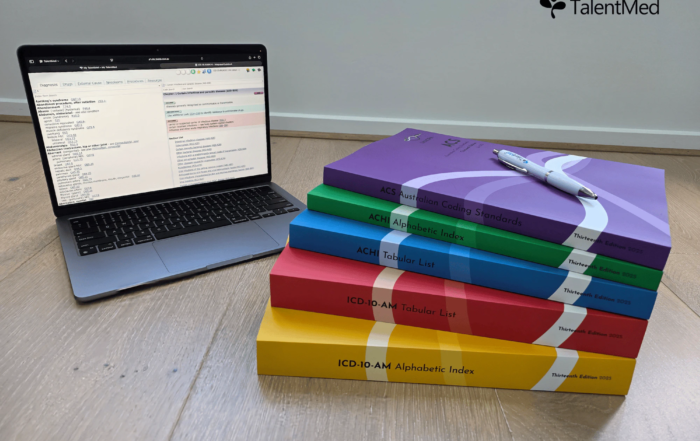
The Australian classifications are ICD-10-AM for diagnoses, ACHI for procedures, and the Australian Coding Standards (ACS) for the rules that govern sequencing and selection. All three are currently in their 13th Edition (2025) and are published by the Independent Health and Aged Care Pricing Authority (IHACPA). Together they feed the AR-DRG that funds the admission and the data the hospital reports back to the state and to IHACPA.
Clinical coding is desk-based, classification-driven and detail-intensive. A typical day involves reading discharge summaries, operation reports, pathology results and consultant notes, drafting a code list, verifying it against the ACS, querying the clinician where documentation is unclear, and finalising. Coders work standard business hours. Many work remotely or hybrid. The work suits people who like clinical reasoning, structured rules, and a quiet, focused environment.

Do you need a medical or healthcare background?
You do not strictly need a healthcare background to enrol in the HLT50321 Diploma of Clinical Coding, but if you have one, you have a real head start. The diploma teaches medical terminology, anatomy and physiology from the ground up, so a motivated career changer with no clinical background can complete the course and reach a coding role. What it cannot teach is the felt familiarity with hospital workflows that nurses, paramedics, allied health professionals, hospital administrators and medical receptionists already carry.
If you have worked in healthcare, the language of clinical documentation is not new to you. You already know what a discharge summary looks like, why the principal diagnosis matters, and how the ED feeds the ward. That existing context lets you spend more of your study time on classification rules, ACS guidance and coding software, and less on translating jargon. Most healthcare workers transition into coding faster than the course average for that reason.
If you do not have a healthcare background, you are not at a dead end. The diploma is designed to bring students to a job-ready level regardless of starting point. You will simply spend more time on the foundational modules and may want to budget closer to the upper end of the typical 10 to 15 hours per week.
The 5 steps to become a clinical coder in Australia
The pathway is the same for nurses, allied health, career changers from outside healthcare, and recent school leavers. One nationally recognised qualification, deliberate practice on realistic records during training, professional connection through CCSA, and a structured job search. Each step is straightforward on its own. Done in order, they take a motivated student about 12 months from enrolment to first coding role.

Assess your background and confirm the entry requirements
Be honest about your starting point. Healthcare experience accelerates the diploma. No healthcare experience is workable but means more time on the foundational modules. Either way, the HLT50321 entry requirements at TalentMed are: completed Year 12 or equivalent, or relevant work experience in a healthcare or administrative setting; basic computer literacy and a reliable internet connection; and the language, literacy and numeracy skills required for diploma-level study.
You do not need a university degree. You do not need prior coding experience. If you are unsure whether you meet the requirements, the TalentMed course advisers can confirm in a short call.
Enrol in the HLT50321 Diploma of Clinical Coding
This is the qualification Australian hospitals look for on a coder’s CV. The HLT50321 Diploma of Clinical Coding is nationally recognised on the Australian Qualifications Framework, sits on TalentMed’s scope of registration as RTO 22151, and is the standard entry credential into the profession.
TalentMed delivers the HLT50321 fully online, self-paced, with daily intakes 365 days a year. Most students complete it in about 12 months while continuing to work. The course covers medical terminology and anatomy across all major body systems, ICD-10-AM coding for diagnoses, ACHI coding for procedures, the Australian Coding Standards in detail, electronic health record navigation, and AR-DRG grouping.
Master the classifications and the ACS
This is where the craft is built. ICD-10-AM and ACHI sit alongside the Australian Coding Standards, and the rules in the ACS govern the order codes go in, when an additional code is required, and how acute-on-chronic and postoperative scenarios are handled. A correct code in the wrong sequence is still a wrong episode, and the ACS is what keeps coders out of that pitfall.
During the diploma you will work through the Alphabetic Index, verify in the Tabular List, and apply ACS guidance on every realistic episode. By the time you finish, the lookup pattern is automatic. That habitual workflow is the core of accurate, efficient coding and it cannot be cut short.
Complete simulated coding placements on real-world records
Reading a textbook about ICD-10-AM is very different from sitting in front of a 12-page discharge summary for a patient with five comorbidities, three procedures and contradictory consultant notes. The HLT50321 builds in extensive simulated workplace experience using authentic-style health records across orthopaedic, cardiac, oncology, obstetric and paediatric case types.
This is the practical exposure that separates job-ready graduates from candidates who know the theory but freeze when the records get complicated. Hospitals look for evidence of this hands-on practice during interviews. TalentMed records every simulated placement so you have a portfolio to talk through.
Join CCSA, build a portfolio, and apply for your first role
Once you have completed your diploma, joining the Clinical Coders’ Society of Australia (CCSA) is a smart professional move. CCSA is the national professional body for clinical coders in Australia. Membership gives you continuing professional development, peer mentoring, networking, and access to industry updates as the classifications evolve. Membership is voluntary and not a regulatory licence, but employers notice it because it signals a commitment to professional standards.
With your HLT50321 in hand and your simulated portfolio ready, the job market is a real one. Australia has a documented shortage of qualified clinical coders. Entry routes include public hospital health information departments, private hospitals and day procedure centres, coding outsource providers (often remote), and consultancy firms. For a deeper view of pay and progression, see the clinical coder salary guide.
How long does it take to become a clinical coder?
Most students complete the HLT50321 Diploma of Clinical Coding in about 12 months, studying around 10 to 15 hours per week. The diploma is self-paced, so motivated students who can study more intensively finish faster, and students with heavy work or family commitments take a little longer. Both ends of that range are normal.
From the moment you enrol to the moment you start your first coding role, the realistic timeline is around 12 to 14 months. Roughly the first three months cover foundational modules in medical terminology, anatomy and the Australian healthcare system. Months four through nine work through ICD-10-AM and ACHI on more and more, complex simulated records. Months 10 through 12 cover advanced units including ACS application, AR-DRG grouping, and EHR coding practice. Most graduates secure their first coding position within one to three months of completing the diploma.
Daily intakes mean you do not wait for a semester to start. You can enrol any day of the year and begin immediately.
How much does it cost?
TalentMed offers four ways to pay for the HLT50321 Diploma of Clinical Coding: a single upfront payment, a 3-instalment plan, ZipMoney with up to 12 months interest-free, and employer-funded study where your employer sponsors the course. Current pricing is on the course page, which is the source of truth for fees and any active offers.
ZipMoney is the option most career changers take. It lets you spread the diploma fee across weekly, fortnightly or monthly repayments while you study, up to 12 months interest-free (approval and terms are ZipMoney’s own). It pairs naturally with the typical 12-month completion window.
Employer-funded study is more common than people realise. Many hospitals, private operators, GP practices, transcription companies and allied health providers use professional development budgets to upskill staff. If you are still working in a healthcare setting, ask your employer directly. TalentMed can provide a letter of support to help that conversation.
HLT50321 is not currently a VET Student Loans (VSL) approved course. If you are looking specifically for VSL-eligible study in healthcare, our HLT57715 Diploma of Practice Management is VSL approved and may be relevant depending on your career direction.
What can you earn as a clinical coder in Australia?
Clinical coder pay sits well above the all-occupations average and rises sharply with experience and credentialing. Entry-level coders typically start higher than many other entry-level health information roles, and senior credentialed coders, coding auditors and coding managers earn substantially more again. State, sector, remote vs onsite, and credentialing all shift the figure, so a one-line answer never tells the whole story.
For current bands by experience level, sector breakdowns (public, private, outsource, contractor) and a state-by-state view, see the clinical coder salary guide. It is updated as job-board and award data shifts and is the reliable place for figures rather than memory or older articles online.
How to get your first coding job
The first coding job is built on three things: a completed HLT50321, a portfolio of simulated coding work that demonstrates the workflow, and a CV that names the classifications and tools the employer is asking for. Coding managers screen for evidence that a graduate can sit down with a real medical record and reach a defensible code list, not just recite the classifications.
Practical things to get right before you apply:
The shortage is real, but it is a shortage of job-ready coders. Treat the diploma’s simulated placements as the most important practical training in your career change, not as homework to rush through.
Common mistakes to avoid when becoming a clinical coder
Most people who stall on the path to clinical coding stall for the same handful of reasons. Knowing the pattern up front is half the fix.
Train with TalentMed: HLT50321 Diploma of Clinical Coding
The HLT50321 Diploma of Clinical Coding at TalentMed is built around the five-step pathway above. You learn the classifications, the ACS, and the workflow that ties them together, on realistic Australian hospital episodes. The simulated placements are graded, recorded and discussed with your trainer-assessor, so by the time you finish you have a portfolio you can take to interview.
The course is 100% online, self-paced, takes about 12 months for most students, and you can start any day of the year.

Related reading
Explore further
Frequently asked questions
Want to find out more?
Speak to a TalentMed course adviser about HLT50321.
12 months, 100% online, flexible payment plans, daily intakes year-round.